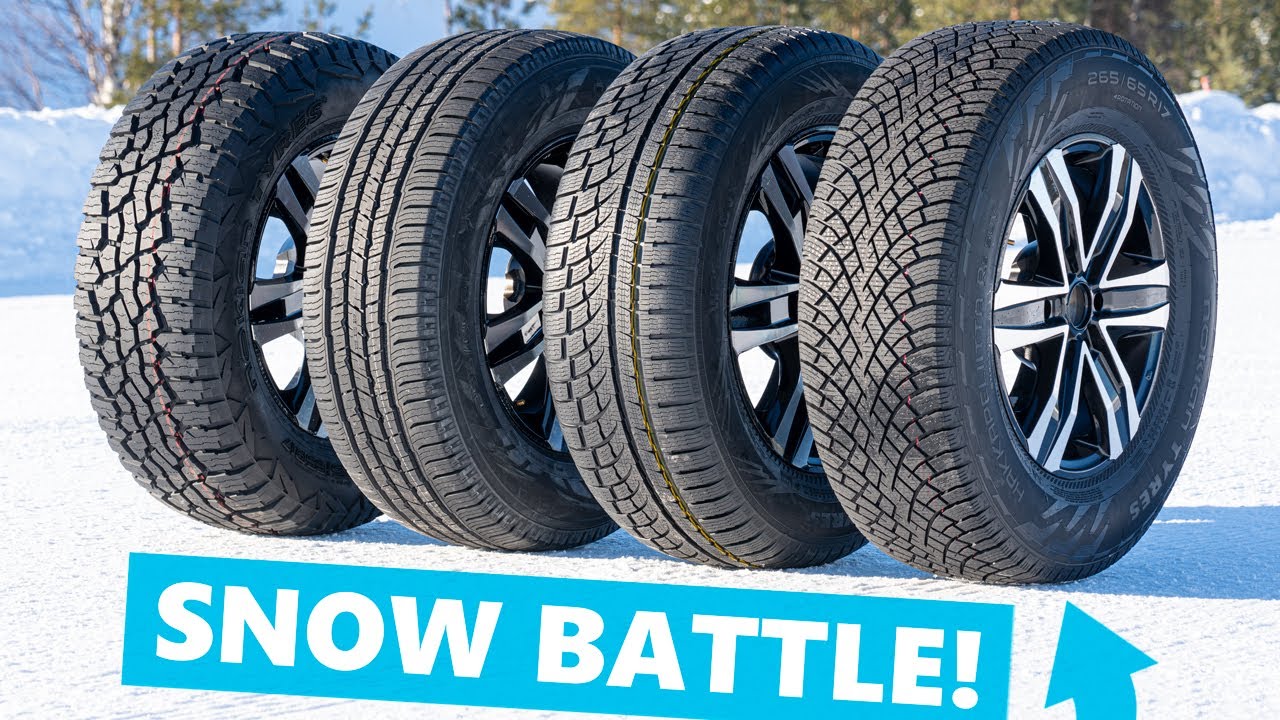
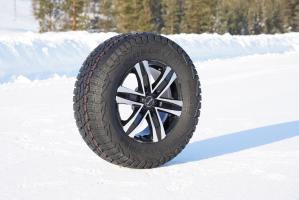
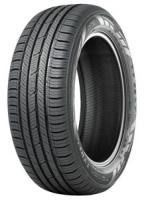
The new Nokian Outpost nAT claims to be an all terrain tire you can use in snow, but how good is it? Nokian invented winter tires, so they're pretty confident, so confident in fact they suggested we test it against the king of winter tires, the Nokian Hakkapeliitta R5, along with their much loved all weather tire, the Nokian WRG4 SUV, and their high mileage all season tire, the Nokian One SUV.
Before we start, it's worth noting that three of the tires are 3PMSF marked, which is the 3 peak mountain snowflake symbol, sometimes called "severe snow rating". The Winter, All Weather and All Terrain tires carry the 3PMSF marking, but the all season does not. The test size was 265/65 R17, and we used a Toyota Hilux for the test in RWD only mode.
Testing Methodology
Test Driver
Jonathan Benson
Tire Size
265/65 R17
Test Location
Professional Proving Ground
Test Year
2023
Tires Tested
4
Show full testing methodologyHide methodology
Every tire is tested using calibrated instrumented measurement and structured subjective assessment. Reference tires are retested throughout each session to correct for changing conditions, ensuring fair, repeatable comparisons. Multiple reference sets are used where needed so that control tire wear does not affect accuracy.
We use professional-grade testing equipment including GPS data loggers, accelerometers, and calibrated microphones. All tires are broken in and conditioned before testing begins. For full details on our equipment, preparation process, and calibration procedures, see our complete testing methodology.
Categories Tested
Snow Braking
For snow braking, I drive the test vehicle at an entry speed of 50 km/h and apply full braking effort to a standstill with ABS active on a groomed, compacted snow surface, measuring 45-5 km/h. I generally use a wide VDA (vehicle dynamic area) and progressively move across the surface between runs so that no tire ever brakes on the same piece of snow twice. My standard programme is twelve runs per tire set, although the sequence can extend further if the data justify it. I analyse the full set of runs and discard statistical outliers before averaging. The surface is regularly groomed throughout the session. To correct for changing snow surface conditions, I run reference tires repeatedly — typically every two candidate test sets.
Snow Traction
For snow traction, I accelerate the vehicle from rest on a groomed snow surface with traction control active and measure speed and time using GPS telemetry. I typically use a 5–35 km/h measurement window to reduce the influence of launch transients and powertrain irregularities. I use a wide VDA (vehicle dynamic area) and progressively move across the surface between runs so that no tire ever accelerates on the same piece of snow twice. The surface is regularly groomed throughout the session. I complete multiple runs per tire set and average the valid results. Reference tires are run typically every two candidate test sets to correct for changing snow surface conditions.
Snow Handling
For snow handling, I drive at the limit of adhesion around a dedicated snow handling circuit with ESC disabled where possible. The circuit is groomed and prepared after every run while tires are being changed, so each set runs on a consistently prepared surface. I usually complete between two and five timed laps per tire set, excluding laps affected by clear driver error or obvious environmental inconsistency. Because snow surfaces degrade more rapidly than asphalt, control runs are carried out more frequently — typically every two candidate test sets.
Snow traction is a difficult test for a tire, especially on an unloaded pickup, so it gave us the largest differences between the tires. The Winter was naturally the best, with the all weather around 18% slower in the acceleration test, the all terrain was 12% behind the all weather, and the all season another 11% behind the all terrain.
Snow Traction
Spread: 3.52 s (71.5%)|Avg: 6.53 s
Snow acceleration time (5 - 35 km/h) [Average Temperature -8c] (Lower is better)
Nokian Hakkapeliitta R5
4.92 s
Nokian WR G4 SUV
5.80 s
Nokian Outpost nAT
6.96 s
Nokian One
8.44 s
Interestingly while the order remained the same for snow braking, the extra weight over the primary axle helped the all terrain finish closer to the all weather, and significantly ahead of the all season.
Snow Braking
Spread: 8.58 M (56.1%)|Avg: 20.01 M
Snow braking in meters (40 - 5 km/h) [Average Temperature -8c] (Lower is better)
Nokian Hakkapeliitta R5
15.30 M
Nokian WR G4 SUV
20.14 M
Nokian Outpost nAT
20.72 M
Nokian One
23.88 M
While the Nokian Hakkapeliitta R5 was unsurprisingly the fastest around the lap, the real brilliance of a full winter tire came in the subjective handling - the confidence you felt on the Hakka R5 was unrivaled. The all terrain was close to the all weather in time, but the all weather tire felt more balanced around the lap.
Snow Handling
Spread: 15.40 s (17.2%)|Avg: 97.89 s
Snow handling time in seconds [Average Temperature -8c] (Lower is better)
The Nokian Hakkapeliitta R5 is totally joyful tire to drive on snow, and proof that a good winter tire can make anything fun in the snow as it made the test Toyota Hilux exceptional fun! Compared to the other tires it just had more grip everywhere, loads of front end grip on turn in, no understeer at all and loads of traction at the rear and when it was sliding it was controllable. This tire is one of the kings of snow performance, and it shows.
Admittedly the WRG4 couldn't match the winter tire in the snow, but it's not a winter tire, it's an all weather tire so should be better in the dry and wet, but the grip is offered was predictable and safe.
The Nokian Outpost nAT was way closer to the all weather than the all season tire, which is very impressive. It's worth reminding you that we're testing on very hard packed snow at around -17c / 0f!
Sure, the all terrain tire felt a little more like a blunt instrument, there was less feedback around the limit of grip and even coming out of the garage you could tell that it's a more solid tire, but considering you could do a weekend of winter offroading in the sunshine then drive back home through a where it's snowing and still be better off than everyone on their all season tires - it's a very impressive blend.
A lot of tire retailers are wanting to recategorise all season tires to "three season tires" to acknowledge their limited snow performance, but the Nokian One HT was surprisingly good, for its category. However, it's still nearly 20% slower than the winter tire around the lap and easily 100% less confidence inspiring. Traction as always was the most noticeable thing when comparing all season tires to full winters, , the small inclines on the track were taken much slower with minimal acceleration. Turning was fine at lower speeds but there was no reserves on the all season tire.