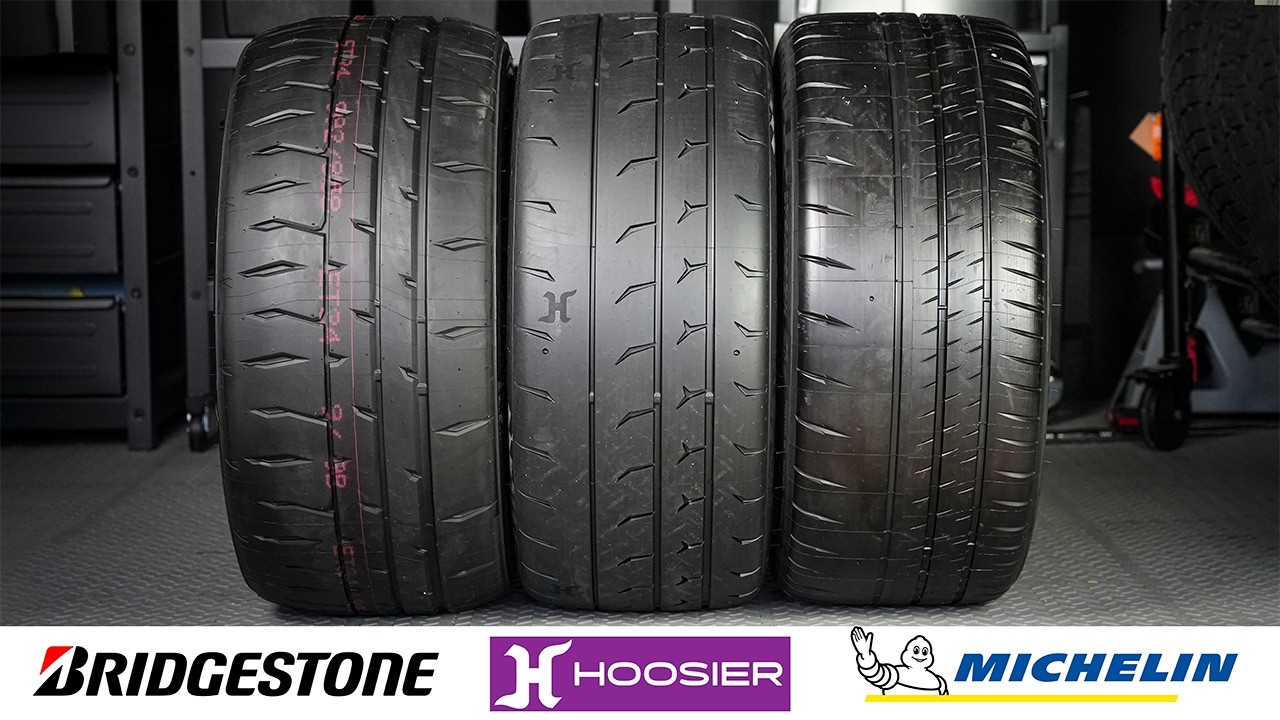
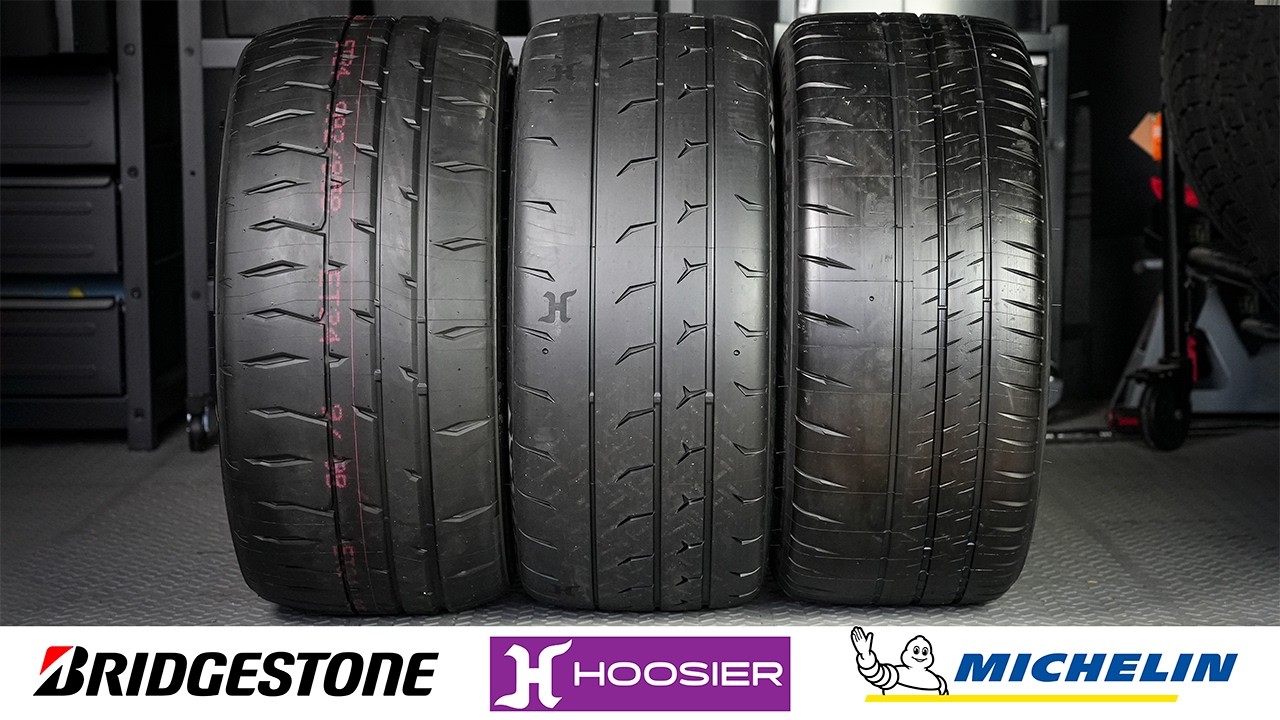
In this test I will finally compare the new Hoosier TrackAttack Pro to the Michelin Pilot Sport Cup 2 R and the Bridgestone Potenza RE71RS on a track AND autocross course.
Testing Methodology
Test Driver
Jonathan Benson
Tire Size
275/35 R19
Test Location
Professional Proving Ground
Test Year
2025
Tires Tested
3
Show full testing methodologyHide methodology
Every tire is tested using calibrated instrumented measurement and structured subjective assessment. Reference tires are retested throughout each session to correct for changing conditions, ensuring fair, repeatable comparisons. Multiple reference sets are used where needed so that control tire wear does not affect accuracy.
We use professional-grade testing equipment including GPS data loggers, accelerometers, and calibrated microphones. All tires are broken in and conditioned before testing begins. For full details on our equipment, preparation process, and calibration procedures, see our complete testing methodology.
Categories Tested
Dry Handling
For dry handling, I drive at the limit of adhesion around a dedicated handling circuit with ESC disabled where possible so I can assess the tire's natural balance, transient response, and limit behaviour without electronic intervention masking the result. I usually complete between two and five timed laps per tire set, depending on the circuit, tire type, and consistency of conditions. I exclude laps affected by clear driver error or obvious environmental inconsistency. Control runs are carried out frequently throughout the session, and I often use multiple sets of control tires so that wear on the references does not become a meaningful variable. For more track-focused products, I also do endurance testing, which is a set number of laps at race pace to determine tire wear patterns and heat resistance over longer driving.
Dry Handling Long Run
For long-run handling assessment, I drive an extended session on a dry handling circuit, completing a high number of consecutive laps per tire set. The average lap time across the full session is used rather than the best laps, capturing how consistent each tire remains as it heats up under sustained high-load driving. This specifically tests thermal stability and performance degradation over extended use — a characteristic that standard short-format handling tests do not reveal.
Dry Handling - Autocross
For autocross handling, I drive the test vehicle on a short, tight course designed to exercise transient handling response and agility at relatively low speeds. I complete multiple timed runs per tire set, with the fastest consistent runs averaged. The tight layout specifically exercises low-speed grip, steering response, and weight transfer characteristics that longer high-speed circuits may not fully reveal.
Subj. Dry Handling
Objective data is only part of the picture, so I also carry out a structured subjective handling assessment at the limit of adhesion on a dedicated dry handling circuit. I score steering precision, steering response, turn-in behaviour, mid-corner balance, corner-exit traction, breakaway characteristics, and overall confidence using a standardised 1–10 scale used consistently across my testing. The final assessment combines numeric scoring with written technical commentary. I complete familiarisation laps on the control tire before evaluating each candidate.
How each category is weighted in the overall score:
Dry100%
Dry Handling40%
Dry Handling Long Run25%
Dry Handling - Autocross25%
Subj. Dry Handling10%
As always with Tire Reviews, transparency is core to the channel, so before the driving I need to explain the tire sizes used.
The test vehicle is a G80 M3, which from the factory runs 275/35 R19 front and 285/30 R20 rear.
I personally believe that if you're serious enough to put your car on this level of tire, you're probably going to want to buy track wheels and drop down to a 19" square fitment which will give you WAY more tire options to choose from, so this is what I've done for the Hoosier and Bridgestone, they're both 275/35 R19 square.
The Cup 2 R is the benchmark everyone has been asking for so I wanted to include this tire too, however, as there are only OE sizes of the cup 2 R I had to break the first rule of tire testing which is, do not test OE tires as it gives them an unfair advantage. This is pretty much unavoidable with any Cup 2 R, as apart from I think one size, they're all OE tires.
The second rule of tire testing is to test the same tire sizes, however, to do that with the Cup 2 R I would have to put the front tire on the rear axle too which I'm not going to do as I know BMW and Michelin spent a lot of time tuning the front and rear tires to do different jobs. So for this test, I am running the full OE sizes for the Cup 2 R, the 19 inch front and the 20 inch rear.
This should, in theory, give the Cup 2 R a subjective advantage, BUT the Cup 2 R is the only tire here that has to adhere to the EU tire label, which heavily detracts from track performance. More on that later.
The geek stats for these three tires are super interesting. Not only does the Bridgestone have the highest starting tread depth, it is BY FAR the widest tire of the three tires. So wide in fact, I found myself repeatedly checking if I was measuring the right tire. Unmounted it's 21mm or nearly an inch wider than both the Hoosier and Michelin at the same 275/35 R19 size.
All this tread depth and width does make it significantly heavier too, nearly 3kgs or 7lbs over the other two, which are surprisingly close on metrics. The Michelin has more tread depth than the hoosier, though it's treadwear is 140 compared to 200.
Below are the times from the big course, and autocross. My full subjective thoughts can be found in the YouTube video, linked above.
Dry
Dry Handling
Dry Handling
Spread: 0.90 s (1%)|Avg: 86.53 s
Dry handling time in seconds [Average Temperature 38c] (Lower is better)
Hoosier TrackAttack Pro
86.00 s
Bridgestone Potenza RE 71RS
86.70 s
Michelin Pilot Sport Cup 2 R
86.90 s
Dry Handling Long Run
Dry Handling Long Run
Spread: 0.73 s (0.8%)|Avg: 87.29 s
Average long run time in seconds (Lower is better)
Hoosier TrackAttack Pro
86.83 s
Michelin Pilot Sport Cup 2 R
87.48 s
Bridgestone Potenza RE 71RS
87.56 s
Dry Handling - Autocross
Dry Handling - Autocross
Spread: 0.37 s (0.9%)|Avg: 41.01 s
Short course lap time in seconds [Average Temperature 38c] (Higher is better)
The Hoosier TrackAttack Pro was the fastest tire on the big track, by nearly a second, and I think it would have been faster if a cat hadn't jumped out and spoiled its first lap. The Hoosier was also subjectively REALLY lovely, its steering was quick and direct like the Michelin, and while the rear axle didn't move quite as in sync, for a non-oe tire I was genuinely surprised at how close it was. Make no mistake, the track attack pro is an epic tire on track.
The Cup 2 R is the OE tire, and as expected, it felt like the purest driving experience. It had loads of grip, the M3s front and rear worked beautifully together, the steering was fast, but it was also super easy to drive. It was my favourite subjectively, and it does give you the best all round driveability of the three tires, this is an OE tire performing as it should.
The Bridgestone warmed up fast, and was easy to drive, but it required bigger steering inputs which made the car feel a little sluggish compared to the OE tire. Also, on a heavy M3 on a hot day, the heat got to it quickly, but it does have more tread depth than the other two tires, which is a big disadvantage for dry pace and thermal management. I expect if it was at the same tread depth its thermal management and lap times would improve, potentially up to the point of the other two. Something to keep in mind.
I take your point about OE tires but the reverse can be true & OE worse. Much depends upon the prioritised parameter of appraisal. As you have noted elsewhere, if the manufacturer is prioritising rolling resistance or longevity in compound design & one's interest is wet grip, then OE will be worse.




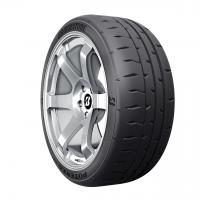
Just wonder that a RE71 exists these times ;)
The original RE71 was a tire I almost bought in 1995 or so for my Escort XR3i but decided to take the newer and cheaper Pirelli P5000 Vizzola
I take your point about OE tires but the reverse can be true & OE worse. Much depends upon the prioritised parameter of appraisal. As you have noted elsewhere, if the manufacturer is prioritising rolling resistance or longevity in compound design & one's interest is wet grip, then OE will be worse.