

In recent months a number of premium tire manufacturers have reignited campaigns for the minimum tread depth law to be changed from the current 1.6mm, to 3mm.
The logic behind the change in law is sound. Once a tire reaches 3mm remaining tread depth, the wet braking and aquaplaning performance drops off rapidly, so the message form the tire companies is understandably about improving the safety of the roads.
The cynic might have another view. By increasing the minimum legal tread depth, tires will naturally have less life, meaning you'll have to replace tires more often, meaning the very tire companies lobbying for the change will sell more products. A little too convenient maybe?
The view from Michelin
Even with the promise of increased sales, Michelin doesn't agree, and they're going to great lengths to explain why. To make their argument, Michelin invited automotive journalist from around Europe to their lead testing facility in Clermont, France to make their case. Their counter arguments are excellent, and cover tire design, accident data and environmental impacts.
Tires don't degrade in every performance
The argument to change at 3mm focuses on the loss of wet performance, but in many ways tires improve with wear.
Dry braking, a key safety quality considering we spend 70% of our time driving on dry roads in the UK, improves due to less block movement. Fuel consumption decreases as there's less material in the tire to heat up, so you use less fuel, and the tire is quieter as there's less air being pushed out of the tread blocks, a key cause of noise in tires.
Changing at 3mm instead of 1.6mm would mean we miss out on the best dry performance of the tire, the lowest fuel use and the quietest part of its life.
A worn mid range tire is still better than a new budget during wet braking
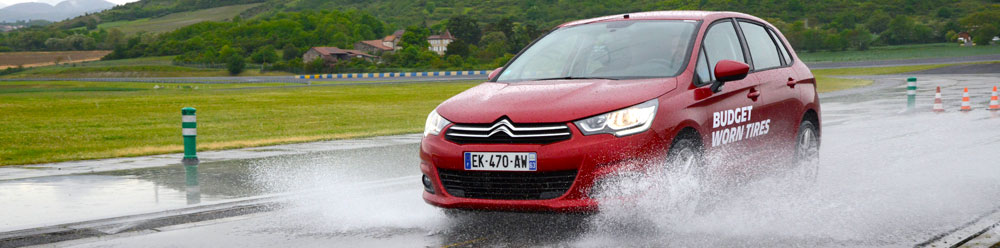
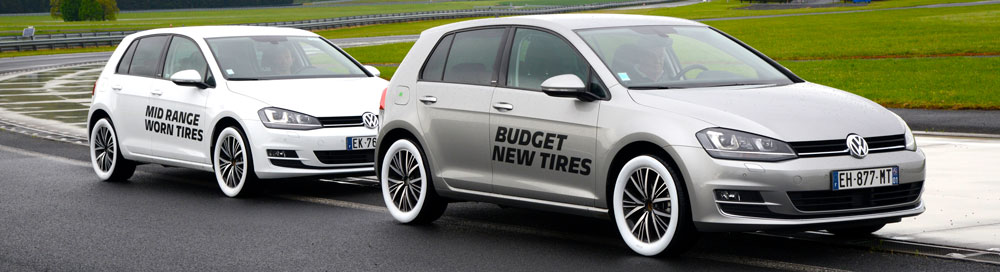
Just because a tire is worn, doesn't mean it's the worst tire to be using. In a demonstration by Michelin, we drove four identical vehicles, the first with new mid range tires, the second with worn mid range tires, the third with new budget tires, and the fourth with worn budget tires, and placed them through a wet braking test in 1mm of water from 80 - 20 kph.
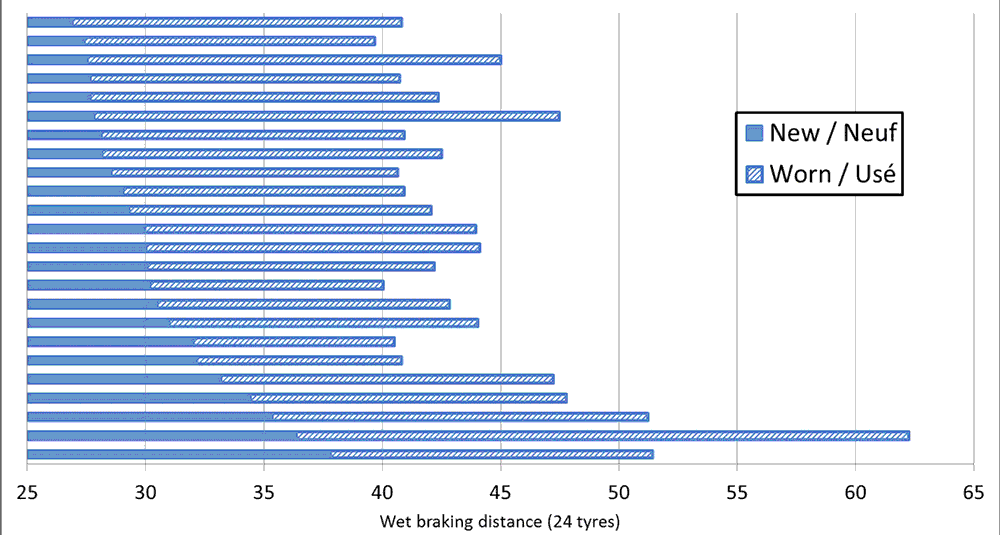
The results? The new mid range tire stopped the car 19.2 meters , the worn mid range tire 22.1 meters, the new budget tire 22.7 meters and the worn budget tire a massive 27.6 meters.
A worn mid range tire offers similar levels of lateral grip to a new budget tire
The next demonstration involved a circle skid pan test with 0.8 mm of water, again using a "well regarded midrange brand" scrubbed to 2mm, and a budget tire at full tread. Driving around the circle, we tracked the peak speed before the car started to understeer obtained on each tire. The worn midrange and new budget recorded near identical peak speeds, with the worn midrange tire just ahead at 58 mph compared to 57 mph for the new budget.
There is no link between tread depth and accidents
There have been two major studies showing there's no recorded link between tread depth and accidents. The first, a TNO report for the European Commission in 2014 quoted "The accident data used in the current study however indicates no benefit in terms of reducing the number of accidents by increasing the mimimum tread depth [...] The results of the study suggest that 1.6mm could be a suitable level based on existing national legislation in member states"
The second by VUFO in Dresden, having research traffic accidents for the past 13 years published in their February 16th 2017 newsletter - "In case of an increase of the mimumum tread depth, tires have to be repalced more often. The resulting increase in costs can lead vehicles owners to not invest in tires with a long term performance due to budget constraints. If tires with a short-term performance are preferred due t ocost considerations this will negatively impact driving and traffic safety"
Tires are expensive
Another excellent point in the consumers favor is that tires are an expensive purchase. Due to less block movement and heat build up as tires wear, tires wear more slowly as the tread reduces. This means, the 1.4 mm of tread between 3 mm and 1.6 mm is 20% of the tires life. This means that world wide, consumers would be spending an extra 6.9 billion euros per year.
Environmental impact
So changing at 3 mm instead of 1.6 mm is important for our pockets, but what about the environment? By wearing tires to the 1.6mm legal limit, instead of 3mm, we would be using 400 million fewer tires a year, which would save 6.6 million tonnes of CO2, 1/2 yearly co2 of New York, and there would be 35% more tire waste and raw material use. For all the green efforts of tire companies, tires are still a difficult thing to produce and tough on the environment.
What should we do?
The solution favored by Michelin is simple, lets test tires when worn too. It's easy to make a tire work well when new, but harder to make a tire work throughout its tread life, and worn testing would give the customer the best idea of how their chosen tire will perform throughout the treadlife.
What about aquaplaning, which is most affected by tread depth? When testing a tire at 2mm, in 1mm of water from 80 - 20 km/h, there's an element of aquaplaning incorporated into the tests as you'll be aquaplaning at the start of the braking phase, so it gives a good overview of how a tire works in both disciplines.
By leaving the law at 1.6mm and testing worn tires, we are giving the consumer the knowledge to make their own choice about when to change their tires.
Now it's just up to the testers.

My Michelin Super Sports are at a 3-mm depth now. So, the article above is very useful for me. If from the current 3-mm to the legal minimum of 1.6mm equals 20% of the tire's life... Why should I bother to change them now? Performance wise, I have not noticed anything bad on the dry. As for the wet, I try to be careful when it rains. The latter means additional fuel economy :). But again, the article is very useful, thank you.
In the old days when cars ran thinner tires they cut through water more easily and when roads were in better condition they tended to be better drained and have less deep puddles as they were resurfaced more often.
Now cars run much wider tires and roads are often in poorer condition with large areas of pooled water aquaplaning is much more common. I would say upping the minimum tread depth to 2mm over 75 - 80% of the tire from the current 1.6mm depth over 75% is quite a sensible idea.
A tire is unlikely to aquaplane running through 1mm of water so this test is pretty pointless, but a bit of extra tread could help a driver retain control through a puddle.
If you can't afford tires then you can't afford to drive, cheap (all) tires should have to pass an aquaplane test at the legal limit to be available for sale in the UK.
As for actual braking distances where do you draw the line? All cars stop much quicker than they did even a couple of decades ago due to improvements in brake & chassis components as well as better tire technology. All cars with anything but the very worst tires will out brake almost anything that was on the road in the 90's and most people were happy to fly about well above the speed limit then. These days most people don't drive fast enough to worry about stopping distances unless they have the reactions of a tortoise in which case they shouldn't be driving.
Aquaplaning though is a much more common occurrence that all the electronics in the world won't help if it gets out of hand.
So what michelin says is that a worn tire has better performance than a new one. Why do they sell then new tires instead of used ones? Will michelin compensate me in case of an accident in a wet road because my car didn't stop in, for example, 15 meters but in 20 meters due to the tread depth? ( because I listened to michelin and didn't change my tires in 4mm depth and now they have 2mm depth)." Wet braking, which we didn't experience first hand due to conditions, is
even more apparent, but not exclusive to winter tires. Like the snow,
from 8mm to 4mm you lose approximately 2% per mm of tread, but at some
point after 4mm the degradation doubles to over 8% per mm, largely due
to the micro aquaplaning influence ". This is from an article you published about testing the braking performance between new and worn winter tires from continental. So, who shall we believe?
Michelin are demonstrating that certain tires when worn are better than others when new. The point of the demonstration was to highlight that not all tires wear curves are equal, and more should be done to highlight worn performance.
But this happens only to very certain models of tires and michelin can not speak in general. The real challenge is how a worn tire behaves with itshelf when it is new. Also, along with the worn tire tests that michelin suggests, you must test the same tires in different cars and in different sizes in the same conditions.
"The real challenge is how a worn tire behaves with itshelf when it is new." That's exactly what they did... Read it again.
Then, how "There is no link between tread depth and accidents", when a worn tire needs at least the double distance to stop? And " new tires are expensive" . How much do they cost a human life; Does it worth it not to spent for example 300 euros in 2 years for new tires and loose a life?
Depends who as been using them, I can corner hard enough on the road to turn the edges of my tires blue and feather the tread. This means they have effectively gone through a heat cycle, too many of those and they won't grip that well even with lots of tread left. Grip usually starts to drop off on my tires by the time the first 2mm has gone in all conditions. I usually bin tires well before they get anywhere near the legal limit as do most of my friends who drive hard as they just don't grip anymore regardless of brand. The only exception was some Pirelli P6000's but they weren't great at any point in their life so could never push them that hard, never cooked them so they lasted. I was poor then otherwise I would have binned them as soon as possible, they came with my car.
There is an unstated and untested discrepancy between accident data obtained from the population at large and that from really good drivers. And there are now plenty of good drivers around owing to the abundance of good tires, powerful, affordable cars, and driver interest in competing in low level motorsport. If there's one thing that sets the good drivers apart it's that they don't get themselves in dangerous situations on the road as easily, and if they do find themselves in one they have an enhanced skill set that enables them to escape more easily. Driving fast on a wet race track very quickly educates you regarding things like aquaplaning - and how to avoid/counteract them safely. Fifty years ago, only the dedicated would be found on race tracks, but now? Factor THAT in if you can. And PLEASE don't confuse the increasing number of skilled motorsport enthusiasts with the bloody brainless petrolheads who provide so much material for the traffic police to engage with. Time for some serious research not concerned solely with physical factors.
How many drivers know or care about their tires and what their car can do? We will consider the majority. Besides the driver, there are the laws of physics. No matter how right or good you hit the brakes, if you need the double distance to stop, you' ll have an accident. To finish the discussion, will you buy a worn tire over a new one?
You are more likely to have an accident with double stopping distance but if you drive according to the vehicles capabilities it won't make any difference. If someone coming the other way gets it wrong it is largely left to chance. None of my mishaps in 25 years of driving have been influenced by brakes. Lack of grip, too much acceleration out of a corner and poor overtaking though have all almost ended my life.
I would buy a worn tire for a temporary vehicle of little value over a brand new ditch finder.
I buy the best I can for anything I drive hard or want to keep. I would buy a hardly worn premium tire like Michelin Pilot Sport 4 if it was a good price but usually go new.
Experienced aquaplaning with one set of tires 3mm on front tires and 4mm on rear. Michelin Pilot Sport 4.
At he time the car was approximately at 120 km/h on a highway with this speed limit. Not sure how deep the water, if 1mm or more.
Good Michelin for providing data again. So refreshing in an advertising world where very single tire sold has 'best grip' from cheapest to most expensive.
That said, I tend to sell my tires at 4-5mm, which with this data makes for a better tire for the next owner than a new budget tire, while I keep my wet aquaplaning performance with a new set as I like to go for performance drives in the wet also...
That's extreme dedication to tire performance!
My favourite performance drives are in the wet. That said, if the water were to be so deep that aquaplaning were to be a real possibility, then I wouldn't be fanging.
Merely wet roads are more compound sensitive than channel depth sensitive &, for enjoyment there, you could hang on a bit more. Tire age would then be more of a factor to be wary of.
I support the idea of standardly adding to a magazine tire test range of disciplines tires' wet performance when shaved. (My own past suggestion in various places has been shaving to 3 mm.)
Of course they will aquaplane more in deep water & of course different styles of tread pattern will cope variously well. But, as noted by Jonathan, of especial interest is handling in merely slick, compound sensitive, conditions.
I think the biggest industry facing the tire industry is how to shave the tire. A tire sanded or cut down to depth by a machine doesn't behave the same as a tire which has been on a car for 2 years, and has been through a number of seasons and many heat cycles. The key for this to work is finding a representative way of wearing the tires which doesn't cost a huge amount in time and money.
Yes, I realise those issues but, imperfect as it is as an approximation to real wear, machine shaving would tell us more than we get at the moment from tests. One could restrict the supplementary test of such 3 mm treaded tires to, say, the best 3 wet tires (on that test's protocols & weightings) to constrain testing time & costs.
Although I generally welcome this Michelin test, which is better than nothing, two things are not in order.
First test works with absolute minimum wet street condition - just symbolic 0,8-1 mm water on the road instead of for instance 7 mm water in the traditional ADAC tests.The test results would look differently...
Second nowhere is stated in the test results what was at least the simulated longevity of the tires in km. Consumers then don't have the full & perfect info.
Accurate wear of a tire is a very difficult thing to test without a lot of money, as essentially you need to perform a very carefully controlled real world driving system, which is time consuming and expensive.
ADAC will test wet braking, handling etc in sub 1mm of water, the 7mm you speak of is the depth used to test full tread depth aquaplaning performance.
1mm of standing water is actually quite a lot of water, it's more than we find on the majority of UK roads in all but the most extreme conditions.
Im really appreciating Michelin of late, theyve got back on form after a bit of a 'bridgestone period' making some slithery beasts, then started making grooves increase as tires wear, and finally created the crossclimate.
This test is long overdue from anyone, and shows michelins current forsight and honesty in a world of veiled logic & absent information.
Well done!