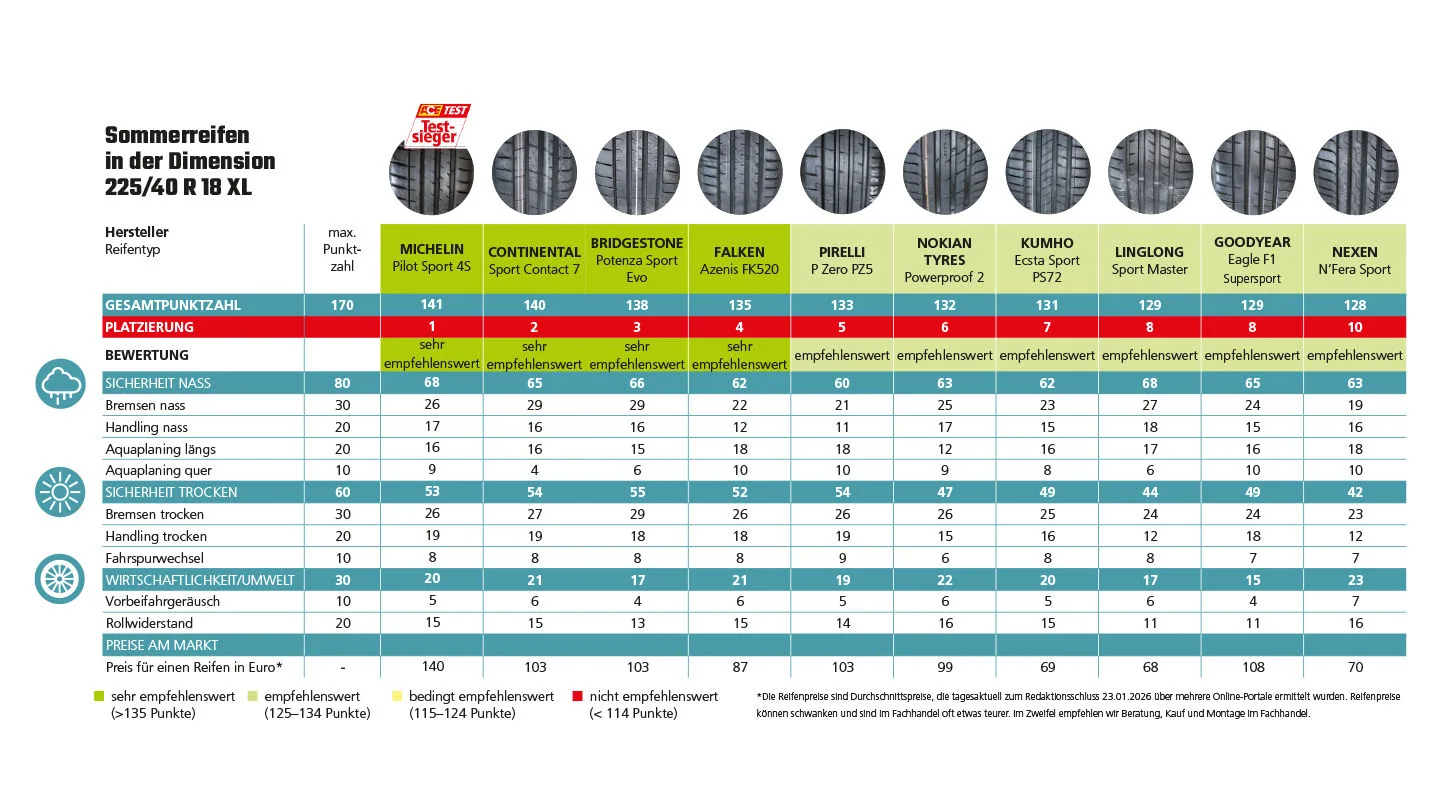
The ACE Auto Club Europa has published the first summer tire test of 2026, kicking off this year's test season. Ten tires in the 225/40 R18 size were tested across wet and dry braking, aquaplaning resistance, handling on both surfaces, rolling resistance, and exterior noise.
Overall, this is quite a confusing set of results. It's a shame ACE does not share the full data, so we are left guessing about what went wrong for tires like the PZ5.
The Pirelli dominated the dry handling course and lane-change manoeuvre, earning specific praise for its steering precision, yet dropped to among the worst in wet handling due to excessive sliding and reduced grip which is very unusual for the Pirelli.
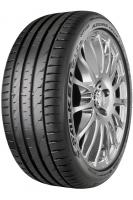
The Falken Azenis FK520 showed an almost identical split, sharing the best dry handling marks and posting the highest curve aquaplaning threshold in the test, only to join Pirelli at the bottom of the wet handling rankings. The Linglong Sport Master presented the reverse: dead last in dry handling alongside Nexen, yet it topped the wet handling course outright and placed in the top three for wet braking - a surprisingly strong wet-weather showing from a budget brand.
The Nexen N'Fera Sport finished last overall but was far from a write-off. It recorded the longest braking distances on both surfaces, yet placed in the top three for curve aquaplaning and posted the best noise result alongside the lowest rolling resistance. The Nokian Tires Powerproof 2 showed a similar mix of highs and lows — second-best in wet handling and joint-best in rolling resistance, but the first tire to aquaplane on the straight and the only one criticised for rear-axle instability in the lane-change test.
By contrast, the top three finishers — Michelin Pilot Sport 4S (141 points), Continental SportContact 7 (140), and Bridgestone Potenza Sport Evo (138) — earned their positions through consistency rather than headline-grabbing individual results. Michelin combined top-tier dry handling with strong wet performance and no weak categories. Continental posted the shortest wet braking distance in the test but was let down only by the lowest curve aquaplaning threshold. Bridgestone was the strongest tire under braking on both surfaces and stayed out of trouble everywhere else. The margins between them were tiny, with just three points separating first from third.
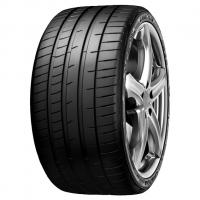
Finally, the Goodyear Eagle F1 Super Sport seems like the wrong tire for this test as it is more dry-focused. The Asymmetric 6 would have been the obvious choice, but it wasn't explained why the Super Sport was chosen. Coincidentally, TireReviews has a test including the Super Sport coming out in a few weeks, but this time against tires you expect it to be against.
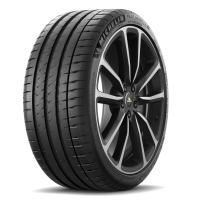
Michelin Pilot Sport 4S claimed the overall test victory with 141 out of 170 points and a "very recommended" rating. It scored 68 out of 80 in wet safety — joint second-best alongside Linglong — and 53 out of 60 in dry safety, placing it among the top tier on both surfaces. It was one of four tires sharing the best dry handling marks, praised for good cornering stability, precise steering, and a safe, controllable character. On the wet handling course it was named among the top three, credited with good traction out of corners. Its only relative weakness was economy at 20 out of 30, the joint lowest alongside Kumho. This well-rounded consistency across both wet and dry disciplines, with no category below the mid-pack, is what ultimately secured it the top position in a very tight field.
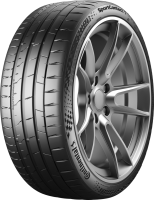
Continental SportContact 7 finished a single point behind the winner at 140 points, also earning a "very recommended" verdict. It scored the highest wet braking points in the test (29 out of 30) off the back of the shortest stopping distance at 24.51 metres, and its overall wet safety score of 65 was solid. It was one of the four tires sharing the best dry handling marks, highlighted for precise steering and cornering confidence, and its dry safety score of 54 was the joint highest in the test. Its one notable weakness was curve aquaplaning, where it scored just 4 out of 10 — the lowest in the field — after recording the earliest loss of grip at 68.3 km/h, more than 3 km/h earlier than the best tire in that discipline. That single vulnerability in standing water is likely what cost it the overall win.
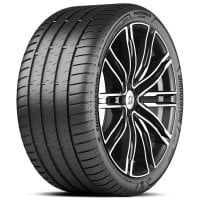
Bridgestone Potenza Sport Evo took third place with 138 points and a "very recommended" rating. It scored 55 out of 60 in dry safety — the highest in the test — built on the outright shortest dry braking distance at 32.85 metres (29 out of 30 for dry braking) and the second-shortest wet braking distance (also 29 out of 30). It was the most capable tire under hard braking overall. Its wet safety score of 66 was third-best in the field, suggesting reliable wet performance without the dramatic handling weaknesses that affected some rivals. Its economy score of 17 was the lowest in the test, indicating higher rolling resistance and noise levels. Still, its braking dominance and absence of any serious weakness in safety-critical categories kept it firmly on the podium.
Falken Azenis FK520 scored 135 points and was the last tire to receive the "very recommended" label. It achieved a strong 52 out of 60 in dry safety, sharing the best dry handling marks alongside Pirelli, Continental, and Michelin, and it was the standout aquaplaning performer in curves with 10 out of 10, holding contact with the road up to 71.5 km/h — the highest threshold recorded. However, its wet safety score of 62 was dragged down by a poor wet handling result of just 12 out of 20. The subjective assessment noted it felt less secure on the wet circuit, suffering from excessive under- and oversteer and reduced lateral grip. That wet handling weakness, combined with a modest economy score of 21, is what separates it from the top three.
Pirelli P Zero PZ5 finished fifth on 133 points with a "recommended" rating, despite delivering some of the test's most impressive individual results. Its dry safety score of 54 — tied for best in the test — included the highest marks on both the dry handling course (19 out of 20) and the lane-change manoeuvre (9 out of 10), where it was singled out for notably precise steering feel. It was the best tire in straight-line aquaplaning, holding on until 82.5 km/h, and scored 10 out of 10 in curve aquaplaning. The downside was dramatic: its wet safety score of 60 was the lowest in the entire field, with a wet handling result of just 11 out of 20. It was described as feeling less secure on the wet circuit, with too much sliding in the bends, imprecise steering response, and weaker lateral guidance. This stark wet-dry personality split prevented it from challenging for the podium.
Nokian Tires Powerproof 2 placed sixth on 132 points with a "recommended" rating. Its wet safety score of 63 was mid-pack, but within that it showed a strong wet handling result of 17 out of 20 — second-best in the test behind Linglong — credited with good traction coming out of bends. However, its straight-line aquaplaning score of 12 was the lowest in the field after it lost surface contact at just 80.1 km/h, the earliest onset recorded. Its dry safety score of 47 was the second-lowest, and in the lane-change test it drew specific criticism for weaker rear-axle support that reduced stability during fast evasive manoeuvres — the only tire to receive a negative call-out in that discipline. It partially offset these weaknesses with the joint second-best economy score of 22 out of 30, driven by strong rolling resistance.
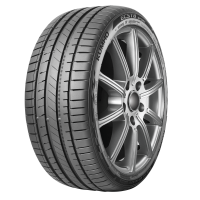
Kumho Ecsta Sport PS72 took seventh on 131 points with a "recommended" rating and at €69 represented the second-cheapest tire in the test. Its dry safety score of 49 placed it in the lower half — below the top group of Pirelli, Continental, Bridgestone, and Michelin but ahead of Linglong and Nexen. Its wet safety score of 62 matched Falken, with a reasonable wet braking result of 23 out of 30 but unremarkable wet handling at 15 out of 20. Its economy score of 20 tied with Michelin at the joint lowest. A tire that avoids the dramatic strengths and weaknesses seen elsewhere in the field, sitting in the mid-pack across almost every category — and offering that consistency at a price point well below the premium brands.
Goodyear Eagle F1 Supersport also tied for eighth on 129 points with a "recommended" rating, though at €108 it was the second most expensive tire in the test — €40 more than the identically scoring Linglong. Its wet safety score of 65 was respectable, sitting above the mid-pack, with a decent wet braking score of 24 out of 30 and a wet handling result of 15 out of 20 — avoiding the harsh criticism levelled at Pirelli and Falken for excessive sliding. Its dry safety score of 49 placed it in the lower half alongside Kumho, with a dry handling score of 18 out of 20 and a lane-change result of 7 out of 10 — behind the leaders but without the specific rear-axle criticism that Nokian received. Its economy score of 15 was third-lowest. A tire that spreads its points evenly without excelling anywhere, which at this price point makes it difficult to recommend over cheaper alternatives with similar or better results.
Linglong Sport Master tied for eighth on 129 points with a "recommended" rating, and at €68 was the cheapest tire in the test. It presented one of the most polarised profiles in the field. Its dry safety score of just 44 was second-worst, driven by a handling score of only 12 out of 20 — joint lowest with Nexen. Yet it completely reversed its fortunes in the wet, scoring 68 out of 80 in wet safety — tied for second-best with Michelin. It topped the wet handling course outright with 18 out of 20 and scored a strong 27 out of 30 in wet braking. The subjective assessment credited it with good traction out of corners on the wet circuit. Its economy score of 17 tied with Bridgestone as the worst. A tire whose compound and tread design appear heavily tilted toward wet-surface performance at the expense of dry-road precision.
Nexen N'Fera Sport came last on 128 points but still earned a "recommended" rating, underscoring that no tire in this test was truly poor. Its clearest weakness was braking: it scored just 19 out of 30 in wet braking and 23 out of 30 in dry braking after posting the longest stopping distances on both surfaces — 34.73 metres dry and 28.34 metres wet, nearly four metres and almost a full car length behind the best in the wet. Its dry safety score of 42 was the worst in the field, with a handling result of just 12 out of 20. Yet it showed a completely different side elsewhere: its wet handling score of 16 was mid-pack, its curve aquaplaning score of 10 out of 10 placed it among the best, and its economy score of 23 was the highest in the test — driven by the best noise result (7 out of 10) and strong rolling resistance (16 out of 20). At €70 it is one of the cheapest options, but the poor braking performance is a significant safety concern that is hard to overlook.
I have PZ4s and they become horrible during cold rainy days. In other tests PZ5 seemed to do well in wet handling but was the opposite in this test. I wonder if this is due to ambient temperature difference in tests?
Interesting article. Could you give some clarity on where you see the border between UHP and UUHP?
I’m interested in the new Pirelli PZ5, Goodyear F1As6, Continental SC7, Michelin PS5. Are these direct competitors i.e. UHP? Or are the PZ5 and SC7 actually UUHP? Some external tests have very unexpected tire comparisons in my opinion.
I’m looking for a fun tire which will still be compliant over bad surfaces. Stability and performance on the autobahn important.
Don't suppose the Bridgestone Potenza Sport Evo is a good recommendation for replacement of Goodyear Eagle F1 6s are they? I have PS4S on my 19inch alloys for the odd track session but my 18inch with goodyears are my everyday wheel.
Looking at some new tires in the next 7 days as the fronts are on 2mm on my Megane RS so holding off if your video is soon!
First test in which I see the Potenza Sport Evo! The Goodyear Eagle F1 Asymmetric 6's on my MX-5 ND are due for replacement and I'm considering the Potenza Sport Evo as the Potenza Sport was considered a lot of fun and according to Bridgestone the weak point of longevity should be addressed. (PZ5 and SC7 not available in 17 inch) Will the Bridgestone Potenza Sport Evo take part in one of your tests this year?





I have PZ4s and they become horrible during cold rainy days. In other tests PZ5 seemed to do well in wet handling but was the opposite in this test. I wonder if this is due to ambient temperature difference in tests?
Interesting article. Could you give some clarity on where you see the border between UHP and UUHP?
I’m interested in the new Pirelli PZ5, Goodyear F1As6, Continental SC7, Michelin PS5. Are these direct competitors i.e. UHP? Or are the PZ5 and SC7 actually UUHP? Some external tests have very unexpected tire comparisons in my opinion.
I’m looking for a fun tire which will still be compliant over bad surfaces. Stability and performance on the autobahn important.
It's a thin, confusing line. All of those I'd classify as UHP unless it's the Conti or Pirelli in 19"+ fitment then they're moer UUHP.
But conti also have the PC7 which in 18" is very similar to the SC7 in 18" soooo.
Thanks for the reply. That helps as I’m looking for a set in 225 40 R18. Looking forward to the coming tests- you’re doing great work.
Don't suppose the Bridgestone Potenza Sport Evo is a good recommendation for replacement of Goodyear Eagle F1 6s are they? I have PS4S on my 19inch alloys for the odd track session but my 18inch with goodyears are my everyday wheel.
Looking at some new tires in the next 7 days as the fronts are on 2mm on my Megane RS so holding off if your video is soon!
Yes, they potentially could be. They're a bit more focused than the Asymmetric 6, but the Evo version should improve the wear issues they had.
Thanks. Took the plunge yesterday https://uploads.disquscdn.c...
I look forward to reading your thoughts!
First test in which I see the Potenza Sport Evo! The Goodyear Eagle F1 Asymmetric 6's on my MX-5 ND are due for replacement and I'm considering the Potenza Sport Evo as the Potenza Sport was considered a lot of fun and according to Bridgestone the weak point of longevity should be addressed. (PZ5 and SC7 not available in 17 inch) Will the Bridgestone Potenza Sport Evo take part in one of your tests this year?
michelin primacy 5 energy review when
Probably not from me this year, sadly.