

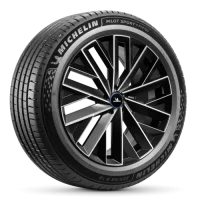
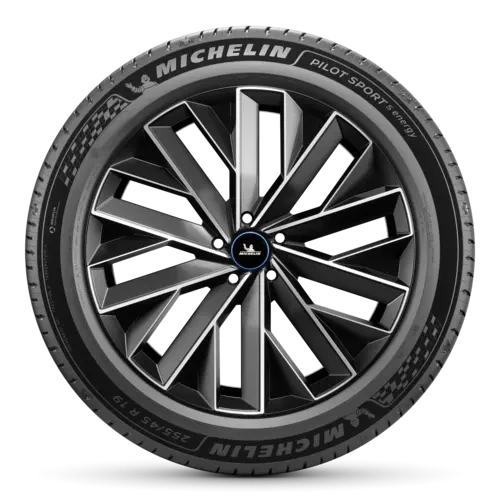
 The Michelin Pilot Sport 5 is a customer favourite - it's test-winning, long-lasting, and one of the best all-round UHP tires you can buy. So adding a low rolling resistance "Energy" version was always going to be tricky. Historically, energy-focused performance tires have meant giving up a noticeable chunk of wet grip. The question is whether Michelin has managed to close that gap.
The data here comes from two test programmes, both commissioned by Michelin. Performance testing was carried out by TÜV SÜD at TRIWO Pferdsfeld in August 2025 (Report Nr. 713379856-S32-01), covering wet braking, dry braking, wet handling, and rolling resistance. Tread wear testing was conducted by DEKRA in Narbonne, France, during September and October 2025 (Report CPA MARK25H). Both used a Tesla Model Y (RWD, 75 kWh, 2,080 kg) and a tire size of 255/40 R20 101Y XL.
Wet Braking
The PS5 stopped in 25.6m compared to 27.8m for the PS5 Energy — a 2.2m advantage. That's a measurable difference, but it's a far smaller penalty than we've seen from previous low-rolling-resistance performance tires.
Dry Braking
From 100-0 km/h on dry asphalt, the PS5 Energy actually stopped fractionally shorter at 34.8m versus 35.1m. This is likely due to lower starting tread depth on the Energy - less tread squirm generally helps dry braking - though the reports don't confirm starting depths.
Wet Handling
On TÜV SÜD's 1,830m wet handling circuit, the PS5 was quicker, scoring 105.4% on lap time versus 100% for the PS5 Energy. Subjective ratings followed: 8.92 versus 8.00. The PS5 is clearly the better wet handler, but an 8.00 subjective score is still a strong result in absolute terms.
Rolling Resistance
This is the headline figure. The PS5 Energy achieved an RR label value of 6.5 versus 7.9 for the standard PS5, that's a huge difference. For EV owners, this translates directly into range, and across the life of the tire that cumulative energy saving is significant.
Tread Wear
In DEKRA's 7,712 km convoy test, the PS5 Energy lost 901g of rubber across all four positions, while the standard PS5 lost 1,138g — 26% more material. Despite this, the extrapolated tread life was essentially identical, with the PS5 projected to last just 101 km longer. The PS5 likely started with more tread depth, giving it a slightly longer runway to the wear limit despite wearing faster.
Verdict
The Pilot Sport 5 Energy gives up some wet grip - the PS5 stops shorter in the wet and is more agile during wet handling. But the margins are much smaller than we've come to expect from this type of tire. Dry braking is a dead heat, tread life is essentially the same, and the rolling resistance improvement is genuinely impressive.
For a tire as well-regarded as the Pilot Sport 5, producing a lower energy variant without undermining its core qualities is a difficult thing to do, and I think Michelin have done a good job here. If you're an EV owner looking to maximise range without dropping to a compromised tire, the PS5 Energy looks like a strong option.

Do you know when/if they're likely to bring out more sizes of this tire? Would be great on my mach e (225 55 19) which at the moment looks like I'll be going to the Michelin Primacy 5 Energy.
I'm intresested in the Pilot Sport 5 Energy for my EV... Does anyone have Informations about comfort and noise level for this tire?
If the general tradeoff is that an "eco" tire will have a lower rolling resistance at the cost of wet grip, while their expected mileage is the same, wouldn't their wet grip performances and rolling resistances just converge over time, and thus the results shown are basically the widest they will ever be.
Additionally if we account for the fact that in this case the PS5 Energy has lower abrasion while achieving the same mileage, the user is essentially buying a tire with a harder compound, which performs worse grip wise.
I would assume that the need for such tires comes from car manufacturers primarily to reduce their carbon tax when selling new vehicles and that there are regulative pressures from EU primarily when it comes to abrasion as tires are a decent factor in micro plastics pollution, it just seems that the rolling resistance gains over the life of the tire are exaggerated over time.
You are correct that, as the tread depth gets worn, they are likely going to get closer overall. Unfortunately, how much closer we don't know without seeing the data, which I'm not sure anyone will ever publish.