



Test setup & methodology
The test setting, the conditions recorded and how the results contribute to the score.
Show full testing methodology
Recorded test conditions
- Snow Braking
- 24.9 → 0.0 mph
- Snow Traction
- 0.0 → 12.4 mph
- Ice Braking
- 12.4 → 0.0 mph
Score Weighting
Weights express the scoring priorities, not how much each discipline actually changed the finishing order. The size of the performance gaps matters too. Category weights contribute to the overall score. Within each category, discipline weights divide that category’s share. Published finishing positions also need to be read alongside the editorial verdict.
| Test | Within category | Share of overall score |
|---|---|---|
| Snow · 72% | ||
| Snow Braking | 32% | 23.04% |
| Snow Traction | 27% | 19.44% |
| Snow Handling | 32% | 23.04% |
| Subj. Snow Handling | 9% | 6.48% |
| Ice · 14% | ||
| Ice Braking | 100% | 14% |
| Comfort · 14% | ||
| Subj. Comfort | 50% | 7% |
| Subj. Noise | 50% | 7% |
Our standard methods
The conditions above are recorded for this test. The descriptions below explain our standard procedures; measurement windows and run counts can vary by test.
Snow Braking
For snow braking, I drive the test vehicle at an entry speed of 50 km/h and apply full braking effort to a standstill with ABS active on a groomed, compacted snow surface, measuring 45-5 km/h. I generally use a wide VDA (vehicle dynamic area) and progressively move across the surface between runs so that no tire ever brakes on the same piece of snow twice. My standard programme is twelve runs per tire set, although the sequence can extend further if the data justify it. I analyze the full set of runs and discard statistical outliers before averaging. The surface is regularly groomed throughout the session. To correct for changing snow surface conditions, I run reference tires repeatedly — typically every two candidate test sets.
Snow Traction
For snow traction, I accelerate the vehicle from rest on a groomed snow surface with traction control active and measure speed and time using GPS telemetry. I typically use a 5–35 km/h measurement window to reduce the influence of launch transients and powertrain irregularities. I use a wide VDA (vehicle dynamic area) and progressively move across the surface between runs so that no tire ever accelerates on the same piece of snow twice. The surface is regularly groomed throughout the session. I complete multiple runs per tire set and average the valid results. Reference tires are run typically every two candidate test sets to correct for changing snow surface conditions.
Snow Handling
For snow handling, I drive at the limit of adhesion around a dedicated snow handling circuit with ESC disabled where possible. The circuit is groomed and prepared after every run while tires are being changed, so each set runs on a consistently prepared surface. I usually complete between two and five timed laps per tire set, excluding laps affected by clear driver error or obvious environmental inconsistency. Because snow surfaces degrade more rapidly than asphalt, control runs are carried out more frequently — typically every two candidate test sets.
Subj. Snow Handling
I also carry out a structured subjective handling assessment at the limit of adhesion on a dedicated snow handling circuit. The circuit is groomed and prepared after every run while tires are being changed, so each set runs on a consistently prepared surface. I score steering precision, turn-in behavior, mid-corner balance, corner-exit traction, breakaway characteristics, and overall confidence on snow using a standardised 1–10 scale used consistently across my testing. The final assessment combines numeric scoring with written technical commentary. I complete familiarisation laps on the control tire before evaluating each candidate.
Ice Braking
For ice braking, I drive the test vehicle at an entry speed of 35 km/h and apply full braking effort to a standstill with ABS active on a prepared ice surface. Surface temperature is continuously monitored as ice friction properties vary substantially with temperature. My standard programme is twelve runs per tire set but with ice testing, you often do many more. I analyze the full set of runs and discard statistical outliers before averaging. Reference tires are run typically every two candidate test sets to correct for changing surface conditions.
Subj. Comfort
To assess comfort, I drive on a wide range of road surfaces (often dedicated comfort tracks at test facilities) at speeds from 50 to 120 km/h, including smooth motorway, coarse surfaces, expansion joints, broken pavement, and sharp-edged obstacles. I evaluate primary ride quality, secondary ride quality, impact harshness, seat-transmitted vibration, and the tire's ability to absorb sharp inputs. Ratings are assigned on a 1–10 scale relative to the reference tire.
Subj. Noise
For subjective noise assessment, I drive at constant speeds across multiple surface types with the windows closed, ventilation off, and audio system off. I assess overall noise level, tonal quality, cavity boom, pattern noise, broadband roar, and sensitivity to both speed and road texture. Each tire is rated on a 1–10 scale and supported by written observations on noise character and annoyance.
Snow
The winter tire had a clear advantage during snow braking testing, with the all season, mild all terrain and aggressive all terrain tire all finishing in a tight group, ahead of the mud terrain off-road tire.
Snow Braking
Snow braking in feet (25 - 0 mph)
Lower is better ↓| Position / Tire | Result | Gap to best | Residual speed |
|---|---|---|---|
| 60 ft | Best | 0 mph | |
| 65 ft | +5 ft | 23 mph | |
| 66 ft | +6 ft | 24 mph | |
| 66 ft | +6 ft | 25 mph | |
| 75 ft | +15 ft | 37 mph |
The difference between best and worst was 26.4% (15 ft ≈ 1.1 Car Lengths). From 80 mph, the General Grabber X3 would still be travelling at 37 mph when the General Grabber Arctic had stopped.
Residual speed is calculated from the measured braking distances, assuming constant deceleration; it is not a separate measurement.
This pattern of grip was broadly replicated during the snow traction testing, with the A/T tires performing slightly better than the all season.
Snow Traction
Snow acceleration time (0 - 12 mph)
Lower is better ↓| Position / Tire | Result | Gap to best |
|---|---|---|
| 6.5 s | Best | |
| 7.6 s | +1.10 s | |
| 7.6 s | +1.10 s | |
| 8 s | +1.50 s | |
| 10.7 s | +4.20 s |
The difference between best and worst was 64.6% (4.2 s).
Snow handling kept the large advantage in favor of the winter tire, with the mud terrain tire again struggling to perform.
Snow Handling
Snow handling time in seconds
Lower is better ↓| Position / Tire | Result | Gap to best |
|---|---|---|
| 84.96 s | Best | |
| 89.48 s | +4.52 s | |
| 89.52 s | +4.56 s | |
| 90.84 s | +5.88 s | |
| 95.43 s | +10.47 s |
The difference between best and worst was 12.3% (10.47 s).
The subjective scoring matched the grip levels of the tires, with the grippier tires offering a better balance, and more control of the vehicle.
Subj. Snow Handling
Subjective Snow Handling Score
Higher is better ↑| Position / Tire | Result | Gap to best |
|---|---|---|
| 10 Points | Best | |
| 8.5 Points | -1.50 Points | |
| 8 Points | -2.00 Points | |
| 7 Points | -3.00 Points | |
| 6 Points | -4.00 Points |
The difference between best and worst was 40% (4 Points).

Ice
Sipes were king on ice, with the winter tire holding its advantage. This time, the Grabber APT outperformed the rest of the tires on test.
Ice Braking
Ice braking in feet (12 - 0 mph)
Lower is better ↓| Position / Tire | Result | Gap to best | Residual speed |
|---|---|---|---|
| 47 ft | Best | 0 mph | |
| 50 ft | +3 ft | 19 mph | |
| 56 ft | +9 ft | 31 mph | |
| 58 ft | +11 ft | 35 mph | |
| 59 ft | +12 ft | 36 mph |
The difference between best and worst was 25.7% (12 ft ≈ 0.8 Car Lengths). From 80 mph, the General Grabber ATx would still be travelling at 36 mph when the General Grabber Arctic had stopped.
Residual speed is calculated from the measured braking distances, assuming constant deceleration; it is not a separate measurement.
Environment
Subjectively the winter tire was also the most comfortable on test, with the all season matching the mild all terrain.
Subj. Comfort
Subjective Comfort Score
Higher is better ↑| Position / Tire | Result | Gap to best |
|---|---|---|
| 10 Points | Best | |
| 9 Points | -1.00 Points | |
| 9 Points | -1.00 Points | |
| 8 Points | -2.00 Points | |
| 7 Points | -3.00 Points |
The difference between best and worst was 30% (3 Points).
The all season tire had the lowest levels of noise on test, and while the MT off-road tire was impressively quiet for its category, it was still noticeably the loudest tire on test.
Subj. Noise
Subjective in car noise levels
Higher is better ↑| Position / Tire | Result | Gap to best |
|---|---|---|
| 10 Points | Best | |
| 9 Points | -1.00 Points | |
| 8 Points | -2.00 Points | |
| 7 Points | -3.00 Points | |
| 6 Points | -4.00 Points |
The difference between best and worst was 40% (4 Points).
Results
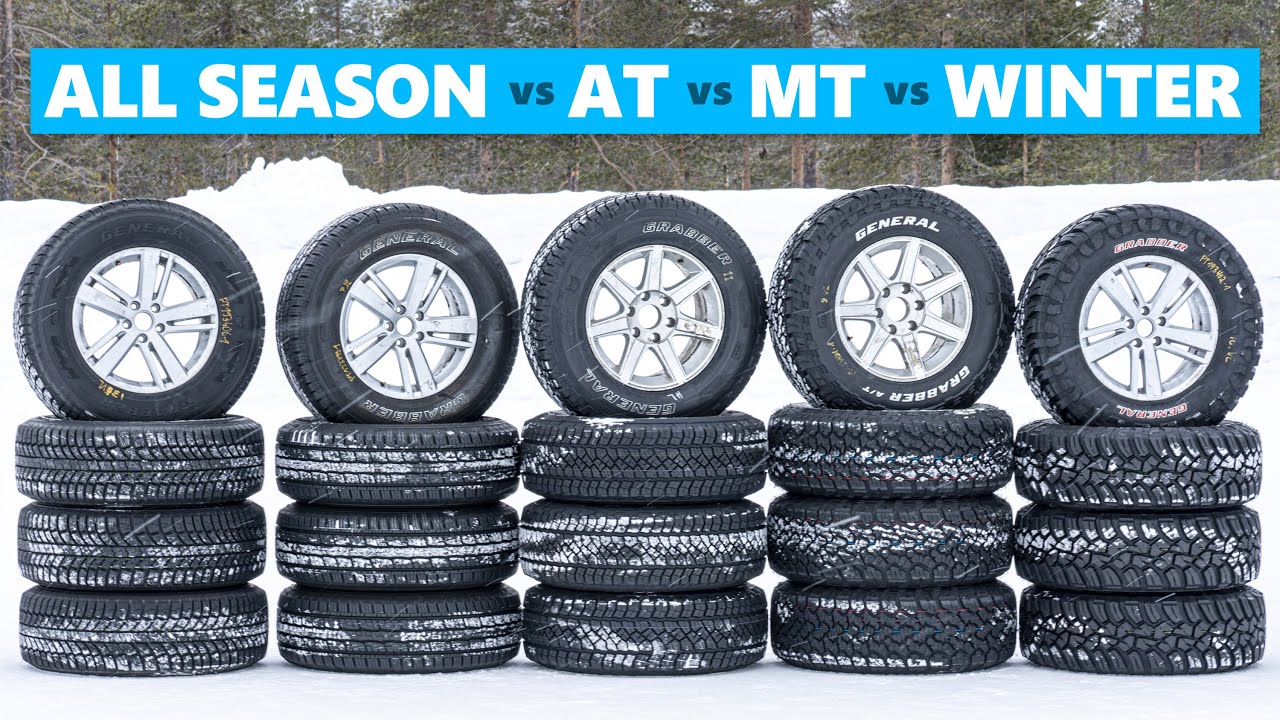 HT vs AT vs MT vs Winter Tires on SnowWatch the full video of this test on YouTube Watch on YouTube
General Grabber Arctic
265/70 R17
Category scores (% of best)
All discipline results (7)
Discipline positions compare the ranked tires in this test, not the whole market. These are individual measurements, not weighted overall scores.
| Test | Position in discipline | Result | Gap to best |
|---|---|---|---|
| Snow BrakingLower is better | 1st / 5 | 60 ft | Best in this discipline |
| Snow TractionLower is better | 1st / 5 | 6.5 s | Best in this discipline |
| Snow HandlingLower is better | 1st / 5 | 84.96 s | Best in this discipline |
| Subj. Snow HandlingHigher is better | 1st / 5 | 10 Points | Best in this discipline |
| Ice BrakingLower is better | 1st / 5 | 47 ft | Best in this discipline |
| Subj. ComfortHigher is better | 1st / 5 | 10 Points | Best in this discipline |
| Subj. NoiseHigher is better | 2nd / 5 | 9 Points | -1.00 Points |
General Grabber HTS60
265/70 R17
Category scores (% of best)
All discipline results (7)
Discipline positions compare the ranked tires in this test, not the whole market. These are individual measurements, not weighted overall scores.
| Test | Position in discipline | Result | Gap to best |
|---|---|---|---|
| Snow BrakingLower is better | 2nd / 5 | 65 ft | +5 ft |
| Snow TractionLower is better | 4th / 5 | 8 s | +1.50 s |
| Snow HandlingLower is better | 2nd / 5 | 89.48 s | +4.52 s |
| Subj. Snow HandlingHigher is better | 2nd / 5 | 8.5 Points | -1.50 Points |
| Ice BrakingLower is better | 3rd / 5 | 56 ft | +9 ft |
| Subj. ComfortHigher is better | 2nd / 5 | 9 Points | -1.00 Points |
| Subj. NoiseHigher is better | 1st / 5 | 10 Points | Best in this discipline |
General Grabber APT
265/70 R17
Category scores (% of best)
All discipline results (7)
Discipline positions compare the ranked tires in this test, not the whole market. These are individual measurements, not weighted overall scores.
| Test | Position in discipline | Result | Gap to best |
|---|---|---|---|
| Snow BrakingLower is better | 4th / 5 | 66 ft | +6 ft |
| Snow TractionLower is better | 2nd / 5 | 7.6 s | +1.10 s |
| Snow HandlingLower is better | 3rd / 5 | 89.52 s | +4.56 s |
| Subj. Snow HandlingHigher is better | 3rd / 5 | 8 Points | -2.00 Points |
| Ice BrakingLower is better | 2nd / 5 | 50 ft | +3 ft |
| Subj. ComfortHigher is better | 2nd / 5 | 9 Points | -1.00 Points |
| Subj. NoiseHigher is better | 3rd / 5 | 8 Points | -2.00 Points |
General Grabber ATx
265/70 R17
Category scores (% of best)
All discipline results (7)
Discipline positions compare the ranked tires in this test, not the whole market. These are individual measurements, not weighted overall scores.
| Test | Position in discipline | Result | Gap to best |
|---|---|---|---|
| Snow BrakingLower is better | 3rd / 5 | 66 ft | +6 ft |
| Snow TractionLower is better | 2nd / 5 | 7.6 s | +1.10 s |
| Snow HandlingLower is better | 4th / 5 | 90.84 s | +5.88 s |
| Subj. Snow HandlingHigher is better | 4th / 5 | 7 Points | -3.00 Points |
| Ice BrakingLower is better | 5th / 5 | 59 ft | +12 ft |
| Subj. ComfortHigher is better | 4th / 5 | 8 Points | -2.00 Points |
| Subj. NoiseHigher is better | 4th / 5 | 7 Points | -3.00 Points |
General Grabber X3
265/70 R17
Category scores (% of best)
All discipline results (7)
Discipline positions compare the ranked tires in this test, not the whole market. These are individual measurements, not weighted overall scores.
| Test | Position in discipline | Result | Gap to best |
|---|---|---|---|
| Snow BrakingLower is better | 5th / 5 | 75 ft | +15 ft |
| Snow TractionLower is better | 5th / 5 | 10.7 s | +4.20 s |
| Snow HandlingLower is better | 5th / 5 | 95.43 s | +10.47 s |
| Subj. Snow HandlingHigher is better | 5th / 5 | 6 Points | -4.00 Points |
| Ice BrakingLower is better | 4th / 5 | 58 ft | +11 ft |
| Subj. ComfortHigher is better | 5th / 5 | 7 Points | -3.00 Points |
| Subj. NoiseHigher is better | 5th / 5 | 6 Points | -4.00 Points |

It would be interesting to see a test of the difference on ice and cold damp roads. In my experience genuine off-road tires like Grabbers are useless for anything but mud, sand or soft snow. Their Off-road design should disqualify them from on-road use. They're a liability on ice or cold damp roads, spinning out of control in conditions that wouldn't bother winter tyes or even regular summer tires.
There's a test on the channel covering these tires offroad, but also in the dry and wet! It's not cold, but it shows the difference in the real world