



Nokian have just announced the Nokian SeasonProof 2, the first tire from their new, state of the art factory in Europe. They are hopeful this will finally be the tire that brings them to the front of the all season market, so of course I had to test it!
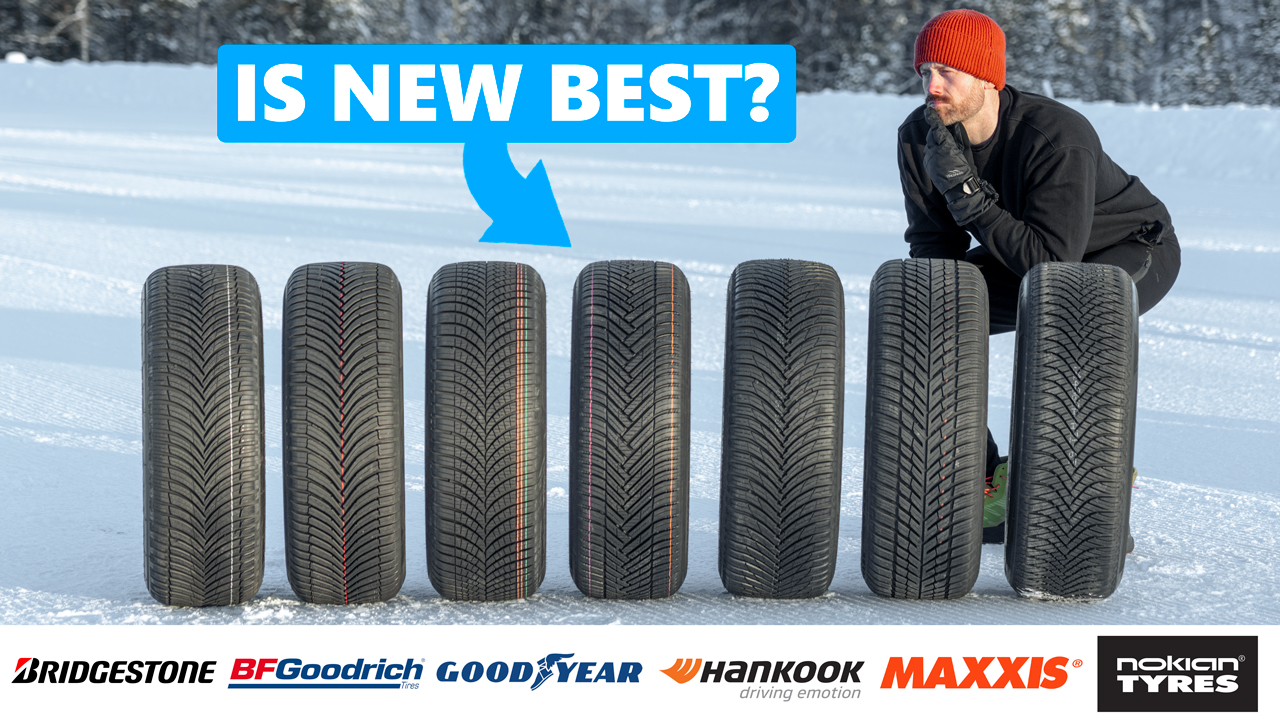
In this test, I will be testing seven of the best all season tires in the popular 235/55 R18 tire size. As these are all season tires, I will be testing them in all seasons, covering the dry, wet and snow performance of these tires, and testing the noise, comfort and rolling resistance levels of the tires to help you make the most informed choice for your own driving needs.
Test setup & methodology
The test setting, the conditions recorded and how the results contribute to the score.
Show full testing methodology
Recorded test conditions
- Dry Braking
- 62.1 → 3.1 mph · 48–52 °F
- Dry Handling
- 54–55 °F
- Wet Braking
- 49.7 → 3.1 mph · 52–55 °F
- Wet Handling
- 46–48 °F
- Snow Traction
- 3.1 → 24.9 mph · 19–21 °F
- Snow Handling
- 19 °F
Score Weighting
Weights express the scoring priorities, not how much each discipline actually changed the finishing order. The size of the performance gaps matters too. Category weights contribute to the overall score. Within each category, discipline weights divide that category’s share. Published finishing positions also need to be read alongside the editorial verdict.
| Test | Within category | Share of overall score |
|---|---|---|
| Dry · 30% | ||
| Dry Braking | 50% | 15% |
| Dry Handling | 35% | 10.5% |
| Subj. Dry Handling | 15% | 4.5% |
| Wet · 40% | ||
| Wet Braking | 40% | 16% |
| Wet Handling | 25% | 10% |
| Subj. Wet Handling | 20% | 8% |
| Straight Aqua | 10% | 4% |
| Curved Aquaplaning | 5% | 2% |
| Snow · 20% | ||
| Snow Braking | 30% | 6% |
| Snow Traction | 30% | 6% |
| Snow Handling | 30% | 6% |
| Subj. Snow Handling | 10% | 2% |
| Comfort · 5% | ||
| Subj. Comfort | 25% | 1.25% |
| Subj. Noise | 25% | 1.25% |
| Noise | 50% | 2.5% |
| Value · 5% | ||
| Rolling Resistance | 100% | 5% |
Our standard methods
The conditions above are recorded for this test. The descriptions below explain our standard procedures; measurement windows and run counts can vary by test.
Dry Braking
For dry braking, I drive the test vehicle at an entry speed of 110 km/h and apply full braking effort to a standstill with ABS active on clean, dry asphalt. I typically use an 100–5 km/h measurement window. My standard programme is five runs per tire set where possible, although the sequence can extend to as many as fifteen runs if conditions and tire category justify it. I analyze the full set of runs and discard statistical outliers before averaging. Reference tires are run repeatedly throughout the session to correct for changing conditions.
Dry Handling
For dry handling, I drive at the limit of adhesion around a dedicated handling circuit with ESC disabled where possible so I can assess the tire's natural balance, transient response, and limit behavior without electronic intervention masking the result. I usually complete between two and five timed laps per tire set, depending on the circuit, tire type, and consistency of conditions. I exclude laps affected by clear driver error or obvious environmental inconsistency. Control runs are carried out frequently throughout the session, and I often use multiple sets of control tires so that wear on the references does not become a meaningful variable. For more track-focused products, I also do endurance testing, which is a set number of laps at race pace to determine tire wear patterns and heat resistance over longer driving.
Subj. Dry Handling
I also carry out a structured subjective handling assessment at the limit of adhesion on a dedicated dry handling circuit. I score steering precision, steering response, turn-in behavior, mid-corner balance, corner-exit traction, breakaway characteristics, and overall confidence using a standardised 1–10 scale used consistently across my testing. The final assessment combines numeric scoring with written technical commentary. I complete familiarisation laps on the control tire before evaluating each candidate.
Wet Braking
For wet braking, I drive the test vehicle at an entry speed of 88 km/h and apply full braking effort to a standstill with ABS active on an asphalt surface with a controlled water film. I typically use an 80–5 km/h measurement window to isolate tire performance from variability in the initial brake application. My standard programme is eight runs per tire set where possible, although the sequence can extend to as many as fifteen runs if conditions and tire category justify it. I analyze the full set of runs and discard statistical outliers before averaging. To correct for changing conditions, I run reference tires repeatedly throughout the session — in wet testing, typically every three candidate test sets.
Wet Handling
For wet handling, I drive at the limit of adhesion around a dedicated handling circuit. I generally use specialist wet circuits with kerb-watering systems designed to maintain a consistent surface condition. ESC is disabled where possible so I can assess the tire's natural balance, transient response, and limit behavior without electronic intervention masking the result. I usually complete between two and five timed laps per tire set, depending on the circuit, tire type, and consistency of conditions. I exclude laps affected by clear driver error or obvious environmental inconsistency. Control runs are carried out frequently throughout the session, and I often use multiple sets of control tires so that wear on the references does not become a meaningful variable.
Subj. Wet Handling
I also carry out a structured subjective handling assessment at the limit of adhesion on a dedicated wet handling circuit. I score steering precision, steering response, turn-in behavior, mid-corner balance, aquaplaning resistance, breakaway characteristics, and overall confidence using a standardised 1–10 scale used consistently across my testing. The final assessment combines numeric scoring with written technical commentary. I complete familiarisation laps on the control tire before evaluating each candidate.
Straight Aqua
To measure straight-line aquaplaning resistance, I drive one side of the vehicle through a water trough of controlled depth, typically around 7 mm, while the opposite side remains on dry pavement. I enter at a fixed speed and then accelerate progressively. I define aquaplaning onset as the point at which the wheel travelling through the water exceeds a specified slip threshold relative to the dry-side reference wheel. I usually perform four runs per tire set and average the valid results.
Curved Aquaplaning
For curved aquaplaning, I use a circular track, typically around 100 meters in diameter, with a flooded arc of controlled water depth, usually about 7 mm. The vehicle is instrumented with GPS telemetry and a tri-axial accelerometer. I drive through the flooded section at progressively increasing speed, typically in 5 km/h increments, and record the minimum sustained lateral acceleration at each step. The test continues until lateral acceleration collapses, indicating complete aquaplaning. The result is expressed as remaining lateral acceleration in m/s² as speed rises.
Snow Braking
For snow braking, I drive the test vehicle at an entry speed of 50 km/h and apply full braking effort to a standstill with ABS active on a groomed, compacted snow surface, measuring 45-5 km/h. I generally use a wide VDA (vehicle dynamic area) and progressively move across the surface between runs so that no tire ever brakes on the same piece of snow twice. My standard programme is twelve runs per tire set, although the sequence can extend further if the data justify it. I analyze the full set of runs and discard statistical outliers before averaging. The surface is regularly groomed throughout the session. To correct for changing snow surface conditions, I run reference tires repeatedly — typically every two candidate test sets.
Snow Traction
For snow traction, I accelerate the vehicle from rest on a groomed snow surface with traction control active and measure speed and time using GPS telemetry. I typically use a 5–35 km/h measurement window to reduce the influence of launch transients and powertrain irregularities. I use a wide VDA (vehicle dynamic area) and progressively move across the surface between runs so that no tire ever accelerates on the same piece of snow twice. The surface is regularly groomed throughout the session. I complete multiple runs per tire set and average the valid results. Reference tires are run typically every two candidate test sets to correct for changing snow surface conditions.
Snow Handling
For snow handling, I drive at the limit of adhesion around a dedicated snow handling circuit with ESC disabled where possible. The circuit is groomed and prepared after every run while tires are being changed, so each set runs on a consistently prepared surface. I usually complete between two and five timed laps per tire set, excluding laps affected by clear driver error or obvious environmental inconsistency. Because snow surfaces degrade more rapidly than asphalt, control runs are carried out more frequently — typically every two candidate test sets.
Subj. Snow Handling
I also carry out a structured subjective handling assessment at the limit of adhesion on a dedicated snow handling circuit. The circuit is groomed and prepared after every run while tires are being changed, so each set runs on a consistently prepared surface. I score steering precision, turn-in behavior, mid-corner balance, corner-exit traction, breakaway characteristics, and overall confidence on snow using a standardised 1–10 scale used consistently across my testing. The final assessment combines numeric scoring with written technical commentary. I complete familiarisation laps on the control tire before evaluating each candidate.
Subj. Comfort
To assess comfort, I drive on a wide range of road surfaces (often dedicated comfort tracks at test facilities) at speeds from 50 to 120 km/h, including smooth motorway, coarse surfaces, expansion joints, broken pavement, and sharp-edged obstacles. I evaluate primary ride quality, secondary ride quality, impact harshness, seat-transmitted vibration, and the tire's ability to absorb sharp inputs. Ratings are assigned on a 1–10 scale relative to the reference tire.
Subj. Noise
For subjective noise assessment, I drive at constant speeds across multiple surface types with the windows closed, ventilation off, and audio system off. I assess overall noise level, tonal quality, cavity boom, pattern noise, broadband roar, and sensitivity to both speed and road texture. Each tire is rated on a 1–10 scale and supported by written observations on noise character and annoyance.
Noise
I measure external pass-by noise in accordance with UNECE Regulation 117 and ISO 13325 using the coast-by method on a compliant test surface. Calibrated microphones are positioned beside the test lane, and the vehicle coasts through the measurement zone under controlled conditions. I record the maximum A-weighted sound pressure level in dB(A), complete multiple runs over the relevant speed range, and normalise the result to the reference speed required by the procedure.
Rolling Resistance
Rolling resistance is measured under controlled laboratory conditions in accordance with ISO 28580 and UNECE Regulation 117 Annex 6. The tire is mounted on a test wheel and loaded against a large-diameter steel drum. After thermal stabilisation at the prescribed test speed, rolling resistance force is measured at the spindle and corrected according to the relevant procedure. The result is expressed as rolling resistance coefficient, typically in kg/tonne.
Wet
In my mind, the wet performance of an all season tire is the most important aspect. My theory is this - if you live in a region with a harsh winter, you'll be fitting proper winter tires already, and if you live in a dry climate, you'll be on summer tires year round. This means the people fitting all season tires are in those areas that get mostly long wet winters, with periods of snow that turns to slush very quickly.

Shockingly, the cheapest tire in the test was the worst in the wet. It had lots of aquaplaning around the lap which was very. In fact the person who calculated the curved aquaplaning data left a note saying "worst I've ever seen" which is crazy when you consider it doesn't look that different from the rest of the tires!
The rest of tires were VERY close, 2% between best and worst. Bridgestone and BFGoodrich were similar with quite a lot of understeer, then you had Maxxis, Hankook, Nokian and Goodyear, in that order, all a little more drivable. They did have some subtle differences in steering response, the nokians steering felt the most relaxed, whereas the maxxis felt the most summer like, but i'm really splitting hairs.

Wet Handling
Wet handling time in seconds (0 - 0 ) [Average Temperature 47°F]
Lower is better ↓| Position / Tire | Result | Gap to best |
|---|---|---|
RefReference Summer |
71.83 s | -0.52 s |
| 72.35 s | Best | |
| 72.38 s | +0.03 s | |
| 72.48 s | +0.13 s | |
| 72.65 s | +0.30 s | |
| 73.66 s | +1.31 s | |
| 73.8 s | +1.45 s | |
| 75.51 s | +3.16 s |
The difference between best and worst was 5.1% (3.68 s).
The wet braking did separate things a little more, the budget was a huge 27% behind the best, which was the new Nokian. Even with wet handling being so close, the order was almost identical between wet handling and wet braking, with the Goodyear and Nokian once again being the best, but this time with Nokian ahead. To give you an idea of difference, I calculated the wet braking distance from the motorway speed limit, the Nokian would have you stopped in under 266 feet and the budget over 328 feet, or another way of looking at it, when you'd stopped on the nokian from 81 mph, you still be doing 37 mph on the budget. Yikes.
Wet Braking
Wet braking in feet (50 - 3 mph) [Average Temperature 54°F]
Lower is better ↓| Position / Tire | Result | Gap to best | Residual speed |
|---|---|---|---|
RefReference Summer |
95 ft | -5 ft | 0 mph |
| 100 ft | Best | 0 mph | |
| 101 ft | +1 ft | 7 mph | |
| 102 ft | +2 ft | 11 mph | |
| 107 ft | +7 ft | 20 mph | |
| 107 ft | +7 ft | 21 mph | |
| 110 ft | +10 ft | 25 mph | |
| 126 ft | +26 ft | 37 mph |
The difference between best and worst was 33.2% (31 ft ≈ 2.1 Car Lengths). From 80 mph, the Westlake All Season Elite Z401 would still be travelling at 37 mph when the Nokian Seasonproof 2 had stopped.
Residual speed is calculated from the measured braking distances, assuming constant deceleration; it is not a separate measurement.
Straight Aqua
Straight Aqua
Float Speed in mph
Higher is better ↑| Position / Tire | Result | Gap to best |
|---|---|---|
| 50.8 mph | Best | |
| 50.3 mph | -0.5 mph | |
| 50.1 mph | -0.7 mph | |
| 50.1 mph | -0.7 mph | |
| 49.7 mph | -1.1 mph | |
| 49.2 mph | -1.6 mph | |
| 42.9 mph | -7.9 mph |
The difference between best and worst was 15.5% (7.9 mph).
Curved Aquaplaning
Curved Aquaplaning
Remaining lateral acceleration
Higher is better ↑| Position / Tire | Result | Gap to best |
|---|---|---|
| 26.8 ft/s² | Best | |
| 26.4 ft/s² | -0.4 ft/s² | |
| 26.3 ft/s² | -0.5 ft/s² | |
| 24.8 ft/s² | -2.0 ft/s² | |
| 24.7 ft/s² | -2.1 ft/s² | |
| 23.8 ft/s² | -3.0 ft/s² | |
| 10.8 ft/s² | -16.0 ft/s² |
The difference between best and worst was 59.9% (16 ft/s²).
Dry
Six tires within 1% of each other around a 75 second lap with 13 turns. I keep saying things are getting close at the front, and it's true again. If you want to buy an all season tire to do a dry track day, anything apart from the budget will do just fine.

Luckily I also spent hours and hours testing the tires sub limit, steering response, lane changes, how they are on center etc which usually gives me more to talk about, and the results… well, they're all just fine, even the budget. On this Tiguan test car I think the BFGoodrich and Goodyear had the best blend of steering, I thought the Maxxis was nice and pointy if that's what you want from a tire, and the Nokian was lovely and relaxed, but still turned well if you needed it to. But, as with the lap times, they're all so close you will be happy with any of these in this size.
Dry Handling
Dry handling time in seconds [Average Temperature 55°F]
Lower is better ↓| Position / Tire | Result | Gap to best |
|---|---|---|
RefReference Summer |
72.2 s | -0.10 s |
| 72.3 s | Best | |
| 72.38 s | +0.08 s | |
| 72.59 s | +0.29 s | |
| 72.97 s | +0.67 s | |
| 73.16 s | +0.86 s | |
| 73.17 s | +0.87 s | |
| 75.86 s | +3.56 s |
The difference between best and worst was 5.1% (3.66 s).
Luckily, as usual, braking spread things out.
Dry Braking
Dry braking in feet (62 - 3 mph) [Average Temperature 50°F]
Lower is better ↓| Position / Tire | Result | Gap to best | Residual speed |
|---|---|---|---|
RefReference Summer |
111 ft | -8 ft | 0 mph |
| 119 ft | Best | 0 mph | |
| 120 ft | +1 ft | 8 mph | |
| 122 ft | +3 ft | 14 mph | |
| 124 ft | +5 ft | 17 mph | |
| 126 ft | +7 ft | 19 mph | |
| 126 ft | +7 ft | 20 mph | |
| 131 ft | +12 ft | 24 mph |
The difference between best and worst was 17.6% (20 ft ≈ 1.3 Car Lengths). From 80 mph, the Westlake All Season Elite Z401 would still be travelling at 24 mph when the BFGoodrich Advantage SUV All Season had stopped.
Residual speed is calculated from the measured braking distances, assuming constant deceleration; it is not a separate measurement.

Snow
I know the snow performance of an all season tire is very important to some people, so tested traction, braking, and handling, and there's some interesting quirks which I'll try and explain.

The slowest around the lap was the budget Westlake, it wasn't terrible, just a little down on grip, and a bit too much oversteer which led to a few 'ahhh' moments when getting quickly sideways. But this will be infinitely better than a summer tire, and more than enough winter performance for somewhere like the UK, so that's a win for the budget! If only it had some wet grip.
Next up was Maxxis, Goodyear and Bridgestone. The maxxis was an interesting one. I wrote in my notes 'there's more grip than the lap time shows, i struggled to get the best from it as it wasn't super predictable around the limit.' More on that in a bit.
I was a little surprised at the Goodyear in fourth, but it understeered quite heavily which is safe, but does penalise time, but it felt good out of the corners which is a plus, and then you had the Bridgestone which lacked a little bite but was well balanced.

Third and second was BFgoodrich and Hankook, both having excellent grip. The BFGoodrich lacked a little feedback, but the hankook was a beautiful tire to drive, very well rounded.
As was the new Nokian, which was the fastest around the lap having what I would call the best blend of grip, balance and communication. And it wasn't a fluke, I was using the Nokian as the control tire so I ran it four times and every time it was superb.
Snow Handling
Snow handling time in seconds [Average Temperature 19°F]
Lower is better ↓| Position / Tire | Result | Gap to best |
|---|---|---|
RefReference Winter Nordic |
80.01 s | -4.06 s |
| 84.07 s | Best | |
| 86.01 s | +1.94 s | |
| 86.91 s | +2.84 s | |
| 87.8 s | +3.73 s | |
| 87.8 s | +3.73 s | |
| 88.15 s | +4.08 s | |
| 89.91 s | +5.84 s |
The difference between best and worst was 12.4% (9.9 s).
As for traction and braking, well this is where I'm a little annoyed. I like data to line up perfectly and be logical, and I know traction and braking often don't line up perfectly with handling, they are looking at a single objective measurement and handling is looking at many things in harmony, however the Maxxis absolutely stomped both traction and braking. It was so far ahead I redid everything, and got the same results, so it's the real deal, good job maxxis. Everything else lined up pretty well, other than the Nokian being a little down on traction. I couldn't tell you why, perhaps the tire works better with a bit of slip, but then it was very good in braking so that doesn't add up either. Still, considering these are all all season tires, they're all fantastic in the snow, other than westlake.
I did run a Nordic winter tire to flex a little, the Nokian Hakkapeliitta R5 to really show what true winter performance is and to try and stop you in serious winter regions trying to run an all season tire, as it was lots ahead. Snow acceleration time (3 - 25 mph) [Average Temperature 20°F] The difference between best and worst was 32.5% (1.04 s). Snow braking in feet The difference between best and worst was 21.4% (12 ft ≈ 0.8 Car Lengths).Snow Traction
Position / Tire Result Gap to best
3.2 s
-0.48 s
3.68 s
Best
3.77 s
+0.09 s
3.77 s
+0.09 s
3.81 s
+0.13 s
3.88 s
+0.20 s
3.95 s
+0.27 s
4.24 s
+0.56 s Snow Braking
Position / Tire Result Gap to best
55 ft
-6 ft
61 ft
Best
62 ft
+1 ft
62 ft
+1 ft
62 ft
+1 ft
63 ft
+2 ft
64 ft
+3 ft
67 ft
+6 ft
Comfort
The subjective, in cabin noise levels of all the tires were virtually indistinguishable, other than the budget, which had a high pitched whine.
Other than that, the new Nokian was the quietest in the external noise test, which is measured in a straight line, but I did mark it down ever so slightly as it produced a bit more noise when turning compared to some others. The other tire with a subjective noise note was the Hankook with a slight hum, though it was very low on the external noise test. But really, for noise, they're all good.

Comfort was also very close with Goodyear, Hankook and BFGoodrich a TINY bit ahead of the rest. But you could buy any for comfort and not be sad, even the budget.
Subj. Comfort
Subjective Comfort Score
Higher is better ↑| Position / Tire | Result | Gap to best |
|---|---|---|
| 10 Points | Best | |
| 10 Points | Best | |
| 10 Points | Best | |
| 9.5 Points | -0.50 Points | |
| 9.5 Points | -0.50 Points | |
| 9.5 Points | -0.50 Points | |
| 9.5 Points | -0.50 Points |
The difference between best and worst was 5% (0.5 Points).
Subj. Noise
Subjective in car noise levels
Higher is better ↑| Position / Tire | Result | Gap to best |
|---|---|---|
| 10 Points | Best | |
| 10 Points | Best | |
| 10 Points | Best | |
| 9.75 Points | -0.25 Points | |
| 9.5 Points | -0.50 Points | |
| 9.5 Points | -0.50 Points | |
| 6 Points | -4.00 Points |
The difference between best and worst was 40% (4 Points).
Noise
External noise in dB
Lower is better ↓| Position / Tire | Result | Gap to best |
|---|---|---|
| 70.7 dB | Best | |
| 70.9 dB | +0.20 dB | |
| 71.2 dB | +0.50 dB | |
| 71.7 dB | +1.00 dB | |
| 71.7 dB | +1.00 dB | |
| 72.1 dB | +1.40 dB | |
| 73.3 dB | +2.60 dB |
The difference between best and worst was 3.7% (2.6 dB).
Value
Please note, when we published the Bridgestones rolling resistance was accidentally set to 9kg/t, the correct value is now featured below. This doesn't change the overall result of the tire, but does highlight the low rolling resistance of the Japanese product.
Rolling Resistance
Rolling resistance in kg t
Lower is better ↓| Position / Tire | Result | Gap to best | Extra fuel / year |
|---|---|---|---|
| 6.57 kg/t | Best | $0 | |
| 6.6 kg/t | +0.03 kg/t | $1 | |
| 7.13 kg/t | +0.56 kg/t | $25 | |
| 7.36 kg/t | +0.79 kg/t | $35 | |
| 7.89 kg/t | +1.32 kg/t | $59 | |
| 7.96 kg/t | +1.39 kg/t | $62 | |
| 8.35 kg/t | +1.78 kg/t | $80 |
The difference between best and worst was 27.1% (1.78 kg / t). Over 12,000 miles a year at $3.60/gal, the Maxxis Premitra All Season AP3 SUV uses about 22 gal ($80) more fuel than the BFGoodrich Advantage SUV All Season.
Adjust the assumptions
Calculated estimates, not additional measurements. Use the controls to explore the assumptions.
Results
 Best SUV All Season Tires for 2025Watch the full video of this test on YouTube Watch on YouTube
Nokian Seasonproof 2
235/55 R18 104V XL
Category scores (% of best)
All discipline results (16)
Discipline positions compare the ranked tires in this test, not the whole market. These are individual measurements, not weighted overall scores.
| Test | Position in discipline | Result | Gap to best |
|---|---|---|---|
| Dry BrakingLower is better | 4th / 7 | 124 ft | +5 ft |
| Dry HandlingLower is better | 6th / 7 | 73.17 s | +0.87 s |
| Subj. Dry HandlingHigher is better | 3rd / 7 | 9.75 Points | -0.25 Points |
| Wet BrakingLower is better | 1st / 7 | 100 ft | Best in this discipline |
| Wet HandlingLower is better | 2nd / 7 | 72.38 s | +0.03 s |
| Subj. Wet HandlingHigher is better | 1st / 7 | 10 Points | Best in this discipline |
| Straight AquaHigher is better | 1st / 7 | 50.8 mph | Best in this discipline |
| Curved AquaplaningHigher is better | 3rd / 7 | 26.3 ft/s² | -0.5 ft/s² |
| Snow BrakingLower is better | 2nd / 7 | 62 ft | +1 ft |
| Snow TractionLower is better | 5th / 7 | 3.88 s | +0.20 s |
| Snow HandlingLower is better | 1st / 7 | 84.07 s | Best in this discipline |
| Subj. Snow HandlingHigher is better | 1st / 7 | 10 Points | Best in this discipline |
| Subj. ComfortHigher is better | 4th / 7 | 9.5 Points | -0.50 Points |
| Subj. NoiseHigher is better | 4th / 7 | 9.75 Points | -0.25 Points |
| NoiseLower is better | 1st / 7 | 70.7 dB | Best in this discipline |
| Rolling ResistanceLower is better | 4th / 7 | 7.36 kg/t | +0.79 kg/t |
- EU Label
- B/A/70
- 3PMSF
- Yes
- Weight
- 12.42 kgs
- Tread
- 8.2 mm
BFGoodrich Advantage SUV All Season
235/55 R18 104V XL
Category scores (% of best)
All discipline results (16)
Discipline positions compare the ranked tires in this test, not the whole market. These are individual measurements, not weighted overall scores.
| Test | Position in discipline | Result | Gap to best |
|---|---|---|---|
| Dry BrakingLower is better | 1st / 7 | 119 ft | Best in this discipline |
| Dry HandlingLower is better | 5th / 7 | 73.16 s | +0.86 s |
| Subj. Dry HandlingHigher is better | 1st / 7 | 10 Points | Best in this discipline |
| Wet BrakingLower is better | 6th / 7 | 110 ft | +10 ft |
| Wet HandlingLower is better | 5th / 7 | 73.66 s | +1.31 s |
| Subj. Wet HandlingHigher is better | 3rd / 7 | 9.5 Points | -0.50 Points |
| Straight AquaHigher is better | 2nd / 7 | 50.3 mph | -0.5 mph |
| Curved AquaplaningHigher is better | 2nd / 7 | 26.4 ft/s² | -0.4 ft/s² |
| Snow BrakingLower is better | 5th / 7 | 63 ft | +2 ft |
| Snow TractionLower is better | 4th / 7 | 3.81 s | +0.13 s |
| Snow HandlingLower is better | 3rd / 7 | 86.91 s | +2.84 s |
| Subj. Snow HandlingHigher is better | 3rd / 7 | 9.5 Points | -0.50 Points |
| Subj. ComfortHigher is better | 1st / 7 | 10 Points | Best in this discipline |
| Subj. NoiseHigher is better | 1st / 7 | 10 Points | Best in this discipline |
| NoiseLower is better | 4th / 7 | 71.7 dB | +1.00 dB |
| Rolling ResistanceLower is better | 1st / 7 | 6.57 kg/t | Best in this discipline |
- EU Label
- B/B/69
- 3PMSF
- Yes
- Weight
- 10.91 kgs
- Tread
- 7.45 mm
Goodyear Vector 4Seasons Gen 3
235/55 R18 104V XL
Category scores (% of best)
All discipline results (16)
Discipline positions compare the ranked tires in this test, not the whole market. These are individual measurements, not weighted overall scores.
| Test | Position in discipline | Result | Gap to best |
|---|---|---|---|
| Dry BrakingLower is better | 6th / 7 | 126 ft | +7 ft |
| Dry HandlingLower is better | 3rd / 7 | 72.59 s | +0.29 s |
| Subj. Dry HandlingHigher is better | 1st / 7 | 10 Points | Best in this discipline |
| Wet BrakingLower is better | 2nd / 7 | 101 ft | +1 ft |
| Wet HandlingLower is better | 1st / 7 | 72.35 s | Best in this discipline |
| Subj. Wet HandlingHigher is better | 3rd / 7 | 9.5 Points | -0.50 Points |
| Straight AquaHigher is better | 5th / 7 | 49.7 mph | -1.1 mph |
| Curved AquaplaningHigher is better | 5th / 7 | 24.7 ft/s² | -2.1 ft/s² |
| Snow BrakingLower is better | 4th / 7 | 62 ft | +1 ft |
| Snow TractionLower is better | 2nd / 7 | 3.77 s | +0.09 s |
| Snow HandlingLower is better | 4th / 7 | 87.8 s | +3.73 s |
| Subj. Snow HandlingHigher is better | 4th / 7 | 9 Points | -1.00 Points |
| Subj. ComfortHigher is better | 1st / 7 | 10 Points | Best in this discipline |
| Subj. NoiseHigher is better | 1st / 7 | 10 Points | Best in this discipline |
| NoiseLower is better | 3rd / 7 | 71.2 dB | +0.50 dB |
| Rolling ResistanceLower is better | 5th / 7 | 7.89 kg/t | +1.32 kg/t |
- EU Label
- C/B/72
- 3PMSF
- Yes
- Weight
- 11.85 kgs
- Tread
- 7.68 mm
Hankook Kinergy 4S 2 X
235/55 R18 104V XL
Category scores (% of best)
All discipline results (16)
Discipline positions compare the ranked tires in this test, not the whole market. These are individual measurements, not weighted overall scores.
| Test | Position in discipline | Result | Gap to best |
|---|---|---|---|
| Dry BrakingLower is better | 5th / 7 | 126 ft | +7 ft |
| Dry HandlingLower is better | 1st / 7 | 72.3 s | Best in this discipline |
| Subj. Dry HandlingHigher is better | 3rd / 7 | 9.75 Points | -0.25 Points |
| Wet BrakingLower is better | 3rd / 7 | 102 ft | +2 ft |
| Wet HandlingLower is better | 3rd / 7 | 72.48 s | +0.13 s |
| Subj. Wet HandlingHigher is better | 3rd / 7 | 9.5 Points | -0.50 Points |
| Straight AquaHigher is better | 6th / 7 | 49.2 mph | -1.6 mph |
| Curved AquaplaningHigher is better | 6th / 7 | 23.8 ft/s² | -3.0 ft/s² |
| Snow BrakingLower is better | 3rd / 7 | 62 ft | +1 ft |
| Snow TractionLower is better | 2nd / 7 | 3.77 s | +0.09 s |
| Snow HandlingLower is better | 2nd / 7 | 86.01 s | +1.94 s |
| Subj. Snow HandlingHigher is better | 1st / 7 | 10 Points | Best in this discipline |
| Subj. ComfortHigher is better | 1st / 7 | 10 Points | Best in this discipline |
| Subj. NoiseHigher is better | 5th / 7 | 9.5 Points | -0.50 Points |
| NoiseLower is better | 2nd / 7 | 70.9 dB | +0.20 dB |
| Rolling ResistanceLower is better | 6th / 7 | 7.96 kg/t | +1.39 kg/t |
- EU Label
- C/B/72
- 3PMSF
- Yes
- Weight
- 13.30 kgs
- Tread
- 7.63 mm
Maxxis Premitra All Season AP3 SUV
235/55 R18 104V XL
Category scores (% of best)
All discipline results (16)
Discipline positions compare the ranked tires in this test, not the whole market. These are individual measurements, not weighted overall scores.
| Test | Position in discipline | Result | Gap to best |
|---|---|---|---|
| Dry BrakingLower is better | 3rd / 7 | 122 ft | +3 ft |
| Dry HandlingLower is better | 2nd / 7 | 72.38 s | +0.08 s |
| Subj. Dry HandlingHigher is better | 3rd / 7 | 9.75 Points | -0.25 Points |
| Wet BrakingLower is better | 4th / 7 | 107 ft | +7 ft |
| Wet HandlingLower is better | 4th / 7 | 72.65 s | +0.30 s |
| Subj. Wet HandlingHigher is better | 1st / 7 | 10 Points | Best in this discipline |
| Straight AquaHigher is better | 3rd / 7 | 50.1 mph | -0.7 mph |
| Curved AquaplaningHigher is better | 1st / 7 | 26.8 ft/s² | Best in this discipline |
| Snow BrakingLower is better | 1st / 7 | 61 ft | Best in this discipline |
| Snow TractionLower is better | 1st / 7 | 3.68 s | Best in this discipline |
| Snow HandlingLower is better | 6th / 7 | 88.15 s | +4.08 s |
| Subj. Snow HandlingHigher is better | 6th / 7 | 8.5 Points | -1.50 Points |
| Subj. ComfortHigher is better | 4th / 7 | 9.5 Points | -0.50 Points |
| Subj. NoiseHigher is better | 5th / 7 | 9.5 Points | -0.50 Points |
| NoiseLower is better | 6th / 7 | 72.1 dB | +1.40 dB |
| Rolling ResistanceLower is better | 7th / 7 | 8.35 kg/t | +1.78 kg/t |
- EU Label
- D/B/72
- 3PMSF
- Yes
- Weight
- 12.65 kgs
- Tread
- 7.18 mm
Bridgestone Turanza All Season 6
235/55 R18 104V XL
Category scores (% of best)
All discipline results (16)
Discipline positions compare the ranked tires in this test, not the whole market. These are individual measurements, not weighted overall scores.
| Test | Position in discipline | Result | Gap to best |
|---|---|---|---|
| Dry BrakingLower is better | 2nd / 7 | 120 ft | +1 ft |
| Dry HandlingLower is better | 4th / 7 | 72.97 s | +0.67 s |
| Subj. Dry HandlingHigher is better | 3rd / 7 | 9.75 Points | -0.25 Points |
| Wet BrakingLower is better | 5th / 7 | 107 ft | +7 ft |
| Wet HandlingLower is better | 6th / 7 | 73.8 s | +1.45 s |
| Subj. Wet HandlingHigher is better | 3rd / 7 | 9.5 Points | -0.50 Points |
| Straight AquaHigher is better | 3rd / 7 | 50.1 mph | -0.7 mph |
| Curved AquaplaningHigher is better | 4th / 7 | 24.8 ft/s² | -2.0 ft/s² |
| Snow BrakingLower is better | 6th / 7 | 64 ft | +3 ft |
| Snow TractionLower is better | 6th / 7 | 3.95 s | +0.27 s |
| Snow HandlingLower is better | 4th / 7 | 87.8 s | +3.73 s |
| Subj. Snow HandlingHigher is better | 4th / 7 | 9 Points | -1.00 Points |
| Subj. ComfortHigher is better | 4th / 7 | 9.5 Points | -0.50 Points |
| Subj. NoiseHigher is better | 1st / 7 | 10 Points | Best in this discipline |
| NoiseLower is better | 4th / 7 | 71.7 dB | +1.00 dB |
| Rolling ResistanceLower is better | 3rd / 7 | 7.13 kg/t | +0.56 kg/t |
- EU Label
- B/B/70
- 3PMSF
- Yes
- Weight
- 11.60 kgs
- Tread
- 7.65 mm
Westlake All Season Elite Z401
235/55 R18 100V
Category scores (% of best)
All discipline results (16)
Discipline positions compare the ranked tires in this test, not the whole market. These are individual measurements, not weighted overall scores.
| Test | Position in discipline | Result | Gap to best |
|---|---|---|---|
| Dry BrakingLower is better | 7th / 7 | 131 ft | +12 ft |
| Dry HandlingLower is better | 7th / 7 | 75.86 s | +3.56 s |
| Subj. Dry HandlingHigher is better | 7th / 7 | 8 Points | -2.00 Points |
| Wet BrakingLower is better | 7th / 7 | 126 ft | +26 ft |
| Wet HandlingLower is better | 7th / 7 | 75.51 s | +3.16 s |
| Subj. Wet HandlingHigher is better | 7th / 7 | 7 Points | -3.00 Points |
| Straight AquaHigher is better | 7th / 7 | 42.9 mph | -7.9 mph |
| Curved AquaplaningHigher is better | 7th / 7 | 10.8 ft/s² | -16.0 ft/s² |
| Snow BrakingLower is better | 7th / 7 | 67 ft | +6 ft |
| Snow TractionLower is better | 7th / 7 | 4.24 s | +0.56 s |
| Snow HandlingLower is better | 7th / 7 | 89.91 s | +5.84 s |
| Subj. Snow HandlingHigher is better | 6th / 7 | 8.5 Points | -1.50 Points |
| Subj. ComfortHigher is better | 4th / 7 | 9.5 Points | -0.50 Points |
| Subj. NoiseHigher is better | 7th / 7 | 6 Points | -4.00 Points |
| NoiseLower is better | 7th / 7 | 73.3 dB | +2.60 dB |
| Rolling ResistanceLower is better | 2nd / 7 | 6.6 kg/t | +0.03 kg/t |
- EU Label
- C/C/72
- 3PMSF
- Yes
- Weight
- 11.70 kgs
- Tread
- 7.39 mm
How would the Nokian compare to the CC2 SUV I have on my Tesla Y RWD right now.
They are up for a change before next winter, and I am a bit upset about the CC3 non sport version dosen come in the correct size. I am locked in chillmode and doesn’t giv anything about sportiness and performance.
Snow traction is the main thing. I don’t want to be stuck.
I'm not 100% sure, I would like to see some more test data for the Nokian. The CrossClimate series is always hard to beat in snow traction, but I expect the Nokian to be better in the wet.
Hi Jonathan
Do you have any plans to test the Nokian Seasonproof 2 in other sizes and any general thoughts about their suitability for non SUVs? I used to run Nokian WRG2s as a dedicated winter tire before going over to all seasons some years back, specifically the Goodyear Vector 4 Season, but I always rated the Nokian as the best tire I ever had for winter. The availability of the brand has always been something of an issue in the UK, but I have now found a national retailer which stocks the Seasonproof 2 for very sensible money. The car I drive is a Kia Ceed SW estate, so for me it’s basically a choice between Goodyear and Nokian. In your view would there be a clear cut winner for UK driving conditions?
Thank you.
I would like to see more tests of the Nokian, I will be testing it again next year.
I have the Nokian and they are fabulous in wet and snow. Precise, silent and well balanced tire. I recommend.
Just an observation. I find the graphs a little misleading in terms of how they visualize the size of the differences betweent the tires, and that affects cognitive appreciation of how small the differences among the best really are. I think a better way of representing this data would be to show the data as a percentage of the best. So the best tire in any test is 100% and the other tires represented as what percentage of that ideal they achieve. Just think it would provide a more easily grasped appreciation of where each tire stands than absolute reference numbers of time or distance.
Having said that, you are the only tire review site I bother with. Nothing else compares in the quality of the data.
Hi John,
Compared to "The Best All Season Tires for 2024 / 2025" test it seems that margin between the reference tires and all season tires is bigger. Is it due to different size/heavier car, or maybe you can think about some other factors?
I'm in the eastern Europe and really concerned about winter performance, compared to a dedicated winter tires. I can't say we have a lot of snow, but some days it can be really cold, like -30C and ice or frozen snow everywhere.
Are the seasonproof 2 available in the UK? I can’t find anyone who stocks them.
Great test! Could you please name the reference summer tire?
It was the Nokian Hakka Green 3 (from memory)
Hi John, amazing review again, as always. It seems this was a US market focussed test? How should we read the results? Do they apply to non SUV sizes? It’s hard for me to interpret the results as the Bridgestones, which normally test super well at smaller sizes seem to have underperformed here, and the Goodyears which also seem to score lower in other tests, given their age, showed better here.
Would it be fair to say that these results should not be used to judge these tires in smaller non size sizes?
Will there be any other non suv tire tests before September (all season, touring or UHP)?
Appreciate your work!
This was EU focused, generally the trend between the SUV variant and 'regular' is good but when things are super tight there can be small differences.
Well it would be nice to have continental, pirelli and michelin as you have already commented but it is good that budget tires are improving. It would also be nice to see yokohama geolandar g061 CV 4S which also is an SUV oriented all season tire. In fact I was looking forward to this test since it's time to change to the Goodyear 4 season GEN-2 SUV on my MAZDA CX-30 (215/55/18) in greece. If am not very wrong, Pirelli SF3 are the more summerish all season tire?
I am also looking forward to a test of the Yokohama G061 CV 4S though this tire is not imported in Greece by the Yokohama importer. Really interested in how they would perform in a test against the above tires and more over the Michelin cc2, pirelli sf3, Bridgestone all seasons.
Have you seen tireracks test? https://www.tirerack.com/ti... It didn't seem super strong in winter, compared to the CC2 (AW)