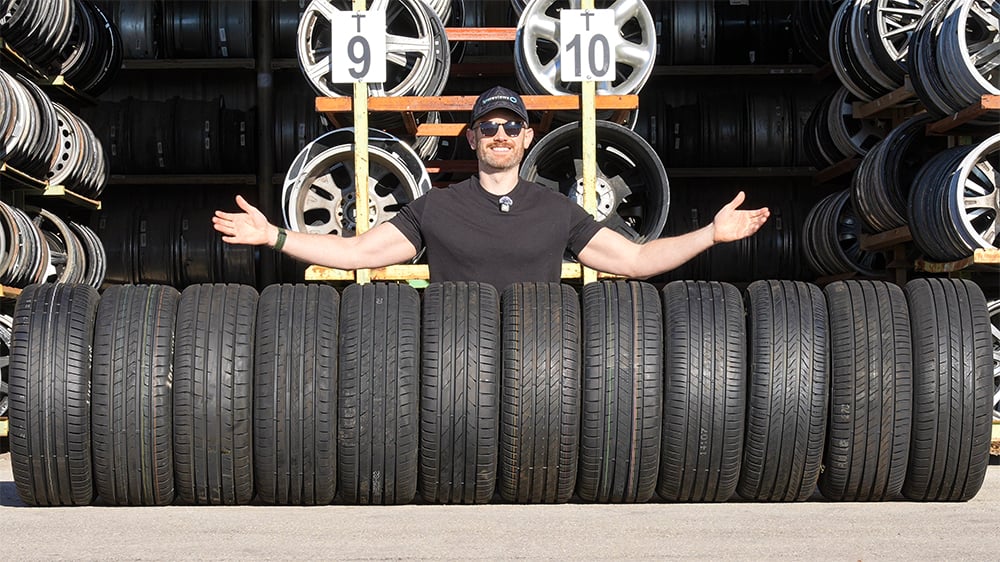
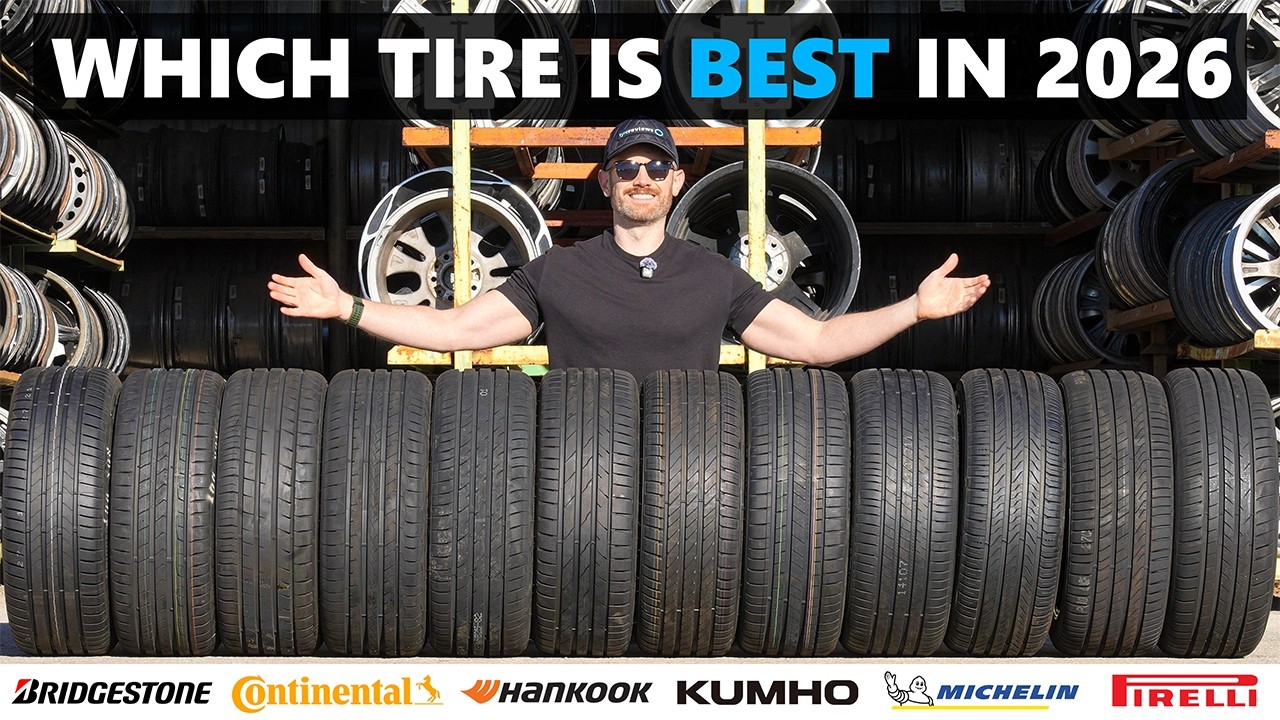
For the first of three tire review summer tire tests this year, I've tested 12 sets of tires in 225/45/17 using a Volkswagen Golf GTI.
All 12 sets of tires were purchased in the open market anonymously. As always, they have been tested in the dry, wet, noise, comfort, and rolling resistance tests to find out exactly which tire is best for your own driving needs.
Testing Methodology
Test Driver
Jonathan Benson
Tire Size
225/45 R17
Test Vehicle
VW Golf GTI
Test Location
Professional Proving Ground
Tire Pressures
35
Test Year
2026
Tires Tested
12
Show full testing methodologyHide methodology
Every tire is tested using calibrated instrumented measurement and structured subjective assessment. Reference tires are retested throughout each session to correct for changing conditions, ensuring fair, repeatable comparisons. Multiple reference sets are used where needed so that control tire wear does not affect accuracy.
We use professional-grade testing equipment including GPS data loggers, accelerometers, and calibrated microphones. All tires are broken in and conditioned before testing begins. For full details on our equipment, preparation process, and calibration procedures, see our complete testing methodology.
Categories Tested
Dry Braking
For dry braking, I drive the test vehicle at an entry speed of 110 km/h and apply full braking effort to a standstill with ABS active on clean, dry asphalt. I typically use an 100–5 km/h measurement window. My standard programme is five runs per tire set where possible, although the sequence can extend to as many as fifteen runs if conditions and tire category justify it. I analyse the full set of runs and discard statistical outliers before averaging. Reference tires are run repeatedly throughout the session to correct for changing conditions.
Dry Handling
For dry handling, I drive at the limit of adhesion around a dedicated handling circuit with ESC disabled where possible so I can assess the tire's natural balance, transient response, and limit behaviour without electronic intervention masking the result. I usually complete between two and five timed laps per tire set, depending on the circuit, tire type, and consistency of conditions. I exclude laps affected by clear driver error or obvious environmental inconsistency. Control runs are carried out frequently throughout the session, and I often use multiple sets of control tires so that wear on the references does not become a meaningful variable. For more track-focused products, I also do endurance testing, which is a set number of laps at race pace to determine tire wear patterns and heat resistance over longer driving.
Subj. Dry Handling
Objective data is only part of the picture, so I also carry out a structured subjective handling assessment at the limit of adhesion on a dedicated dry handling circuit. I score steering precision, steering response, turn-in behaviour, mid-corner balance, corner-exit traction, breakaway characteristics, and overall confidence using a standardised 1–10 scale used consistently across my testing. The final assessment combines numeric scoring with written technical commentary. I complete familiarisation laps on the control tire before evaluating each candidate.
Wet Braking
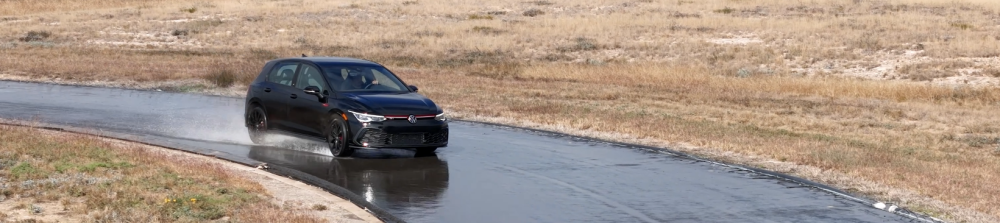
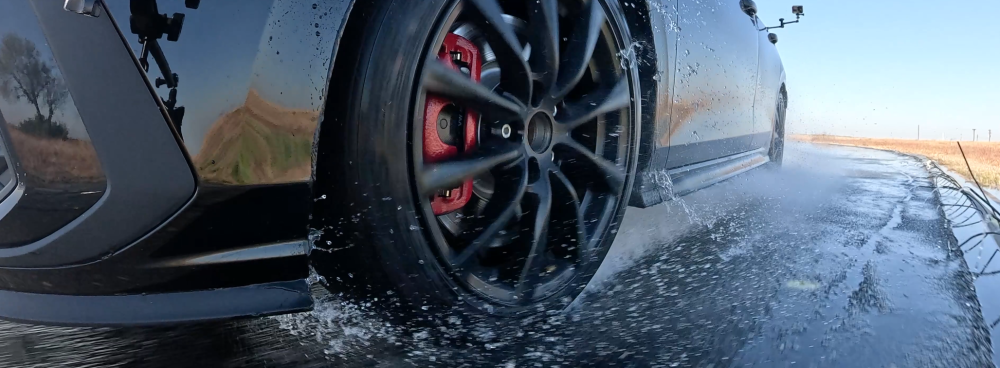
For wet braking, I drive the test vehicle at an entry speed of 88 km/h and apply full braking effort to a standstill with ABS active on an asphalt surface with a controlled water film. I typically use an 80–5 km/h measurement window to isolate tire performance from variability in the initial brake application. My standard programme is eight runs per tire set where possible, although the sequence can extend to as many as fifteen runs if conditions and tire category justify it. I analyse the full set of runs and discard statistical outliers before averaging. To correct for changing conditions, I run reference tires repeatedly throughout the session — in wet testing, typically every three candidate test sets.
Wet Handling
For wet handling, I drive at the limit of adhesion around a dedicated handling circuit. I generally use specialist wet circuits with kerb-watering systems designed to maintain a consistent surface condition. ESC is disabled where possible so I can assess the tire's natural balance, transient response, and limit behaviour without electronic intervention masking the result. I usually complete between two and five timed laps per tire set, depending on the circuit, tire type, and consistency of conditions. I exclude laps affected by clear driver error or obvious environmental inconsistency. Control runs are carried out frequently throughout the session, and I often use multiple sets of control tires so that wear on the references does not become a meaningful variable.
Subj. Wet Handling
Objective data is only part of the picture, so I also carry out a structured subjective handling assessment at the limit of adhesion on a dedicated wet handling circuit. I score steering precision, steering response, turn-in behaviour, mid-corner balance, aquaplaning resistance, breakaway characteristics, and overall confidence using a standardised 1–10 scale used consistently across my testing. The final assessment combines numeric scoring with written technical commentary. I complete familiarisation laps on the control tire before evaluating each candidate.
Wet Circle
For wet lateral grip testing, I use a circular track of fixed radius, typically between 30 and 50 metres, broadly aligned with ISO 4138 principles. The surface is wetted in a controlled and repeatable manner. I progressively increase speed until the maximum sustainable cornering speed is reached. I normally record multiple laps in both clockwise and counterclockwise directions to reduce the influence of camber, banking, or directional track bias. I then calculate average lateral acceleration and compare the result with the reference tire.
Straight Aqua
To measure straight-line aquaplaning resistance, I drive one side of the vehicle through a water trough of controlled depth, typically around 7 mm, while the opposite side remains on dry pavement. I enter at a fixed speed and then accelerate progressively. I define aquaplaning onset as the point at which the wheel travelling through the water exceeds a specified slip threshold relative to the dry-side reference wheel. I usually perform four runs per tire set and average the valid results.
Curved Aquaplaning
For curved aquaplaning, I use a circular track, typically around 100 metres in diameter, with a flooded arc of controlled water depth, usually about 7 mm. The vehicle is instrumented with GPS telemetry and a tri-axial accelerometer. I drive through the flooded section at progressively increasing speed, typically in 5 km/h increments, and record the minimum sustained lateral acceleration at each step. The test continues until lateral acceleration collapses, indicating complete aquaplaning. The result is expressed as remaining lateral acceleration in m/s² as speed rises.
Subj. Comfort
To assess comfort, I drive on a wide range of road surfaces (often dedicated comfort tracks at test facilities) at speeds from 50 to 120 km/h, including smooth motorway, coarse surfaces, expansion joints, broken pavement, and sharp-edged obstacles. I evaluate primary ride quality, secondary ride quality, impact harshness, seat-transmitted vibration, and the tire's ability to absorb sharp inputs. Ratings are assigned on a 1–10 scale relative to the reference tire.
Noise
I measure external pass-by noise in accordance with UNECE Regulation 117 and ISO 13325 using the coast-by method on a compliant test surface. Calibrated microphones are positioned beside the test lane, and the vehicle coasts through the measurement zone under controlled conditions. I record the maximum A-weighted sound pressure level in dB(A), complete multiple runs over the relevant speed range, and normalise the result to the reference speed required by the procedure.
Rolling Resistance
Rolling resistance is measured under controlled laboratory conditions in accordance with ISO 28580 and UNECE Regulation 117 Annex 6. The tire is mounted on a test wheel and loaded against a large-diameter steel drum. After thermal stabilisation at the prescribed test speed, rolling resistance force is measured at the spindle and corrected according to the relevant procedure. The result is expressed as rolling resistance coefficient, typically in kg/tonne.
How each category is weighted in the overall score:
Dry35%
Dry Braking45%
Dry Handling45%
Subj. Dry Handling10%
Wet50%
Wet Braking40%
Wet Handling30%
Subj. Wet Handling10%
Wet Circle5%
Straight Aqua10%
Curved Aquaplaning5%
Comfort5%
Subj. Comfort50%
Noise50%
Value10%
Rolling Resistance100%
Wet
The slowest tire in the wet was the Davanti, in a group of its own, significantly behind every other tire including the other cheap ones. It was difficult to drive, had no bite, and you really couldn't get it into or out of corners. One to avoid!
Next up were the Bridgestone and Goodride with similar lap times, though the Bridgestone was much nicer subjectively - lovely and predictable with a stable front axle. The Goodride, while posting a similar time, just wasn't as understandable and was the only tire where I almost fell off the track. Good Ride is not yet a good ride, but last time I tested it, it was a terrible ride, so they're improving. The Kleber and Vredestein were a step up in grip and both actually quite nice to drive. The Kleber almost felt sporty, which surprised me - as a Michelin sub-brand they've always taken on the Michelin ethos of safe, boring understeer. But while it still felt safe, it actually turned really nicely.
The Debica was an odd one. On its first lap it felt like a cheap tire, sliding at the back and difficult to get into corners. But once it had some heat in it, the second lap was significantly better - nearly a full second quicker, which is unusual as my delta between laps is normally about a tenth. On the road, especially in cooler conditions around 15 degrees, I think the lap time is probably over-promising what you'll get on the street.
The Michelin Primacy 5 was absolutely classic Michelin - understeer-y, very safe and easy to control. As always with the Primacy range, Michelin go for total life performance and excellent tread life, and I think that often hurts them in the wet because it's never the best tire in the wet. Once again it was just average in this group, but average and safe and very Michelin.
The Maxxis Premitra HP6 continued its recent strong wet form. My one quibble was that it was a little bit peaky around the limits of grip - you'd be turning and suddenly wouldn't get much notice about the breakaway. It took a little longer than average to recover, but its actual grip was excellent.
The Kumho Ecsta Sport did a very good job, finishing fourth in lap time. Subjectively, and this is a compliment, it didn't give me anything to worry about. I just got round the lap and thought "good job, no nasty surprises," which is one of the higher compliments I can pay a tire.
However, the Hankook, Pirelli and Continental were in a bubble of their own, showing that the Hankook can definitely mix with the big boys. The Hankook was incredible - I finally felt like I was attacking the surface and the car was going where I wanted it to. The Pirelli was even better, about half a second quicker with slightly sharper steering response, though its window between grip and no grip was narrower than the Hankook's, which is where it falls back slightly subjectively. The Continental Premium Contact 7 was a blend of the two - maybe not quite as direct as the Pirelli, but with a wide sliding window, making it the best all-rounder. These three tires are incredible. The Kumho did pretty well too, but anything below the top four could do with more grip to really be excellent in the wet.
Wet Handling
Spread: 12.17 s (18%)|Avg: 71.81 s
Wet handling time in seconds (Lower is better)
Continental PremiumContact 7
67.70 s
Pirelli Cinturato C3
68.09 s
Hankook Ventus Evo
68.69 s
Kumho Ecsta Sport PS72
70.46 s
Maxxis Premitra HP6
71.10 s
Michelin Primacy 5
71.35 s
Debica Presto UHP2
71.59 s
Vredestein Ultrac plus
71.86 s
Kleber Dynaxer HP5
72.07 s
Goodride Solmax 1
72.17 s
Bridgestone Turanza 6
72.65 s
Reference UHP All Season Ref
75.98 s
Davanti Protoura Sport
79.87 s
The top four in wet braking were the same as the top four in wet handling, just in a slightly different order, which happens when everything is this close at the top. I also ran a wet circle test, which further confirms the top four.
Wet Braking
Spread: 6.61 M (23.9%)|Avg: 29.46 M
Wet braking in meters (80 - 0 km/h) (Lower is better)
Hankook Ventus Evo
27.66 M
Pirelli Cinturato C3
27.68 M
Continental PremiumContact 7
27.73 M
Kumho Ecsta Sport PS72
28.38 M
Kleber Dynaxer HP5
29.12 M
Bridgestone Turanza 6
29.47 M
Goodride Solmax 1
29.53 M
Maxxis Premitra HP6
29.53 M
Michelin Primacy 5
29.73 M
Vredestein Ultrac plus
30.20 M
Debica Presto UHP2
30.23 M
Davanti Protoura Sport
34.27 M
In the deeper water of the aquaplaning test, the Hankook, Michelin and Continental all performed excellently, with a shout out to Debica, winning curved aquaplaning.
Straight Aqua
Spread: 8.78 Km/H (11.1%)|Avg: 74.39 Km/H
Float Speed in Km/H (Higher is better)
Hankook Ventus Evo
78.81 Km/H
Michelin Primacy 5
76.97 Km/H
Pirelli Cinturato C3
76.86 Km/H
Vredestein Ultrac plus
75.36 Km/H
Debica Presto UHP2
75.25 Km/H
Continental PremiumContact 7
74.88 Km/H
Maxxis Premitra HP6
74.59 Km/H
Kleber Dynaxer HP5
73.38 Km/H
Goodride Solmax 1
72.93 Km/H
Bridgestone Turanza 6
72.24 Km/H
Kumho Ecsta Sport PS72
71.43 Km/H
Davanti Protoura Sport
70.03 Km/H
Curved Aquaplaning
Spread: 0.60 m/sec2 (15.3%)|Avg: 3.64 m/sec2
Remaining lateral acceleration (Higher is better)
Debica Presto UHP2
3.92 m/sec2
Continental PremiumContact 7
3.85 m/sec2
Hankook Ventus Evo
3.84 m/sec2
Vredestein Ultrac plus
3.76 m/sec2
Michelin Primacy 5
3.72 m/sec2
Maxxis Premitra HP6
3.68 m/sec2
Goodride Solmax 1
3.59 m/sec2
Bridgestone Turanza 6
3.59 m/sec2
Kleber Dynaxer HP5
3.59 m/sec2
Pirelli Cinturato C3
3.42 m/sec2
Davanti Protoura Sport
3.37 m/sec2
Kumho Ecsta Sport PS72
3.32 m/sec2
Dry
In the dry handling test, the Goodride and Davanti were bad. The Goodride should have been faster but I made a mistake, usually I exclude these laps but it was so tricky to drive subjectively I thought it was ok to keep in.
Then you have the Bridgestone to Debica group, all fine grip, but not really suited to being on track. For this class of tire, braking and comfort is more important than dry handling, but the Debica was impressive for its pricepoint being lovely and easy to drive. If you don't know, Debica is a goodyear subbrand, I wonder if there's some old asymmetric technology in it.
The first to 5th place split by 1%.
The Maxxis was the real surprise, it didn't have the most grip as proven by the braking data, but it was the most drivable so ended up the fastest. This is the Tire Reviews top tip I know some of you are here for, if you want a cheaper 17" road tire that is fun on track, this might be the new product.
It's no surprise that Pirelli, Kumho, Conti and Hankook were all excellent. I'd like to give a nod to kumho. I've seen this tire tested a lot, and it's a really nice tire subjectively, as is the Hankook, both slightly ahead of the Pirelli dynamically, which itself was ahead of the Continental.
Dry Handling
Spread: 3.33 s (4.6%)|Avg: 74.21 s
Dry handling time in seconds (Lower is better)
Maxxis Premitra HP6
72.83 s
Pirelli Cinturato C3
72.97 s
Kumho Ecsta Sport PS72
73.15 s
Continental PremiumContact 7
73.29 s
Hankook Ventus Evo
73.48 s
Debica Presto UHP2
73.67 s
Vredestein Ultrac plus
74.52 s
Michelin Primacy 5
74.56 s
Kleber Dynaxer HP5
74.83 s
Bridgestone Turanza 6
74.91 s
Reference UHP All Season Ref
74.95 s
Davanti Protoura Sport
75.45 s
Goodride Solmax 1
76.16 s
Pirelli led dry braking, Continental was a close second, with Kumho 3rd. Interestingly, the Maxxis, which did well in the dry handling test, only placed ninth in dry braking, 7% behind the best.
Dry Braking
Spread: 6.74 M (18.9%)|Avg: 38.15 M
Dry braking in meters (100 - 0 km/h) (Lower is better)
Pirelli Cinturato C3
35.75 M
Continental PremiumContact 7
36.03 M
Kumho Ecsta Sport PS72
37.11 M
Hankook Ventus Evo
37.33 M
Bridgestone Turanza 6
37.45 M
Kleber Dynaxer HP5
37.98 M
Debica Presto UHP2
38.39 M
Michelin Primacy 5
38.39 M
Maxxis Premitra HP6
38.66 M
Goodride Solmax 1
38.86 M
Vredestein Ultrac plus
39.33 M
Davanti Protoura Sport
42.49 M
Comfort
Sadly, I didn't have the time to dig into the subjective comfort levels of the tires too much. I just did one quick lap of the comfort lanes before going off to handling. However, a colleague ran the test a few days earlier, so I'm using his scoring.
Overall, if comfort is your focus, the Michelin Primacy 5 and the Debica are good choices, though the Continental is also strong in comfort, if not a little noisier in the EU label external noise test. Basically, as always, they are all incredibly close. On my brief run around the comfort course, I found it difficult to notice many differences, even on the firm GTI suspension. Comfort amongst tires is definitely getting closer.
The only two that really struggled in comfort were the Goodride and the Davanti, but ironically they had the lowest external noise levels, so if noise is your thing, they are the ones to buy. But hopefully by now you have seen enough data to know not to buy them.
Subj. Comfort
Spread: 1.50 Points (21.1%)|Avg: 6.55 Points
Subjective Comfort Score (Higher is better)
Debica Presto UHP2
7.10 Points
Reference UHP All Season Ref
7.00 Points
Continental PremiumContact 7
6.90 Points
Michelin Primacy 5
6.90 Points
Kleber Dynaxer HP5
6.90 Points
Bridgestone Turanza 6
6.60 Points
Pirelli Cinturato C3
6.60 Points
Maxxis Premitra HP6
6.60 Points
Hankook Ventus Evo
6.50 Points
Vredestein Ultrac plus
6.40 Points
Kumho Ecsta Sport PS72
6.10 Points
Goodride Solmax 1
5.90 Points
Davanti Protoura Sport
5.60 Points
Noise
Spread: 3.50 dB (5%)|Avg: 72.10 dB
External noise in dB (Lower is better)
Davanti Protoura Sport
70.60 dB
Goodride Solmax 1
70.70 dB
Hankook Ventus Evo
70.70 dB
Michelin Primacy 5
70.90 dB
Debica Presto UHP2
71.00 dB
Kleber Dynaxer HP5
72.30 dB
Kumho Ecsta Sport PS72
72.30 dB
Reference UHP All Season Ref
72.30 dB
Vredestein Ultrac plus
72.60 dB
Bridgestone Turanza 6
72.80 dB
Continental PremiumContact 7
73.10 dB
Maxxis Premitra HP6
73.90 dB
Pirelli Cinturato C3
74.10 dB
Value
The rolling resistance levels, or energy use of the tires were interesting. For some reason, Bridgestone had a 10% lead over the next best tire, which was the Michelin Primacy 5, and that in itself was nearly 10% better than the average of the rest of the tires. There are clearly some different opinions on the levels of rolling resistance these tires should have, and that does explain the Bridgestone's relatively weak wet grip, as low rolling resistance and good wet grip are opposing performance qualities.
Rolling Resistance
Spread: 3.10 kg / t (48%)|Avg: 8.11 kg / t
Rolling resistance in kg t (Lower is better)
Bridgestone Turanza 6
6.46 kg / t
Michelin Primacy 5
7.12 kg / t
Maxxis Premitra HP6
7.69 kg / t
Vredestein Ultrac plus
7.73 kg / t
Kleber Dynaxer HP5
7.81 kg / t
Kumho Ecsta Sport PS72
8.14 kg / t
Davanti Protoura Sport
8.16 kg / t
Pirelli Cinturato C3
8.27 kg / t
Debica Presto UHP2
8.29 kg / t
Continental PremiumContact 7
8.43 kg / t
Hankook Ventus Evo
8.84 kg / t
Goodride Solmax 1
8.95 kg / t
Reference UHP All Season Ref
9.56 kg / t
19,000 km
£1.45/L
8.0 L/100km
--
Annual Difference
--
Lifetime Savings
--
Extra Fuel/Energy
--
Extra CO2
Estimates based on typical driving conditions. Rolling resistance accounts for approximately 20% of IC vehicle fuel consumption and 25% of EV energy consumption. Actual savings vary based on driving style, vehicle weight, road conditions, and tire age. For comparative purposes only. Lifetime savings based on a 40,000km / 25,000 mile tread life.
Results
I've used the standard score weighting I've always used for this category of tires to keep it fair and consistent, but as always, you can go to the 'Results Table' tab and adjust the score weighting for your own driving needs eg if you would prefer a more comfort bias results set or lower rolling resistance etc, you can go and do that. I've actually improved this functionality a lot in the past few months. It is well worth checking out.
Top-level grip in both dry and wet, with an easy, confidence-building balance when you push on.
Measured noise was the worst here, and standing-water performance was only mid-pack.
The Pirelli Cinturato C3 finished joint wins the test with the Continental Premium Contact 7. The C3 was best in dry braking and stayed right at the front across the wet tests, including near-best wet braking and 2nd in wet handling and wet circle. Subjectively it also scored at the top for dry handling and very high in the wet, which matched how easy it was to drive quickly. The compromises were refinement and water performance: it recorded the highest measured noise in the test and only mid-pack curved aquaplaning, plus rolling resistance was only average.
Best wet performance overall, combining very fast lap times with strong aquaplaning resistance.
Efficiency and measured noise were below average, and it didn't feel as sporty or supported as the most track-leaning tires.
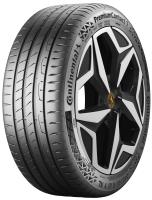
The Continental PremiumContact 7 finished a joint test winner with the Pirelli Cinturato C3. The PC7 set the quickest wet handling time and was also 1st on the wet circle, while staying very close to the best in wet braking and near the top for curved aquaplaning. Dry results were still competitive, but it only managed 4th in dry handling and my notes describe a safe balance without the body control of the more enthusiast-focused tires. Comfort was solid rather than standout, and rolling resistance sat towards the back of the group.
Best wet braking and aquaplaning performance, with a sporty feel and excellent confidence at the limit.
Rolling resistance was near the bottom, and dry braking wasn't at the same level as the test winners.
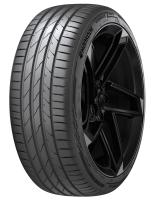
The Hankook Ventus Evo finished 3rd overall and earned a Highly Recommended award. It delivered the best wet braking and the highest straight-line aquaplaning result, backed up by a front-running wet handling time and the highest subjective wet handling score. In the dry it stayed in the leading group, with a strong handling result and one of the top subjective dry scores. The main weakness in this dataset is efficiency, where rolling resistance was near the bottom, and it didn't match the very shortest dry braking distances.
A strong blend of dry and wet grip with sporty, predictable steering and a high-confidence feel.
Aquaplaning resistance was near the bottom and comfort scores were in the lower part of the group.
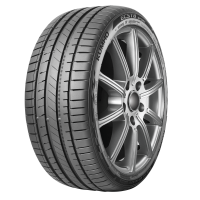
The Kumho Ecsta Sport PS72 finished joint 4th overall and earned a Recommended award. It was consistently near the front for objective grip with top-four placements across wet and dry braking and handling, and it backed that up with one of the top subjective dry handling scores and a strong subjective wet score. My notes repeatedly mention steering and predictability, which fits the balanced results. Its clear weaknesses were aquaplaning performance, where it was low in both straight and curved tests, and comfort, where it sat towards the back on subjective scoring.
Best in test for efficiency, giving a clear rolling resistance advantage over everything else here.
Wet handling pace was well behind the leaders, and it didn't have the bite or grip level I expected in the wet.
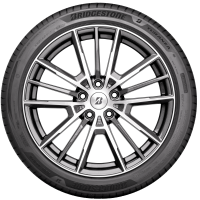
The Bridgestone Turanza 6 finished joint 4th overall, mainly because it was 1st in rolling resistance. In braking it was mid-pack in both wet and dry, but in the wet it gave away a lot of time compared to the top tires and my notes mention a lack of bite when turning and braking, plus a couple of hydroplaning moments. In the dry it felt touring-focused with understeer and a step down in grip once hot. If efficiency is your priority it makes sense, but it's not a wet performance choice in this group.
A quiet, comfortable, efficient road tire with a stable, safe balance in both wet and dry driving.
Grip-based results were mostly mid-pack, so it isn't a front-runner for braking or handling pace.
The Michelin Primacy 5 finished 6th overall and earned a Recommended award. It was one of the more road-leaning tires in the test, combining 2nd best rolling resistance with good comfort results, including a strong subjective comfort score and a good measured noise reading. In wet aquaplaning it did well in the straight-line test, but objective wet grip was more mid-pack and the wet circle result was towards the back. Dry performance followed a similar pattern: safe and usable, but not a leader for braking or handling.
A very even all-rounder with predictable behaviour and no big weaknesses across the main tests.
It didn't have the outright wet or dry lap time pace to run with the leading group.
The Kleber Dynaxer HP5 finished 7th overall. It delivered a very even set of results: mid-pack in wet braking, dry braking, wet handling and dry handling, plus decent aquaplaning and a solid rolling resistance figure. Subjectively it also landed around the middle with a good wet handling score and a strong comfort score. My wet notes were positive about predictability and smooth transitions, but the lap time data shows it didn't have the final step of grip to match the tires at the front.
Fastest on the dry handling course with a sporty, track-friendly feel and strong steering response.
Wet confidence at the limit was low on subjective scoring compared with its objective wet pace.
The Maxxis Premitra HP6 finished 8th overall, but it had one clear highlight: it was 1st in dry handling time and also scored in the top group for subjective dry handling. It also delivered a strong rolling resistance result compared with several performance-focused tires. In the wet, the objective results were decent in the middle group, but the subjective wet handling score was in the bottom group, which suggests the way it reached and went past the limit in the wet wasn't as confidence-inspiring as the stopwatch alone.
Very strong comfort and standing-water resistance, with a surprisingly sporty dry handling feel for the price point.
Wet braking and wet confidence were only mid-pack, and its behaviour changed a lot between cold and warm running.
The Debica Presto UHP2 finished 9th overall. It stood out for comfort and aquaplaning, with the highest subjective comfort score and the best curved aquaplaning result. Dry handling was also relatively strong for its finishing position, supported by a high subjective dry score, and my dry notes were very positive about steering response and adjustability. The weaknesses were in wet grip, where wet braking and subjective wet handling were in the lower half, and my wet notes describe very different cold versus warm behaviour, making it harder to predict in changing conditions.
Good wet stability with strong aquaplaning results and sensible efficiency for an everyday road tire.
Dry performance and subjective dry handling were below average, and it overheated quickly when driven hard.
The Vredestein Ultrac plus finished 10th overall. In the wet it was generally solid, with good straight-line aquaplaning and a strong curved aquaplaning result, plus mid-pack wet handling and a sensible rolling resistance figure. Subjectively it also sat around the middle in the wet, and my notes mention good communication even if it wasn't the sharpest. In the dry it dropped back with below-average dry braking and a low subjective dry handling score, and my dry notes mention understeer and overheating quickly on track.
Poor dry handling and weak efficiency, with abrupt transitions and low confidence at the limit.
The Goodride Solmax 1 finished 11th overall. It had a couple of positives in the data, including one of the better measured noise results and a mid-pack wet braking distance. However, the core performance results were mostly towards the back: it was slowest in dry handling, last in subjective dry handling, and rolling resistance was also near the bottom. In the wet, both objective and subjective handling results were in the lower half, and my notes repeatedly mention abrupt transitions and poor communication at and beyond the limit.
The best measured noise result in the test, so it can look refined on a simple dB reading.
Worst in the key wet grip tests, with weak braking and handling and poor communication at the limit.
The Davanti Protoura Sport finished 12th overall. It recorded the lowest measured noise, but the performance results put it at the back where it matters: last in wet handling, last on the wet circle, and 12th in wet braking, plus weak straight aquaplaning. Dry results were also towards the bottom, including low positions in dry braking and subjective dry handling. My wet notes describe weak turn-in, low braking confidence and abrupt breakaway, and the large gaps in wet lap time and braking distance show it wasn't close to the main group in this test.
I really appreciate your tests. However, after sitting in tire comfort and stability for tens of years ... I have to emphasise that not explicitly stating or even mixing LIs (91 vs 94) is just misunderstanding of these comfort and stability issues. All the best!
Is it intentional to have mixed max performance and touring segments? It’s too bad that the Asy6 wasn’t available as it’s a good bridge between the 2 segments.
I see in the results charts that the Hankook has top marks in both subjective handlings, while in the video, you seem to say that the Pirelli has a better dynamic feeling, despite being a touring tire. Which one would you actually prefer? In the other sizes, the Continental seems to have a better dynamic behaviour vs the Pirelli (cf. https://www.tyrereviews.com/Compare/PremiumContact-7-VS-Cinturato-C3.htm ), but you say otherwise here, and as it is the more expensive option, I ruled it out.
I’ve dug into the comparisons on the website for the Hankook vs the others (GY F1 Asy 6, PS5, Potenza Sport Evo, and also the CPC7 despite your test), and the Hankook seems to win almost always on the braking and handling. This is the only test in which the Hankook and the Pirelli are confronted, so I’m struggling to decide.
Which Hankook model did you use in the test?? 1. Hankook Ventus S1 Evo 2 K117 2. Hankook Ventus S1 Evo 2 K117B HRS 3. Hankook Ventus S1 Evo 3 K127 4.Hankook Ventus evo K137 5. Hankook Ventus V12 Evo 2 K120
The summer tire test I was waiting for, very useful for choosing the right tires for my roads and driving style. Is the reference UHP All Season the Michelin CrossClimate 3 Sport? Would’ve been nice to see it compared with the others in dry and wet braking too.
Really interesting test, what really surprises me is the diffrent category of tires from each brand and how similar they perform. For example I would expect the Michelin pilot sport 5 to be compared to the Hankook Evo, not the primacy 5 that is a direct competitor of the Ventus Prime 4. Same with Pirelli, Kumho etc where some had their UHP offers and others their touring. Big one missing here is the Falken (either FK520 or ZE320).
What is really surprising is that the performance of UHP and touring tires both in comfort and wet/dry is really mixed between the two categories, with no clear distinctions between the two. I'd expect the uhp tires to strugle a bit in the comfort segment and the tourings in grip.
Good job as always looking forward for the next tests. Thanks for all the great work and data you provide to us!




As always, excellent test.
Is it intentional to have mixed max performance and touring segments?
It’s too bad that the Asy6 wasn’t available as it’s a good bridge between the 2 segments.
I see in the results charts that the Hankook has top marks in both subjective handlings, while in the video, you seem to say that the Pirelli has a better dynamic feeling, despite being a touring tire. Which one would you actually prefer?
In the other sizes, the Continental seems to have a better dynamic behaviour vs the Pirelli (cf. https://www.tyrereviews.com/Compare/PremiumContact-7-VS-Cinturato-C3.htm ), but you say otherwise here, and as it is the more expensive option, I ruled it out.
I’ve dug into the comparisons on the website for the Hankook vs the others (GY F1 Asy 6, PS5, Potenza Sport Evo, and also the CPC7 despite your test), and the Hankook seems to win almost always on the braking and handling. This is the only test in which the Hankook and the Pirelli are confronted, so I’m struggling to decide.
No Goodyear EfficientGrip Performance 2 or F1 AS6? Why so?
He said in the video that he couldn’t get the AS6 in time for the test, which is really a shame.
Which Hankook model did you use in the test??
1. Hankook Ventus S1 Evo 2 K117
2. Hankook Ventus S1 Evo 2 K117B HRS
3. Hankook Ventus S1 Evo 3 K127
4.Hankook Ventus evo K137
5. Hankook Ventus V12 Evo 2 K120
The same as is listed, the Hankook Ventus Evo
It’s the K137A, actually, AKA the S1 Evo 4.
The summer tire test I was waiting for, very useful for choosing the right tires for my roads and driving style.
Is the reference UHP All Season the Michelin CrossClimate 3 Sport? Would’ve been nice to see it compared with the others in dry and wet braking too.
No it's actually an American UHP all season tire, I should really get that deleted from the results as it was just used for evolution benchmarking.
In the Youtube video and in some tire comparisons there's a reference to a wet circle test but it doesn't show in this article.
Try the "test charts" link at the top and it should be in there!
Got it! Thanks!
Really interesting test, what really surprises me is the diffrent category of tires from each brand and how similar they perform. For example I would expect the Michelin pilot sport 5 to be compared to the Hankook Evo, not the primacy 5 that is a direct competitor of the Ventus Prime 4. Same with Pirelli, Kumho etc where some had their UHP offers and others their touring. Big one missing here is the Falken (either FK520 or ZE320).
What is really surprising is that the performance of UHP and touring tires both in comfort and wet/dry is really mixed between the two categories, with no clear distinctions between the two. I'd expect the uhp tires to strugle a bit in the comfort segment and the tourings in grip.
Good job as always looking forward for the next tests. Thanks for all the great work and data you provide to us!
One of the better comparisons i've seen. Detailed and transparent. Well done.