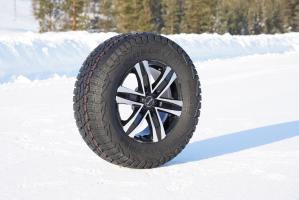
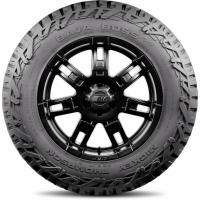
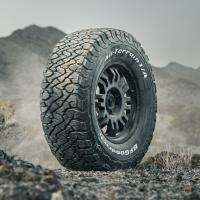
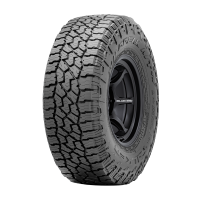
For this test I have taken five of the most popular snow-rated all-terrain tires in LT 265/70 R17 and tested them in snow and ice to find out which one is best for the upcoming winter!
In order to give you the complete picture, each tire has been tested and rated in snow handling, snow circle, snow traction and braking, and ice traction and braking!
Testing Methodology
Test Driver
Jonathan Benson
Tire Size
265/70 R17
Test Vehicle
Ford F-150
Test Location
Professional Proving Ground
Test Year
2025
Tires Tested
5
Show full testing methodologyHide methodology
Every tire is tested using calibrated instrumented measurement and structured subjective assessment. Reference tires are retested throughout each session to correct for changing conditions, ensuring fair, repeatable comparisons. Multiple reference sets are used where needed so that control tire wear does not affect accuracy.
We use professional-grade testing equipment including GPS data loggers, accelerometers, and calibrated microphones. All tires are broken in and conditioned before testing begins. For full details on our equipment, preparation process, and calibration procedures, see our complete testing methodology.
Categories Tested
Snow Braking
For snow braking, I drive the test vehicle at an entry speed of 50 km/h and apply full braking effort to a standstill with ABS active on a groomed, compacted snow surface, measuring 45-5 km/h. I generally use a wide VDA (vehicle dynamic area) and progressively move across the surface between runs so that no tire ever brakes on the same piece of snow twice. My standard programme is twelve runs per tire set, although the sequence can extend further if the data justify it. I analyse the full set of runs and discard statistical outliers before averaging. The surface is regularly groomed throughout the session. To correct for changing snow surface conditions, I run reference tires repeatedly — typically every two candidate test sets.
Snow Traction
For snow traction, I accelerate the vehicle from rest on a groomed snow surface with traction control active and measure speed and time using GPS telemetry. I typically use a 5–35 km/h measurement window to reduce the influence of launch transients and powertrain irregularities. I use a wide VDA (vehicle dynamic area) and progressively move across the surface between runs so that no tire ever accelerates on the same piece of snow twice. The surface is regularly groomed throughout the session. I complete multiple runs per tire set and average the valid results. Reference tires are run typically every two candidate test sets to correct for changing snow surface conditions.
Snow Handling
For snow handling, I drive at the limit of adhesion around a dedicated snow handling circuit with ESC disabled where possible. The circuit is groomed and prepared after every run while tires are being changed, so each set runs on a consistently prepared surface. I usually complete between two and five timed laps per tire set, excluding laps affected by clear driver error or obvious environmental inconsistency. Because snow surfaces degrade more rapidly than asphalt, control runs are carried out more frequently — typically every two candidate test sets.
Subj. Snow Handling
Objective data is only part of the picture, so I also carry out a structured subjective handling assessment at the limit of adhesion on a dedicated snow handling circuit. The circuit is groomed and prepared after every run while tires are being changed, so each set runs on a consistently prepared surface. I score steering precision, turn-in behaviour, mid-corner balance, corner-exit traction, breakaway characteristics, and overall confidence on snow using a standardised 1–10 scale used consistently across my testing. The final assessment combines numeric scoring with written technical commentary. I complete familiarisation laps on the control tire before evaluating each candidate.
Snow Circle
For snow lateral grip testing, I use a circular snow track of fixed radius, broadly aligned with ISO 4138 principles. The surface is regularly groomed throughout the session. I progressively increase speed until the maximum sustainable cornering speed is reached. I normally record multiple laps in both clockwise and counterclockwise directions to reduce the influence of surface bias. Because snow surfaces degrade more rapidly, the control tire is retested at regular intervals and I often use multiple sets of control tires.
Ice Braking
For ice braking, I drive the test vehicle at an entry speed of 35 km/h and apply full braking effort to a standstill with ABS active on a prepared ice surface. Surface temperature is continuously monitored as ice friction properties vary substantially with temperature. My standard programme is twelve runs per tire set but with ice testing, you often do many more. I analyse the full set of runs and discard statistical outliers before averaging. Reference tires are run typically every two candidate test sets to correct for changing surface conditions.
Ice Traction
For ice traction, I accelerate the vehicle from rest on a prepared ice surface with traction control active and measure speed and time using GPS telemetry. I typically use a 5–35 km/h measurement window to reduce the influence of launch transients. I use a wide VDA (vehicle dynamic area) and progressively move across the surface between runs so that no tire ever accelerates on the same piece of ice twice. Surface temperature is continuously monitored. I complete multiple runs per tire set and average the valid results, with reference tires run typically every two candidate test sets.
The snow handling tests did not go as I expected. I thought we'd have quite a lot of differences between the five sets, and in handling at least, I was wrong! Well, sort of.
The Falken Wildpeak AT4W was, once again, down on its rivals. All these tires are three-peak marked, which means they're severe snow rated, and the Falken will get you moving in a pinch, but it was 9 seconds off the best which is quite a lot. Subjectively that is quite a big drop too—the tire broke into slides earlier, you had to be very delicate on the throttle, and when you were past the limit of grip it took a long time to recover. Falken has told me that the LT version of the tire has less snow grip than the P-metric version. One day I hope to test that version.
Then in a near tie, we had the Nokian Outpost nAT, Toyo Open Country AT, and BFGoodrich All-Terrain KO3.
The Nokian and Toyo were lovely and rounded to drive, meaning the grip circle felt even and it was predictable and easy to place. The BFGoodrich felt like it was great in traction, but didn't quite have the initial bite of the best when turning. However, as traction is very important on a truck like this, it produced the lap time. We knew the KO2 was very good in the snow, and the KO3 is too—we've now proven that.
The surprise of the group for me was the Mickey Thompson. Coming out of the garage, this tire felt heavy and industrial. Even on snow it felt like a blunt instrument—it was slow to respond on the front axle and didn't give much feedback, so you didn't feel that confident turning. This means that when, at the end of the first lap, it posted a time 9 seconds faster than the previous tire I'd just run, which turned out was the Falken, I was gobsmacked. Naturally I did some more laps, and it really held that pace so it wasn't a fluky one-off lap. The Baja Boss AT might not look or act the most graceful, but damn it has some grip.
Finally, how do these stack up against a real winter tire? You've probably heard of the Nokian Hakkapeliitta range—at least at time of testing it's widely considered to be the best winter tire in the snow, so it's a tough benchmark. The F-150 had some used Nokian winter tires on it, so I ran them too. Even in their used state, they were still way faster than any of the all-terrains, but the controllability was even more impressive. You went from being nervous to thinking you were the Alabama version of Colin McRae. There really is quite a difference—a snow-rated all-terrain tire is no substitute for a real winter tire if you live in a severe winter climate.
Snow Handling
Spread: 15.23 s (16.4%)|Avg: 100.64 s
Snow handling time in seconds [Average Temperature -7c] (Lower is better)
Reference Winter Nordic Ref
92.70 s
Mickey Thompson Baja Boss AT
98.82 s
BFGoodrich All Terrain TA KO3
101.09 s
Toyo Open Country AT III
101.50 s
Nokian Outpost nAT
101.78 s
Falken Wildpeak AT4W
107.93 s
The Mickey Thompson was again the best in snow braking with the Nokian a close second, then a small gap to BFGoodrich in third, and then the Falken and Toyo not performing particularly well.
Snow Braking
Spread: 2.30 M (10.7%)|Avg: 22.63 M
Snow braking in meters (40 - 5 km/h) [Average Temperature -13c] (Lower is better)
Mickey Thompson Baja Boss AT
21.44 M
Nokian Outpost nAT
21.79 M
BFGoodrich All Terrain TA KO3
22.63 M
Falken Wildpeak AT4W
23.57 M
Toyo Open Country AT III
23.74 M
The traction test had the BFGoodrich back at the front, which confirms my theory that BFGoodrich have really focused on traction with the KO3, with the Nokian again in second, this time tied with Toyo. We're starting to see that the Nokian is strong in all snow tests, and sadly for the Falken, it is weak in all the snow tests.
Snow Traction
Spread: 0.43 s (12.1%)|Avg: 3.72 s
Snow acceleration time (5 - 40 km/h) [Average Temperature -13c] (Lower is better)
BFGoodrich All Terrain TA KO3
3.55 s
Toyo Open Country AT III
3.64 s
Nokian Outpost nAT
3.64 s
Mickey Thompson Baja Boss AT
3.77 s
Falken Wildpeak AT4W
3.98 s
Ice
I also performed smooth ice traction and braking. I've said it before—even with an indoor ice tunnel for consistent surface conditions and repeated runs for averaging, ice is still a hard test, especially when none of the tires have been designed for smooth ice use. I almost didn't do the test, but I know you'll want it.
The Nokian proved to be on average the best, with the best braking and reasonable traction, though the Mickey Thompson was again also strong, and the Toyo had good traction.
Ice Braking
Spread: 1.81 M (16%)|Avg: 12.62 M
Ice braking in meters (20 - 5 km/h) [Average Temperature -9c] (Lower is better)
Nokian Outpost nAT
11.33 M
Mickey Thompson Baja Boss AT
12.80 M
Falken Wildpeak AT4W
12.89 M
Toyo Open Country AT III
12.94 M
BFGoodrich All Terrain TA KO3
13.14 M
Interestingly, the BFGoodrich All-Terrain KO3, which I've always thought of as the benchmark for an all-terrain tire in winter conditions, could NOT get it together on ice and was firmly last in both traction and braking. This is really interesting, and I don't have an explanation for it yet. Follow Tire Reviews on Instagram and if I get the answer I'll post it there.
Ice Traction
Spread: 0.31 s (17.2%)|Avg: 1.98 s
Ice acceleration time (5 - 20 km/h) [Average Temperature -9c] (Lower is better)
Well, based on my score weighting, which can be adjusted on results tab above, the Nokian Outpost nAT is on average, the best all terrain tire for the winter. While it's only standout was ice braking, it was well rounded and consistent across all the tests, without any huge flaws which led to a solid first place.
Second place went to the Mickey Thompson Baja Boss AT, which was a very impressive product. I was really surprised by this tires performance, it wasn't the easiest to drive around the but it's grip was excellent.
Third place with this score weighting goes to the Toyo Open Country ATIII, I always enjoy driving this tire whatever the conditions, and it had good traction in all tests, but did seem to give up a little braking performance to get that traction.
In fourth place is the BFgoodrich All Terrain KO3. Now, this is one of those results where score weighting really matters. The KO3 Is a VERY strong tire in the snow, essentially drawing with the Nokian, so if you really don't care about ice it's top 2, and if all you care about is snow traction, it is the best. But with this score weighting, which includes ice as 25% of the overall result, that drops it down in this close group.
The Falken Wildpeak AT4W. finishes a disappointing last place. We've now seen in multiple tests that the LT version at least, has given up some snow performance to get that improved wear resistance over the AT3W. This means it is the only tire of this test I would not rush to use in the winter, but I plan to test all of these and more in the dry, wet and offroad next year, I'm I'm sure the AT4W will shine there.