



Vi Bilägare evaluated eight different tire models in the popular SUV size of 235/60 R18. The test, featured in issue number 12, utilized a Volvo XC60 AWD as the primary vehicle to assess performance on ice, snow, and both wet and dry asphalt. The lineup included five premium brands—Continental, Goodyear, Michelin, Nokian, and Pirelli—alongside three more budget-focused offerings from Nexen, Goodride, and Triangle.
Test setup & methodology
The test setting, the conditions recorded and how the results contribute to the score.
Recorded test conditions
Recorded test conditions
- Dry Braking
- 62.1 → 3.1 mph
- Snow Braking
- 21.7 → 3.1 mph
- Snow Traction
- 3.1 → 21.7 mph
- Ice Braking
- 15.5 → 3.1 mph
- Ice Traction
- 3.1 → 15.5 mph
The test highlights the significant engineering compromises required when designing tires for heavy, powerful SUVs. The testers note that the performance gaps between the tires were larger than they typically see with smaller passenger car tires. A central theme is the direct trade-off between performance on ice and performance on wet asphalt, with the article stating that ice grip and wet grip are "opposites of each other". This conflict between competing characteristics is a recurring point, demonstrating that no single tire excels in all conditions.
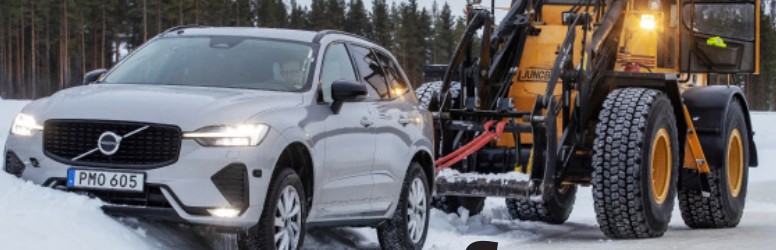
This variability in performance is clearly illustrated by the results. The test winner, the Nokian Hakkapeliitta 10, delivered the best grip and handling on ice and snow but simultaneously had the longest braking distance on wet roads and the lowest resistance to aquaplaning. Conversely, the Triangle IceLynk TI501 produced a startlingly polarized result. Despite being a studded tire, its performance on ice was described as a "total lack" of grip, with braking distances more than double that of the top performers. However, the Triangle tire recorded the shortest braking distances of the entire group on both wet and dry asphalt.
Other tires showcased more balanced, if less specialized, performance. The second-place Goodyear UltraGrip Arctic 2 was commended for providing a good balance between its ice and wet grip capabilities. The Continental IceContact 3, despite its name, showed a weakness on ice but was a strong and stable performer on snow and asphalt. Ultimately, the test demonstrates that for heavy SUVs, tire choice involves a critical evaluation of performance trade-offs, with even premium manufacturers prioritizing different characteristics in their designs.
Dry
On a dry surface, the Triangle delivers the best braking performance, while the Goodyear and Michelin require the longest distance to come to a stop.
Dry Braking
Dry braking in feet (62 - 3 mph)
Lower is better ↓| Position / Tire | Result | Gap to best | Residual speed |
|---|---|---|---|
| 145 ft | Best | 0 mph | |
| 148 ft | +3 ft | 10 mph | |
| 148 ft | +3 ft | 12 mph | |
| 150 ft | +5 ft | 14 mph | |
| 151 ft | +6 ft | 15 mph | |
| 151 ft | +6 ft | 16 mph | |
| 154 ft | +9 ft | 19 mph | |
| 155 ft | +10 ft | 20 mph |
The difference between best and worst was 6.6% (10 ft ≈ 0.6 Car Lengths). From 80 mph, the Michelin X Ice North 4 SUV would still be travelling at 20 mph when the Triangle IcelynX TI501 had stopped.
Residual speed is calculated from the measured braking distances, assuming constant deceleration; it is not a separate measurement.
Based on subjective feel, the Pirelli, Continental, and Michelin tires performed best on dry roads, while the Triangle and Goodride felt vague and unresponsive.
Subj. Dry Handling
Subjective Dry Handling Score
Higher is better ↑| Position / Tire | Result | Gap to best |
|---|---|---|
| 5 Points | Best | |
| 5 Points | Best | |
| 5 Points | Best | |
| 4 Points | -1.00 Points | |
| 4 Points | -1.00 Points | |
| 4 Points | -1.00 Points | |
| 3 Points | -2.00 Points | |
| 2 Points | -3.00 Points |
The difference between best and worst was 60% (3 Points).
Wet
Demonstrating the trade-off with ice grip, the Triangle tire provides the shortest wet braking distance by a clear margin, while the ice-focused Michelin and Nokian tires require the most distance to stop.
Wet Braking
Wet braking in feet
Lower is better ↓| Position / Tire | Result | Gap to best |
|---|---|---|
| 142 ft | Best | |
| 153 ft | +11 ft | |
| 154 ft | +12 ft | |
| 157 ft | +15 ft | |
| 158 ft | +16 ft | |
| 159 ft | +17 ft | |
| 163 ft | +21 ft | |
| 166 ft | +24 ft |
The difference between best and worst was 17.3% (24 ft ≈ 1.7 Car Lengths).
The Pirelli tire was the fastest and most controllable around the wet handling circuit, whereas the Triangle was the slowest due to severe understeer.
Wet Handling
Wet handling time in seconds
Lower is better ↓| Position / Tire | Result | Gap to best |
|---|---|---|
| 63.31 s | Best | |
| 63.46 s | +0.15 s | |
| 63.71 s | +0.40 s | |
| 63.96 s | +0.65 s | |
| 64.09 s | +0.78 s | |
| 64.78 s | +1.47 s | |
| 64.79 s | +1.48 s | |
| 64.79 s | +1.48 s |
All the tires in the Wet Handling test finished less than 3% apart.
The Pirelli and Nexen tires offer the best resistance to aquaplaning, while the test-winning Nokian is the most susceptible to losing grip in deep standing water
Straight Aqua
Float Speed in mph
Higher is better ↑| Position / Tire | Result | Gap to best |
|---|---|---|
| 44.4 mph | Best | |
| 43.8 mph | -0.6 mph | |
| 43.1 mph | -1.3 mph | |
| 42.8 mph | -1.6 mph | |
| 42.6 mph | -1.8 mph | |
| 42.3 mph | -2.1 mph | |
| 42.1 mph | -2.3 mph | |
| 41.0 mph | -3.4 mph |
The difference between best and worst was 7.7% (3.4 mph).
Snow
The braking distances on snow show only marginal differences between the tested tires, with the Nexen requiring a slightly longer distance to stop.
Snow Braking
Snow braking in feet (22 - 3 mph)
Lower is better ↓| Position / Tire | Result | Gap to best | Residual speed |
|---|---|---|---|
| 37 ft | Best | 0 mph | |
| 37 ft | 0 ft | 6 mph | |
| 37 ft | 0 ft | 8 mph | |
| 37 ft | 0 ft | 8 mph | |
| 37 ft | 0 ft | 11 mph | |
| 37 ft | 0 ft | 11 mph | |
| 37 ft | 0 ft | 12 mph | |
| 39 ft | +2 ft | 19 mph |
The difference between best and worst was 6.2% (2 ft). From 80 mph, the Nexen WinGuard WinSpike 3 would still be travelling at 19 mph when the Continental IceContact 3 had stopped.
Residual speed is calculated from the measured braking distances, assuming constant deceleration; it is not a separate measurement.
On snow, the acceleration grip is much more evenly matched between the tires, with only the Nexen showing a noticeable disadvantage.
Snow Traction
Snow acceleration time (3 - 22 mph)
Lower is better ↓| Position / Tire | Result | Gap to best |
|---|---|---|
| 1.77 s | Best | |
| 1.78 s | +0.01 s | |
| 1.79 s | +0.02 s | |
| 1.79 s | +0.02 s | |
| 1.8 s | +0.03 s | |
| 1.83 s | +0.06 s | |
| 1.85 s | +0.08 s | |
| 1.9 s | +0.13 s |
The difference between best and worst was 7.3% (0.13 s).
Nokian was the fastest on the snow handling course with excellent control, while Goodride and Triangle were the slowest and least predictable.
Snow Handling
Snow handling time in seconds
Lower is better ↓| Position / Tire | Result | Gap to best |
|---|---|---|
| 68.4 s | Best | |
| 68.6 s | +0.20 s | |
| 69.1 s | +0.70 s | |
| 69.6 s | +1.20 s | |
| 70.2 s | +1.80 s | |
| 71.9 s | +3.50 s | |
| 72.2 s | +3.80 s | |
| 72.3 s | +3.90 s |
The difference between best and worst was 5.7% (3.9 s).

Ice
Nokian delivers the shortest braking distance on ice, with Goodyear and Michelin also impressing, whereas the Triangle's stopping distance is more than double that of the leader.
Ice Braking
Ice braking in feet (16 - 3 mph)
Lower is better ↓| Position / Tire | Result | Gap to best | Residual speed |
|---|---|---|---|
| 38 ft | Best | 0 mph | |
| 41 ft | +3 ft | 21 mph | |
| 47 ft | +9 ft | 35 mph | |
| 52 ft | +14 ft | 42 mph | |
| 55 ft | +17 ft | 45 mph | |
| 58 ft | +20 ft | 48 mph | |
| 58 ft | +20 ft | 48 mph | |
| 84 ft | +46 ft | 59 mph |
The difference between best and worst was 121.8% (46 ft ≈ 3.1 Car Lengths). From 80 mph, the Triangle IcelynX TI501 would still be travelling at 59 mph when the Nokian Hakkapeliitta 10 SUV had stopped.
Residual speed is calculated from the measured braking distances, assuming constant deceleration; it is not a separate measurement.
Nokian provides the best acceleration on ice, followed by Goodyear and Michelin, while Triangle struggles significantly with almost non-existent grip.
Ice Traction
Ice acceleration time (3 - 16 mph)
Lower is better ↓| Position / Tire | Result | Gap to best |
|---|---|---|
| 2.72 s | Best | |
| 2.83 s | +0.11 s | |
| 2.95 s | +0.23 s | |
| 3.26 s | +0.54 s | |
| 3.45 s | +0.73 s | |
| 3.47 s | +0.75 s | |
| 3.73 s | +1.01 s | |
| 5.19 s | +2.47 s |
The difference between best and worst was 90.8% (2.47 s).
The Nokian tire was the quickest and most controllable around the ice handling track, while the Triangle was the slowest by a considerable margin.
Ice Handling
Ice handling time in seconds
Lower is better ↓| Position / Tire | Result | Gap to best |
|---|---|---|
| 84 s | Best | |
| 85.9 s | +1.90 s | |
| 86.5 s | +2.50 s | |
| 86.9 s | +2.90 s | |
| 91.7 s | +7.70 s | |
| 93.2 s | +9.20 s | |
| 94 s | +10.00 s | |
| 96.6 s | +12.60 s |
The difference between best and worst was 15% (12.6 s).
Comfort
In subjective noise evaluation, the Triangle and Michelin were the quietest and most pleasant-sounding tires, while the Nexen produced the most intrusive cabin noise, similar to a bad wheel bearing
Noise
External noise in dB
Lower is better ↓| Position / Tire | Result | Gap to best |
|---|---|---|
| 72.6 dB | Best | |
| 73.6 dB | +1.00 dB | |
| 73.9 dB | +1.30 dB | |
| 73.9 dB | +1.30 dB | |
| 74.5 dB | +1.90 dB | |
| 74.7 dB | +2.10 dB | |
| 74.8 dB | +2.20 dB | |
| 75.5 dB | +2.90 dB |
The difference between best and worst was 4% (2.9 dB).
Value
The Continental tire proved to be the most fuel-efficient with the lowest rolling resistance, while the Triangle was the least efficient.
Fuel Consumption
Fuel consumption in Liters per 100 km
Lower is better ↓| Position / Tire | Result | Gap to best | Extra fuel / year |
|---|---|---|---|
| 6.3 l/100km | Best | $0 | |
| 6.45 l/100km | +0.15 l/100km | $28 | |
| 6.5 l/100km | +0.20 l/100km | $37 | |
| 6.5 l/100km | +0.20 l/100km | $37 | |
| 6.5 l/100km | +0.20 l/100km | $37 | |
| 6.5 l/100km | +0.20 l/100km | $37 | |
| 6.6 l/100km | +0.30 l/100km | $55 | |
| 6.7 l/100km | +0.40 l/100km | $73 |
The difference between best and worst was 6.3% (0.4 l/100km). Over 12,000 miles a year at $3.60/gal, the Triangle IcelynX TI501 uses about 20 gal ($73) more fuel than the Continental IceContact 3.
Adjust the assumptions
Calculated estimates, not additional measurements. Use the controls to explore the assumptions.
Results
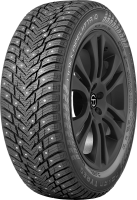
Nokian Hakkapeliitta 10 SUV
235/60 R18 107T XL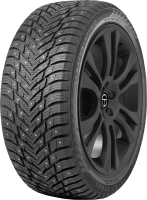
Category scores (% of best)
All discipline results (13)
Discipline positions compare the ranked tires in this test, not the whole market. These are individual measurements, not weighted overall scores.
| Test | Position in discipline | Result | Gap to best |
|---|---|---|---|
| Dry BrakingLower is better | 6th / 8 | 151 ft | +6 ft |
| Subj. Dry HandlingHigher is better | 4th / 8 | 4 Points | -1.00 Points |
| Wet BrakingLower is better | 7th / 8 | 163 ft | +21 ft |
| Wet HandlingLower is better | 5th / 8 | 64.09 s | +0.78 s |
| Straight AquaHigher is better | 8th / 8 | 41.0 mph | -3.4 mph |
| Snow BrakingLower is better | 5th / 8 | 37 ft | 0 ft |
| Snow TractionLower is better | 3rd / 8 | 1.79 s | +0.02 s |
| Snow HandlingLower is better | 1st / 8 | 68.4 s | Best in this discipline |
| Ice BrakingLower is better | 1st / 8 | 38 ft | Best in this discipline |
| Ice TractionLower is better | 1st / 8 | 2.72 s | Best in this discipline |
| Ice HandlingLower is better | 1st / 8 | 84 s | Best in this discipline |
| NoiseLower is better | 5th / 8 | 74.5 dB | +1.90 dB |
| Fuel ConsumptionLower is better | 3rd / 8 | 6.5 l/100km | +0.20 l/100km |
- Origin
- Finland
- Weight
- 15.9 kgs
- Tread
- 9.4 mm
- Price
- 2945.00
Goodyear UltraGrip Arctic 2 SUV
235/60 R18 107T XL
Category scores (% of best)
All discipline results (13)
Discipline positions compare the ranked tires in this test, not the whole market. These are individual measurements, not weighted overall scores.
| Test | Position in discipline | Result | Gap to best |
|---|---|---|---|
| Dry BrakingLower is better | 7th / 8 | 154 ft | +9 ft |
| Subj. Dry HandlingHigher is better | 4th / 8 | 4 Points | -1.00 Points |
| Wet BrakingLower is better | 4th / 8 | 157 ft | +15 ft |
| Wet HandlingLower is better | 4th / 8 | 63.96 s | +0.65 s |
| Straight AquaHigher is better | 3rd / 8 | 43.1 mph | -1.3 mph |
| Snow BrakingLower is better | 3rd / 8 | 37 ft | 0 ft |
| Snow TractionLower is better | 5th / 8 | 1.8 s | +0.03 s |
| Snow HandlingLower is better | 5th / 8 | 70.2 s | +1.80 s |
| Ice BrakingLower is better | 2nd / 8 | 41 ft | +3 ft |
| Ice TractionLower is better | 2nd / 8 | 2.83 s | +0.11 s |
| Ice HandlingLower is better | 2nd / 8 | 85.9 s | +1.90 s |
| NoiseLower is better | 3rd / 8 | 73.9 dB | +1.30 dB |
| Fuel ConsumptionLower is better | 7th / 8 | 6.6 l/100km | +0.30 l/100km |
- Origin
- Germany
- Weight
- 15.0 kgs
- Tread
- 9.8 mm
- Price
- 2594.00
Continental IceContact 3
235/60 R18 107T XL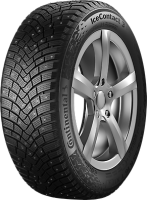
Category scores (% of best)
All discipline results (13)
Discipline positions compare the ranked tires in this test, not the whole market. These are individual measurements, not weighted overall scores.
| Test | Position in discipline | Result | Gap to best |
|---|---|---|---|
| Dry BrakingLower is better | 2nd / 8 | 148 ft | +3 ft |
| Subj. Dry HandlingHigher is better | 1st / 8 | 5 Points | Best in this discipline |
| Wet BrakingLower is better | 5th / 8 | 158 ft | +16 ft |
| Wet HandlingLower is better | 3rd / 8 | 63.71 s | +0.40 s |
| Straight AquaHigher is better | 6th / 8 | 42.3 mph | -2.1 mph |
| Snow BrakingLower is better | 1st / 8 | 37 ft | Best in this discipline |
| Snow TractionLower is better | 1st / 8 | 1.77 s | Best in this discipline |
| Snow HandlingLower is better | 2nd / 8 | 68.6 s | +0.20 s |
| Ice BrakingLower is better | 4th / 8 | 52 ft | +14 ft |
| Ice TractionLower is better | 4th / 8 | 3.26 s | +0.54 s |
| Ice HandlingLower is better | 4th / 8 | 86.9 s | +2.90 s |
| NoiseLower is better | 2nd / 8 | 73.6 dB | +1.00 dB |
| Fuel ConsumptionLower is better | 1st / 8 | 6.3 l/100km | Best in this discipline |
- Origin
- Poland
- Weight
- 15.7 kgs
- Tread
- 8.3 mm
- Price
- 2933.00
Michelin X Ice North 4 SUV
235/60 R18 107T XL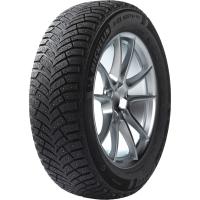
Category scores (% of best)
All discipline results (13)
Discipline positions compare the ranked tires in this test, not the whole market. These are individual measurements, not weighted overall scores.
| Test | Position in discipline | Result | Gap to best |
|---|---|---|---|
| Dry BrakingLower is better | 8th / 8 | 155 ft | +10 ft |
| Subj. Dry HandlingHigher is better | 1st / 8 | 5 Points | Best in this discipline |
| Wet BrakingLower is better | 8th / 8 | 166 ft | +24 ft |
| Wet HandlingLower is better | 6th / 8 | 64.78 s | +1.47 s |
| Straight AquaHigher is better | 5th / 8 | 42.6 mph | -1.8 mph |
| Snow BrakingLower is better | 4th / 8 | 37 ft | 0 ft |
| Snow TractionLower is better | 2nd / 8 | 1.78 s | +0.01 s |
| Snow HandlingLower is better | 4th / 8 | 69.6 s | +1.20 s |
| Ice BrakingLower is better | 3rd / 8 | 47 ft | +9 ft |
| Ice TractionLower is better | 3rd / 8 | 2.95 s | +0.23 s |
| Ice HandlingLower is better | 3rd / 8 | 86.5 s | +2.50 s |
| NoiseLower is better | 3rd / 8 | 73.9 dB | +1.30 dB |
| Fuel ConsumptionLower is better | 2nd / 8 | 6.45 l/100km | +0.15 l/100km |
- Origin
- Germany
- Weight
- 15.3 kgs
- Tread
- 8.4 mm
- Price
- 2722.00
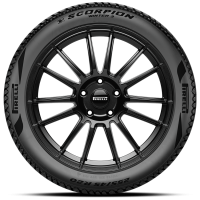
Pirelli Scorpion IceZero 2
235/60 R18 107H XL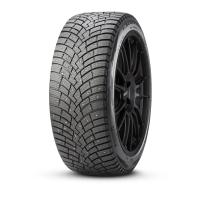
Category scores (% of best)
All discipline results (13)
Discipline positions compare the ranked tires in this test, not the whole market. These are individual measurements, not weighted overall scores.
| Test | Position in discipline | Result | Gap to best |
|---|---|---|---|
| Dry BrakingLower is better | 4th / 8 | 150 ft | +5 ft |
| Subj. Dry HandlingHigher is better | 1st / 8 | 5 Points | Best in this discipline |
| Wet BrakingLower is better | 3rd / 8 | 154 ft | +12 ft |
| Wet HandlingLower is better | 1st / 8 | 63.31 s | Best in this discipline |
| Straight AquaHigher is better | 1st / 8 | 44.4 mph | Best in this discipline |
| Snow BrakingLower is better | 2nd / 8 | 37 ft | 0 ft |
| Snow TractionLower is better | 3rd / 8 | 1.79 s | +0.02 s |
| Snow HandlingLower is better | 3rd / 8 | 69.1 s | +0.70 s |
| Ice BrakingLower is better | 6th / 8 | 58 ft | +20 ft |
| Ice TractionLower is better | 5th / 8 | 3.45 s | +0.73 s |
| Ice HandlingLower is better | 6th / 8 | 93.2 s | +9.20 s |
| NoiseLower is better | 7th / 8 | 74.8 dB | +2.20 dB |
| Fuel ConsumptionLower is better | 3rd / 8 | 6.5 l/100km | +0.20 l/100km |
- Origin
- Romania
- Weight
- 15.5 kgs
- Tread
- 8.7 mm
- Price
- 2479.00
Nexen WinGuard WinSpike 3
235/60 R18 107T XLCategory scores (% of best)
All discipline results (13)
Discipline positions compare the ranked tires in this test, not the whole market. These are individual measurements, not weighted overall scores.
| Test | Position in discipline | Result | Gap to best |
|---|---|---|---|
| Dry BrakingLower is better | 3rd / 8 | 148 ft | +3 ft |
| Subj. Dry HandlingHigher is better | 4th / 8 | 4 Points | -1.00 Points |
| Wet BrakingLower is better | 2nd / 8 | 153 ft | +11 ft |
| Wet HandlingLower is better | 2nd / 8 | 63.46 s | +0.15 s |
| Straight AquaHigher is better | 2nd / 8 | 43.8 mph | -0.6 mph |
| Snow BrakingLower is better | 8th / 8 | 39 ft | +2 ft |
| Snow TractionLower is better | 8th / 8 | 1.9 s | +0.13 s |
| Snow HandlingLower is better | 7th / 8 | 72.2 s | +3.80 s |
| Ice BrakingLower is better | 5th / 8 | 55 ft | +17 ft |
| Ice TractionLower is better | 6th / 8 | 3.47 s | +0.75 s |
| Ice HandlingLower is better | 5th / 8 | 91.7 s | +7.70 s |
| NoiseLower is better | 8th / 8 | 75.5 dB | +2.90 dB |
| Fuel ConsumptionLower is better | 3rd / 8 | 6.5 l/100km | +0.20 l/100km |
- Origin
- South Korea
- Weight
- 14.9 kgs
- Tread
- 8.6 mm
- Price
- 2140.00
Triangle IcelynX TI501
235/60 R18 107T XL
Category scores (% of best)
All discipline results (13)
Discipline positions compare the ranked tires in this test, not the whole market. These are individual measurements, not weighted overall scores.
| Test | Position in discipline | Result | Gap to best |
|---|---|---|---|
| Dry BrakingLower is better | 1st / 8 | 145 ft | Best in this discipline |
| Subj. Dry HandlingHigher is better | 8th / 8 | 2 Points | -3.00 Points |
| Wet BrakingLower is better | 1st / 8 | 142 ft | Best in this discipline |
| Wet HandlingLower is better | 7th / 8 | 64.79 s | +1.48 s |
| Straight AquaHigher is better | 4th / 8 | 42.8 mph | -1.6 mph |
| Snow BrakingLower is better | 6th / 8 | 37 ft | 0 ft |
| Snow TractionLower is better | 7th / 8 | 1.85 s | +0.08 s |
| Snow HandlingLower is better | 6th / 8 | 71.9 s | +3.50 s |
| Ice BrakingLower is better | 8th / 8 | 84 ft | +46 ft |
| Ice TractionLower is better | 8th / 8 | 5.19 s | +2.47 s |
| Ice HandlingLower is better | 8th / 8 | 96.6 s | +12.60 s |
| NoiseLower is better | 1st / 8 | 72.6 dB | Best in this discipline |
| Fuel ConsumptionLower is better | 8th / 8 | 6.7 l/100km | +0.40 l/100km |
- Origin
- China
- Weight
- 16.4 kgs
- Tread
- 9.1 mm
- Price
- 1499.00
Goodride IceMaster Spike Z 506
235/60 R18 107T XL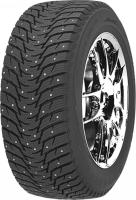
Category scores (% of best)
All discipline results (13)
Discipline positions compare the ranked tires in this test, not the whole market. These are individual measurements, not weighted overall scores.
| Test | Position in discipline | Result | Gap to best |
|---|---|---|---|
| Dry BrakingLower is better | 5th / 8 | 151 ft | +6 ft |
| Subj. Dry HandlingHigher is better | 7th / 8 | 3 Points | -2.00 Points |
| Wet BrakingLower is better | 6th / 8 | 159 ft | +17 ft |
| Wet HandlingLower is better | 7th / 8 | 64.79 s | +1.48 s |
| Straight AquaHigher is better | 7th / 8 | 42.1 mph | -2.3 mph |
| Snow BrakingLower is better | 7th / 8 | 37 ft | 0 ft |
| Snow TractionLower is better | 6th / 8 | 1.83 s | +0.06 s |
| Snow HandlingLower is better | 8th / 8 | 72.3 s | +3.90 s |
| Ice BrakingLower is better | 7th / 8 | 58 ft | +20 ft |
| Ice TractionLower is better | 7th / 8 | 3.73 s | +1.01 s |
| Ice HandlingLower is better | 7th / 8 | 94 s | +10.00 s |
| NoiseLower is better | 6th / 8 | 74.7 dB | +2.10 dB |
| Fuel ConsumptionLower is better | 3rd / 8 | 6.5 l/100km | +0.20 l/100km |
- Origin
- China
- Weight
- 16.7 kgs
- Tread
- 8.9 mm
- Price
- 1675.00
What´s this test's really tire size: 235/60 R18 or 205/55 R16? It must be the first one but we can see on every tire´s score ranking and on the "test publication" header the size 205/55 R16.
Anyway, too bad they didn´t pick up a winter tire and/or a winter nordic compound tire for reference.
You're right, they were the 18" size, sorry.
I have a studded tire in my nordic studless test next week as reference.