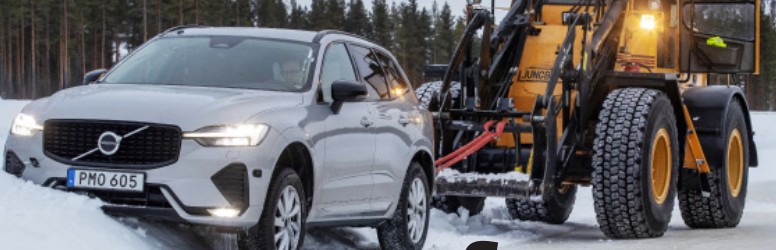
Vi Bilägare evaluated eight different tire models in the popular SUV size of 235/60 R18. The test, featured in issue number 12, utilized a Volvo XC60 AWD as the primary vehicle to assess performance on ice, snow, and both wet and dry asphalt. The lineup included five premium brands—Continental, Goodyear, Michelin, Nokian, and Pirelli—alongside three more budget-focused offerings from Nexen, Goodride, and Triangle.
The test highlights the significant engineering compromises required when designing tires for heavy, powerful SUVs. The testers note that the performance gaps between the tires were larger than they typically see with smaller passenger car tires. A central theme is the direct trade-off between performance on ice and performance on wet asphalt, with the article stating that ice grip and wet grip are "opposites of each other". This conflict between competing characteristics is a recurring point, demonstrating that no single tire excels in all conditions.
This variability in performance is clearly illustrated by the results. The test winner, the Nokian Hakkapeliitta 10, delivered the best grip and handling on ice and snow but simultaneously had the longest braking distance on wet roads and the lowest resistance to aquaplaning. Conversely, the Triangle IceLynk TI501 produced a startlingly polarized result. Despite being a studded tire, its performance on ice was described as a "total lack" of grip, with braking distances more than double that of the top performers. However, the Triangle tire recorded the shortest braking distances of the entire group on both wet and dry asphalt.
Other tires showcased more balanced, if less specialized, performance. The second-place Goodyear UltraGrip Arctic 2 was commended for providing a good balance between its ice and wet grip capabilities. The Continental IceContact 3, despite its name, showed a weakness on ice but was a strong and stable performer on snow and asphalt. Ultimately, the test demonstrates that for heavy SUVs, tire choice involves a critical evaluation of performance trade-offs, with even premium manufacturers prioritizing different characteristics in their designs.
Dry
On a dry surface, the Triangle delivers the best braking performance, while the Goodyear and Michelin require the longest distance to come to a stop.
Dry Braking
Spread: 2.91 M (6.6%)|Avg: 45.81 M
Dry braking in meters (100 - 5 km/h) (Lower is better)
Dry Braking: Safety Impact: Best vs Worst Tire
Based on subjective feel, the Pirelli, Continental, and Michelin tires performed best on dry roads, while the Triangle and Goodride felt vague and unresponsive.
Subj. Dry Handling
Spread: 3.00 Points (60%)|Avg: 4.00 Points
Subjective Dry Handling Score (Higher is better)
Continental IceContact 3
5.00 Points
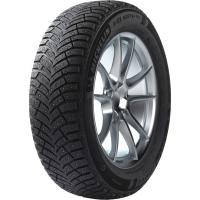
Michelin X Ice North 4 SUV
5.00 Points
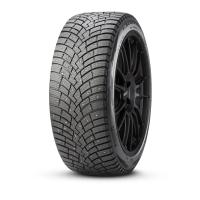
Pirelli Scorpion IceZero 2
5.00 Points
Nokian Hakkapeliitta 10 SUV
4.00 Points
Goodyear UltraGrip Arctic 2 SUV
4.00 Points
Nexen WinGuard WinSpike 3
4.00 Points
Goodride IceMaster Spike Z 506
3.00 Points
Triangle IcelynX TI501
2.00 Points
Wet
Demonstrating the trade-off with ice grip, the Triangle tire provides the shortest wet braking distance by a clear margin, while the ice-focused Michelin and Nokian tires require the most distance to stop.
Wet Braking
Spread: 7.48 M (17.3%)|Avg: 47.70 M
Wet braking in meters (Lower is better)
Triangle IcelynX TI501
43.25 M
Nexen WinGuard WinSpike 3
46.54 M
Pirelli Scorpion IceZero 2
46.97 M
Goodyear UltraGrip Arctic 2 SUV
47.90 M
Continental IceContact 3
48.04 M
Goodride IceMaster Spike Z 506
48.50 M
Nokian Hakkapeliitta 10 SUV
49.69 M
Michelin X Ice North 4 SUV
50.73 M
The Pirelli tire was the fastest and most controllable around the wet handling circuit, whereas the Triangle was the slowest due to severe understeer.
Wet Handling
Spread: 1.48 s (2.3%)|Avg: 64.11 s
Wet handling time in seconds (Lower is better)
Pirelli Scorpion IceZero 2
63.31 s
Nexen WinGuard WinSpike 3
63.46 s
Continental IceContact 3
63.71 s
Goodyear UltraGrip Arctic 2 SUV
63.96 s
Nokian Hakkapeliitta 10 SUV
64.09 s
Michelin X Ice North 4 SUV
64.78 s
Triangle IcelynX TI501
64.79 s
Goodride IceMaster Spike Z 506
64.79 s
The Pirelli and Nexen tires offer the best resistance to aquaplaning, while the test-winning Nokian is the most susceptible to losing grip in deep standing water
Straight Aqua
Spread: 5.50 Km/H (7.7%)|Avg: 68.84 Km/H
Float Speed in Km/H (Higher is better)
Pirelli Scorpion IceZero 2
71.50 Km/H
Nexen WinGuard WinSpike 3
70.50 Km/H
Goodyear UltraGrip Arctic 2 SUV
69.40 Km/H
Triangle IcelynX TI501
68.80 Km/H
Michelin X Ice North 4 SUV
68.60 Km/H
Continental IceContact 3
68.10 Km/H
Goodride IceMaster Spike Z 506
67.80 Km/H
Nokian Hakkapeliitta 10 SUV
66.00 Km/H
Snow
The braking distances on snow show only marginal differences between the tested tires, with the Nexen requiring a slightly longer distance to stop.
Snow Braking
Spread: 0.69 M (6.2%)|Avg: 11.34 M
Snow braking in meters (35 - 5 km/h) (Lower is better)
Snow Braking: Safety Impact: Best vs Worst Tire
On snow, the acceleration grip is much more evenly matched between the tires, with only the Nexen showing a noticeable disadvantage.
Snow Traction
Spread: 0.13 s (7.3%)|Avg: 1.81 s
Snow acceleration time (5 - 35 km/h) (Lower is better)
Continental IceContact 3
1.77 s
Michelin X Ice North 4 SUV
1.78 s
Nokian Hakkapeliitta 10 SUV
1.79 s
Pirelli Scorpion IceZero 2
1.79 s
Goodyear UltraGrip Arctic 2 SUV
1.80 s
Goodride IceMaster Spike Z 506
1.83 s
Triangle IcelynX TI501
1.85 s
Nexen WinGuard WinSpike 3
1.90 s
Nokian was the fastest on the snow handling course with excellent control, while Goodride and Triangle were the slowest and least predictable.
Snow Handling
Spread: 3.90 s (5.7%)|Avg: 70.29 s
Snow handling time in seconds (Lower is better)
Nokian Hakkapeliitta 10 SUV
68.40 s
Continental IceContact 3
68.60 s
Pirelli Scorpion IceZero 2
69.10 s
Michelin X Ice North 4 SUV
69.60 s
Goodyear UltraGrip Arctic 2 SUV
70.20 s
Triangle IcelynX TI501
71.90 s
Nexen WinGuard WinSpike 3
72.20 s
Goodride IceMaster Spike Z 506
72.30 s
Ice
Nokian delivers the shortest braking distance on ice, with Goodyear and Michelin also impressing, whereas the Triangle's stopping distance is more than double that of the leader.
Ice Braking
Spread: 13.99 M (121.8%)|Avg: 16.47 M
Ice braking in meters (25 - 5 km/h) (Lower is better)
Ice Braking: Safety Impact: Best vs Worst Tire
Nokian provides the best acceleration on ice, followed by Goodyear and Michelin, while Triangle struggles significantly with almost non-existent grip.
Ice Traction
Spread: 2.47 s (90.8%)|Avg: 3.45 s
Ice acceleration time (5 - 25 km/h) (Lower is better)
Nokian Hakkapeliitta 10 SUV
2.72 s
Goodyear UltraGrip Arctic 2 SUV
2.83 s
Michelin X Ice North 4 SUV
2.95 s
Continental IceContact 3
3.26 s
Pirelli Scorpion IceZero 2
3.45 s
Nexen WinGuard WinSpike 3
3.47 s
Goodride IceMaster Spike Z 506
3.73 s
Triangle IcelynX TI501
5.19 s
The Nokian tire was the quickest and most controllable around the ice handling track, while the Triangle was the slowest by a considerable margin.
Ice Handling
Spread: 12.60 s (15%)|Avg: 89.85 s
Ice handling time in seconds (Lower is better)
Nokian Hakkapeliitta 10 SUV
84.00 s
Goodyear UltraGrip Arctic 2 SUV
85.90 s
Michelin X Ice North 4 SUV
86.50 s
Continental IceContact 3
86.90 s
Nexen WinGuard WinSpike 3
91.70 s
Pirelli Scorpion IceZero 2
93.20 s
Goodride IceMaster Spike Z 506
94.00 s
Triangle IcelynX TI501
96.60 s
Comfort
In subjective noise evaluation, the Triangle and Michelin were the quietest and most pleasant-sounding tires, while the Nexen produced the most intrusive cabin noise, similar to a bad wheel bearing
Noise
Spread: 2.90 dB (4%)|Avg: 74.19 dB
External noise in dB (Lower is better)
Triangle IcelynX TI501
72.60 dB
Continental IceContact 3
73.60 dB
Michelin X Ice North 4 SUV
73.90 dB
Goodyear UltraGrip Arctic 2 SUV
73.90 dB
Nokian Hakkapeliitta 10 SUV
74.50 dB
Goodride IceMaster Spike Z 506
74.70 dB
Pirelli Scorpion IceZero 2
74.80 dB
Nexen WinGuard WinSpike 3
75.50 dB
Value
The Continental tire proved to be the most fuel-efficient with the lowest rolling resistance, while the Triangle was the least efficient.
Fuel Consumption
Spread: 0.40 l/100km (6.3%)|Avg: 6.51 l/100km
Fuel consumption in Litres per 100 km (Lower is better)
Continental IceContact 3
6.30 l/100km
Michelin X Ice North 4 SUV
6.45 l/100km
Nokian Hakkapeliitta 10 SUV
6.50 l/100km
Pirelli Scorpion IceZero 2
6.50 l/100km
Goodride IceMaster Spike Z 506
6.50 l/100km
Nexen WinGuard WinSpike 3
6.50 l/100km
Goodyear UltraGrip Arctic 2 SUV
6.60 l/100km
Triangle IcelynX TI501
6.70 l/100km
19,000 km
£1.45/L
8.0 L/100km
--
Annual Difference
--
Lifetime Savings
--
Extra Fuel/Energy
--
Extra CO2
Estimates based on typical driving conditions. Rolling resistance accounts for approximately 20% of IC vehicle fuel consumption and 25% of EV energy consumption. Actual savings vary based on driving style, vehicle weight, road conditions, and tire age. For comparative purposes only. Lifetime savings based on a 40,000km / 25,000 mile tread life.
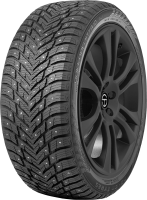
The Nokian Hakkapeliitta 10 SUV demonstrates why Finnish expertise in winter conditions remains unmatched, delivering the test's best overall performance with exceptional ice grip capabilities. This tire excels particularly in winter handling scenarios, offering quick steering response and allowing drivers to change direction confidently without losing control on both ice and hard-packed snow. The grip balance is well-calibrated and the tire maintains excellent control even under pressure. However, the superior winter performance comes with trade-offs on wet surfaces, where it exhibits longer braking distances and earlier aquaplaning compared to competitors. On dry asphalt, the steering feel is somewhat non-linear, though the behavior during emergency maneuvers remains reassuringly predictable.
The Goodyear UltraGrip Arctic 2 SUV comes closest to challenging Nokian in winter conditions, offering impressive grip in both longitudinal acceleration and braking scenarios on ice. While the tire matches Nokian's performance in straight-line winter driving, it falls short in cornering precision, displaying delayed steering response and an inconsistent grip balance that can shift unpredictably between understeer and oversteer. On wet roads, Goodyear performs admirably with strong aquaplaning resistance and short braking distances, though it lacks the precise steering feel found on dry asphalt. The tire also shows slightly higher rolling resistance compared to some competitors, affecting fuel economy.
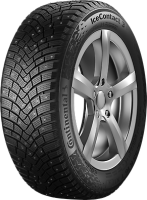
The Continental IceContact 3 may not lead in pure ice performance, but it compensates with exceptional road manners and predictable behavior that builds driver confidence. This tire excels at communicating grip limits to the driver, providing early warning when approaching the adhesion threshold, combined with calm, controlled behavior under pressure featuring mild understeer that's easy to manage. Continental performs significantly better on snow than ice, and truly shines on asphalt with outstanding straight-line stability and confident handling during emergency maneuvers. The tire also achieves the best rolling resistance in the test, contributing to improved fuel economy, though ice grip remains its relative weakness.
The Michelin X-Ice North 4 SUV has long been a favorite for combining strong ice and snow braking performance with refined on-road characteristics, maintaining its reputation in this larger SUV dimension. While braking capabilities on winter surfaces remain impressive, the tire shows some limitations during more aggressive cornering, particularly struggling with larger steering inputs. On asphalt, the tire exhibits pronounced understeer under pressure, which contributes to a calm and safe character in emergency situations without risk of sudden breakaway. The major weakness lies in wet weather performance, where grip is notably compromised with poor cornering ability and the longest stopping distances in the test, though it compensates with low road noise and good rolling resistance.
The Pirelli Scorpion IceZero 2, despite its SUV-specific naming, closely resembles the manufacturer's standard IceZero2 in both tread design and performance characteristics. Ice grip doesn't match the premium competitors' standards, and the tire displays an oversteer-biased balance on snow and ice where the rear end tends to step out first, though this behavior is never surprising or uncontrollable. Where Pirelli truly excels is on asphalt surfaces, offering the best steering feel and responsiveness of any tire in the test, with exceptional ability to navigate quickly around obstacles in emergency situations. The tire also leads in aquaplaning resistance and achieves the highest cornering speeds on wet surfaces, though road noise levels are among the higher in the group.
The Nexen WinGuard WinSpike 3 features the hardest rubber compound in the test, resulting in significant grip challenges on winter surfaces, particularly struggling with snow adhesion compared to other test participants. The grip balance is heavily understeer-biased, with the front wheels consistently losing grip first in a sudden, unpredictable manner that provides little warning to the driver. Safety levels improve considerably on asphalt where aquaplaning resistance is good and both braking distances and cornering behavior maintain high standards, especially on wet surfaces. However, the tire's major drawback is an unacceptably high noise level that becomes intrusive, making it the loudest option in the test.
The Triangle IceLynx TI501 presents a puzzling contradiction, being a studded tire with virtually non-existent ice grip that performs worse than even worn friction tires on slippery surfaces. Ice braking distances are more than double those of the best performers, making it genuinely dangerous on winter roads, while snow performance is only marginally better with the tire struggling to maintain grip in corners despite adequate straight-line traction. Surprisingly, the tire redeems itself on asphalt with the shortest braking distances in the test, particularly excelling on wet surfaces, though it suffers from severe understeer and reluctance to change direction quickly. The one saving grace is exceptionally low road noise with a smooth, homogeneous sound character free from disturbing resonances or frequencies.
The Goodride IceMaster Spike Z-506, despite marketing claims of Finnish development, struggles to live up to its Nordic associations with consistently poor performance across most test categories. The tire's relatively stiff construction and hard rubber compound work adequately on asphalt surfaces where it achieves middle-of-the-pack ratings at best, but winter performance is severely compromised with low grip levels and a tendency toward sudden breakaway when adhesion is lost. The tire consistently ranks among the worst performers regardless of test conditions, offering little in the way of redeeming qualities beyond short asphalt braking distances and reasonable wet grip, ultimately earning last place in the overall standings due to its comprehensive mediocrity.
What´s this test's really tire size: 235/60 R18 or 205/55 R16? It must be the first one but we can see on every tire´s score ranking and on the "test publication" header the size 205/55 R16. Anyway, too bad they didn´t pick up a winter tire and/or a winter nordic compound tire for reference.




What´s this test's really tire size: 235/60 R18 or 205/55 R16? It must be the first one but we can see on every tire´s score ranking and on the "test publication" header the size 205/55 R16.
Anyway, too bad they didn´t pick up a winter tire and/or a winter nordic compound tire for reference.
You're right, they were the 18" size, sorry.
I have a studded tire in my nordic studless test next week as reference.