Data Explorer / Vi Bilagare
2024 Nordic Friction Winter Tire Test
- Tested size
- 225/45 R17
- Tires tested
- 8
- Disciplines
- 13

Set the weightings
Move a slider. The other categories rebalance automatically to keep the total at 100%.
No test-specific category weights are recorded; this starts with season defaults.
Season defaults
Results
Movement is compared with the default calculation, not the published finishing order. Scores use unrounded totals for ranking.
No ranking for this setup. Give at least one category a positive weight and include a discipline in each active category, or reset the weights.
Filtering never changes the benchmark, scores or positions.
No tires selected. Add tires to your shortlist to focus the ranking.
| ft ↓ | Points ↑ | ft ↓ | s ↓ | mph ↑ | ft ↓ | s ↓ | s ↓ | ft ↓ | s ↓ | s ↓ | dB ↓ | l/100km ↓ | ||||||||||
|---|---|---|---|---|---|---|---|---|---|---|---|---|---|---|---|---|---|---|---|---|---|---|
| 1 | 2 | 90.84 | 105 | 5 | 83.8 | 123 | 40.6 | 42.6 | 83.3 | 41 | 4.04 | 79.6 | 100.0 | 42 | 8.99 | 66.4 | 88.3 | 71.5 | 100.0 | 5.25 | 100.0 | |
StrengthsThe Goodyear UltraGrip Ice 3 is the best Nordic winter tire on tarmac, second only to the all-season Michelin for wet braking, wet handling and aquaplaning, and it is first for snow braking, traction and handling. It is also the quietest tire in the test, has the lowest fuel consumption and shares the best dry handling score. ConsiderationsIce is its relative weakness, fourth for braking and traction and third for handling, and its dry braking is only fifth. Score contributionCategory score × of overall score Dry83.84 × 19% = 15.93 Wet83.32 × 33% = 27.5 Snow100 × 29% = 29 Ice88.25 × 5% = 4.41 Comfort100 × 5% = 5 Fuel Consumption100 × 9% = 9 | ||||||||||||||||||||||
| 2 | 4 | 88.85 | 102 | 4 | 82.4 | 132 | 41.2 | 37.2 | 79.5 | 42 | 4.19 | 79.7 | 98.0 | 39 | 8.44 | 64.6 | 92.8 | 71.8 | 99.6 | 5.30 | 99.1 | |
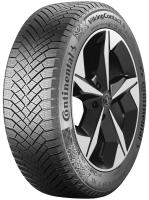
StrengthsThe Continental VikingContact 8 has the best ice handling in the test, is second for snow traction and dry braking, joint second for snow handling and third for ice braking and traction, and it is more stable on tarmac than its predecessor. ConsiderationsAquaplaning resistance is poor, joint sixth of eight, and it is only fourth for wet braking and snow braking. Score contributionCategory score × of overall score Dry82.37 × 19% = 15.65 Wet79.5 × 33% = 26.24 Snow98.02 × 29% = 28.43 Ice92.81 × 5% = 4.64 Comfort99.58 × 5% = 4.98 Fuel Consumption99.06 × 9% = 8.92 | ||||||||||||||||||||||
| 3 | 5 | 87.83 | 103 | 3 | 78.6 | 138 | 41.7 | 37.2 | 77.7 | 41 | 4.20 | 79.7 | 98.5 | 37 | 8.01 | 65.0 | 95.8 | 71.9 | 99.4 | 5.30 | 99.1 | |
StrengthsThe Nokian Hakkapeliitta R5 is one of the best tires on ice and snow, second for ice braking, traction and handling and for snow braking, and joint second for snow handling. It also shares the second-lowest fuel consumption. ConsiderationsIt struggles with aquaplaning, joint sixth of eight, and it is only sixth for wet braking and dry handling, with slightly inconsistent steering feel. Score contributionCategory score × of overall score Dry78.64 × 19% = 14.94 Wet77.68 × 33% = 25.63 Snow98.55 × 29% = 28.58 Ice95.79 × 5% = 4.79 Comfort99.44 × 5% = 4.97 Fuel Consumption99.06 × 9% = 8.92 | ||||||||||||||||||||||
| 4 | 3 | 88.91 | 104 | 4 | 81.6 | 128 | 41.7 | 40.2 | 80.4 | 41 | 4.23 | 81.0 | 97.7 | 35 | 7.53 | 67.8 | 98.4 | 72.1 | 99.2 | 5.45 | 96.3 | |
StrengthsThe Michelin X Ice Snow has the best ice braking and ice traction in the test and is third for snow braking, wet braking and straight-line aquaplaning, with strong braking in all conditions. ConsiderationsCornering grip is lower than its rivals in winter and summer conditions, with a tendency to break away suddenly, and it is fifth for ice handling. It is also the second-loudest tire and the most expensive in the test. Score contributionCategory score × of overall score Dry81.56 × 19% = 15.5 Wet80.43 × 33% = 26.54 Snow97.66 × 29% = 28.32 Ice98.44 × 5% = 4.92 Comfort99.17 × 5% = 4.96 Fuel Consumption96.33 × 9% = 8.67 | ||||||||||||||||||||||
| 5 | 6 | 86.78 | 106 | 4 | 79.9 | 132 | 42.5 | 38.8 | 78.4 | 42 | 4.20 | 81.5 | 97.1 | 51 | 11.00 | 69.3 | 76.5 | 71.7 | 99.7 | 5.40 | 97.2 | |
StrengthsThe Hankook Winter i*cept iZ2 W616 shares the second-lowest noise level and is joint third for snow traction and dry handling, with good straight-line stability on tarmac. ConsiderationsIce grip is well behind the premium tires, sixth for ice braking and ice handling, and its dry braking and wet handling are also only sixth. Score contributionCategory score × of overall score Dry79.88 × 19% = 15.18 Wet78.39 × 33% = 25.87 Snow97.14 × 29% = 28.17 Ice76.53 × 5% = 3.83 Comfort99.72 × 5% = 4.99 Fuel Consumption97.22 × 9% = 8.75 | ||||||||||||||||||||||
| 6 | 1 | 96.40 | 85 | 5 | 100.0 | 90 | 38.4 | 53.4 | 100.0 | 44 | 4.21 | 84.7 | 94.6 | 60 | 13.00 | 72.8 | 68.2 | 72.9 | 98.1 | 5.45 | 96.3 | |
StrengthsThe Michelin CrossClimate 2 is the best tire on wet and dry roads, first for braking in the dry and the wet, wet handling and aquaplaning, and it shares the best dry handling score. ConsiderationsAs an all-season tire it is last on ice for braking and handling and last for snow braking and handling, so it is not suited to icy roads. It is also the loudest tire in the test. Score contributionCategory score × of overall score Dry100 × 19% = 19 Wet100 × 33% = 33 Snow94.56 × 29% = 27.42 Ice68.16 × 5% = 3.41 Comfort98.08 × 5% = 4.9 Fuel Consumption96.33 × 9% = 8.67 | ||||||||||||||||||||||
| 7 | 7 | 82.76 | 107 | 1 | 69.2 | 140 | 43.9 | 36.2 | 74.9 | 42 | 4.46 | 81.8 | 94.9 | 51 | 11.00 | 67.0 | 77.8 | 72.0 | 99.3 | 5.55 | 94.6 | |
StrengthsThe Radar Dimax Ice has reasonable ice grip from its soft compound, fourth for ice handling and fifth for ice braking, and it is the second-cheapest tire in the test. ConsiderationsIt has the longest wet braking distance and the worst aquaplaning resistance in the test, is last for snow traction and second from last for dry braking, and its handling at the limit is unpredictable. Score contributionCategory score × of overall score Dry69.19 × 19% = 13.15 Wet74.93 × 33% = 24.73 Snow94.89 × 29% = 27.52 Ice77.77 × 5% = 3.89 Comfort99.31 × 5% = 4.97 Fuel Consumption94.59 × 9% = 8.51 | ||||||||||||||||||||||
| 8 | 8 | 82.47 | 107 | 1 | 69.0 | 139 | 44.3 | 39.3 | 75.4 | 43 | 4.30 | 83.0 | 95.2 | 60 | 13.00 | 69.7 | 69.5 | 71.7 | 99.7 | 5.60 | 93.8 | |
StrengthsThe Greenmax LL Winter Ice I 15 shares the second-lowest noise level, is fourth for straight-line aquaplaning and is the cheapest tire in the test. ConsiderationsIt has the longest dry braking distance, the worst wet handling and the highest fuel consumption, and it is second from last for braking and handling on ice and snow, with sudden breakaway on both. Score contributionCategory score × of overall score Dry68.97 × 19% = 13.1 Wet75.35 × 33% = 24.87 Snow95.18 × 29% = 27.6 Ice69.47 × 5% = 3.47 Comfort99.72 × 5% = 4.99 Fuel Consumption93.75 × 9% = 8.44 | ||||||||||||||||||||||
Raw results do not change when you move the sliders. Scroll horizontally to see every discipline.
Leading with these priorities
Michelin CrossClimate 2
These are calculated scenarios, not new test awards. The published verdict may reflect judgement, close results and factors outside this calculation.
Not ranked: a measurement needed for these weights is missing. Missing results are not treated as zero or redistributed.
Reference tires provide context only. They do not set the benchmark and cannot win the personalised ranking.
Weighting vs real impact
What decides this ranking
The weighting is how much each category counts. The real impact is how much of the difference between the tires it creates: a discipline in which every tire performed about the same barely changes the order, however much it counts.
No weighting is recorded for this test, so the weighting here starts from Tire Reviews’ season defaults, not from the test’s own scoring.
- Dry Weighting 19% Real impact 31%
- Wet Weighting 33% Real impact 33%
- Snow Weighting 29% Real impact 13%
- Ice Weighting 5% Real impact 18%
- Comfort Weighting 5% Real impact <1%
- Fuel Consumption Weighting 9% Real impact 6%
- Subj. Dry Handling counts for 3.2% of the score but creates 22% of the difference between the tires, because their results in it were far apart.
- Snow Traction counts for 10.2% of the score but creates only 2% of the difference, because most tires performed about the same in it.
Every discipline 13
| Discipline | Weighting | Real impact |
|---|---|---|
| Dry Braking | 15.8% | 9% |
| Subj. Dry Handling | 3.2% | 22% |
| Wet Braking | 14.9% | 17% |
| Wet Handling | 14.5% | 11% |
| Straight Aqua | 3.6% | 5% |
| Snow Braking | 8.7% | 5% |
| Snow Traction | 10.2% | 2% |
| Snow Handling | 10.2% | 6% |
| Ice Braking | 1.7% | 8% |
| Ice Traction | 1.7% | 8% |
| Ice Handling | 1.7% | 2% |
| Noise | 5% | <1% |
| Fuel Consumption | 9% | 6% |
How it is worked out: each discipline’s weighting is multiplied by the spread of its results (the gap across the middle half of the tires, as a percentage of the best result), then shared out so that all the disciplines add up to 100%. It estimates what separates the tires; it is not a second set of weights, and it follows the weights you set.

How your ranking is calculated
Each discipline is scored against the best non-reference tire in the full test field: best ÷ result × 100 when lower is better, or result ÷ best × 100 when higher is better. Discipline scores are rounded to two decimal places, then combined using your weights.
Within-category weights divide that category’s share of the overall score. A 50% wet category and 40% wet-braking share give wet braking 20% of the total. A weight is a scoring priority, not a measure of its actual effect on the ranking: the performance gaps matter too. What decides this ranking ↑
Published joint positions are preserved separately. Calculated positions tie only when their underlying scores match; two displayed scores can look equal after rounding.
A zero weight excludes that category or discipline. At least one active discipline is required, and the disciplines in every active category must have a positive total.
More tire tests
Cross-check this test
Where these tires were tested again, and how the verdict held up.
2025 Friction and Studded Winter Tire Test
205/55 R1614 tires tested
5 of these 8 tires tested again
2025 Studded, Friction and European Winter Tire Test
235/45 R1820 tires tested
4 of these 8 tires tested again
The Best Snow Tires for 2025/26
205/55 R165 tires tested
4 of these 8 tires tested again