

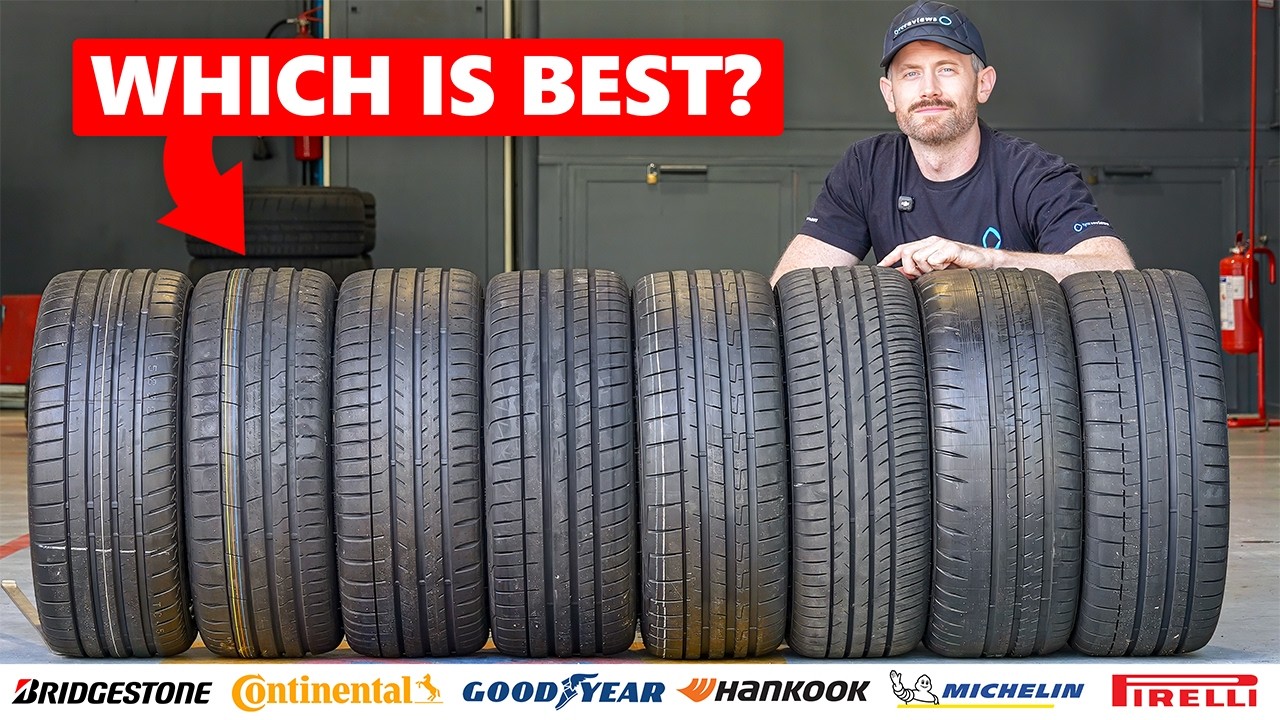
For enthusiastic drivers subjective handling, as in how this tire reacts to steering, how balanced the tire is, and how much ability you have to adjust things mid-corner, is often more important than outright grip. In this test I take eight of the very best ultra ultra high performance summer tires and put them through my usual array of dry, wet, noise, comfort, and rolling resistance testing but with a heavy focus on subjective handling to find out which tire will make you feel the happiest when driving!
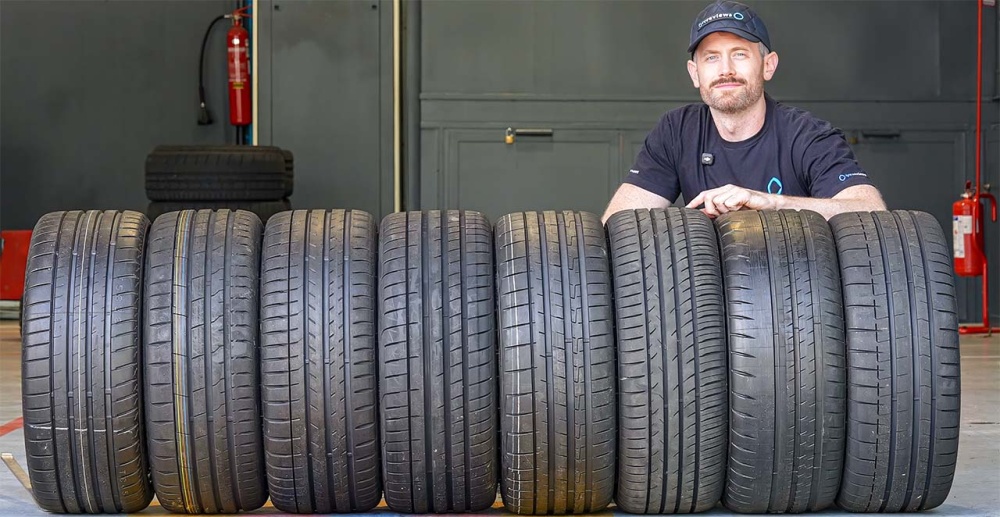
One of the most interesting aspects of this test to be the inclusion of the Michelin Pilot Sport Cup 2, which Michelin say is an 80% track tire and 20% road tire, whereas the rest of the tires are more road-biased. Seeing how the Michelin track product performed in a group of street tires was fascinating and some of the data will certainly surprise you.
Testing Methodology

- Test Driver
- Jonathan Benson
- Tire Size
- 235/35 R19
- Test Vehicle
- VW Golf 8 GTI ClubSport
- Test Location
- Professional Proving Ground
- Tire Pressures
- 2.5
- Test Year
- 2026
- Tires Tested
- 8
Dry
Starting with the King Boss, in isolation it didn't feel terrible - steering reaction was acceptable and grip seemed adequate - but it was six seconds a lap down on the fastest, which tells the full story. Moving up, the Falken was a clear step forward; turn-in to lock was perhaps a touch slower than ideal but it was beautifully weighted and built up progressively, and it put in a consistent lap time. The Hankook was similar, though it wasn't quite as direct as the Falken on initial turn-in, with a very slight two-stage feel where the front and rear would build up at slightly different speeds - a small quirk but noticeable in a group this competitive.

The Continental Sport Contact 7 showed a duality I've observed before: around centre there is just a slight elasticity to the steering that isn't my favourite, but once you're genuinely committed to a corner it comes alive, turns hard and feels very stable. It's clearly leaning into its road-focused character.
The Goodyear Eagle F1 SuperSport was a step up in steering directness and outright grip over the Continental, Hankook, and Falken, and it was one of the few tires that got meaningfully quicker on its second lap once the compound was fully up to temperature. The one mild criticism is that before it's fully warm, it felt slightly numb on the limit - just a fraction short of the feedback of the very best here.
The Bridgestone Potenza Sport Evo once again did what I can only describe as Bridgestone things. Its steering ramp-up is non-linear - you turn and then suddenly you are turning faster and faster without additional steering input - which isn't objectively ideal but delivers a genuinely thrilling, exciting feel even at sub-limit pace. On the lap it was fast, aggressive, and rewarding.
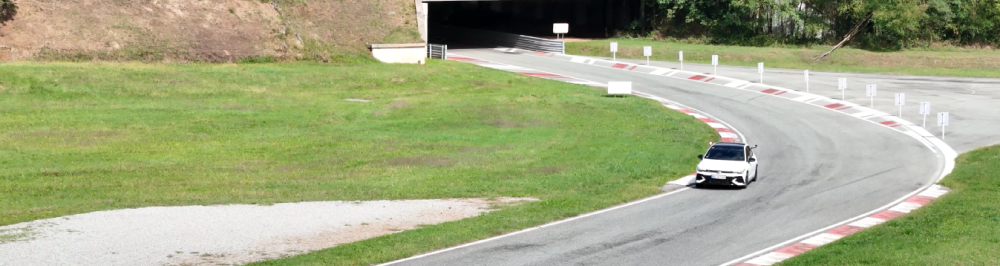
Then came the Michelin Pilot Sport Cup 2. Sub-limit it felt sensational, with the sharpest front-end steering reaction of the group by a small but definite margin, and wonderful granularity through the front axle. However, on lap one turn one the front bit hard and then a split second later the rear came round - I had to correct it, losing around two seconds in the opening corners. Even giving it an extra warm-up lap, and despite having clear advantages in very high-speed, high-load corners, it was bleeding small amounts of time in braking zones, low-speed corners and traction zones everywhere else.
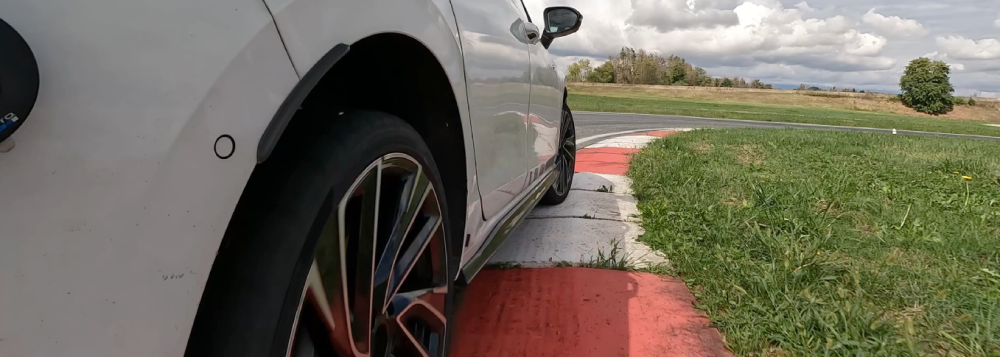
The Pirelli P Zero R was shockingly fast. Its steering has a linear ramp-up - not quite the manic edge of the Bridgestone - but it is still very sporty and possibly the best overall front-end feel of the group. Under braking on the first lap I had to roll off and re-apply the brakes because I was stopping more quickly than I had anticipated. It was a second faster than the Bridgestone in the dry and, despite genuine effort to close the gap with the Michelin, the P Zero R was faster in almost every part of the lap. Whatever Pirelli have been doing recently, it is working.
Dry braking was very closely aligned with dry handling, which always makes me happy. That also means the Pirelli P Zero R was once again the best, Cup 2 second best, Bridgestone third and Continental fourth.
Wet
The King Boss was simply outclassed; with no useful wet grip. The Falken didn't feel especially sporty in the wet - it wasn't as direct or sharp as the rest and broke into understeer fairly early, though in absolute terms it still posted a respectable time in a very competitive field. The Michelin Pilot Sport Cup 2 shared the same lap time as the Falken in this test, though they arrived there very differently. The Cup 2 felt excellent on surface where it had proper contact - grippy, direct and with the nicest steering of the group - but in the deeper standing water it would lift, making the rear axle a little unpredictable. The ambient air temperature was over 18 degrees and the water temperature was warm so in the real world on the road in the wet things would be even trickier.
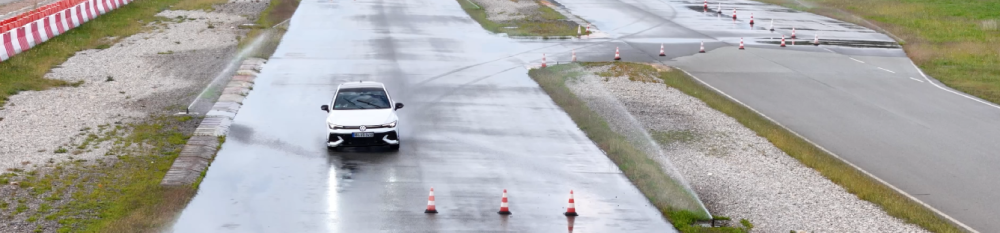
The Hankook and Continental were remarkably similar to each other. Neither had quite the front-axle bite of the very fastest in the group, but both were genuinely lovely to drive - completely manageable across the full two-minute lap from damp surface to standing water with no aquaplaning concerns and a well-planted rear end.
The Bridgestone Potenza Sport Evo was once again remarkable in the wet. The front-end bite was excellent, steering off-centre was quick and well-weighted, the rear remained stable throughout, and aquaplaning was rarely an issue. It was noticeably faster than the Continental and I came away once again deeply impressed by this tire.
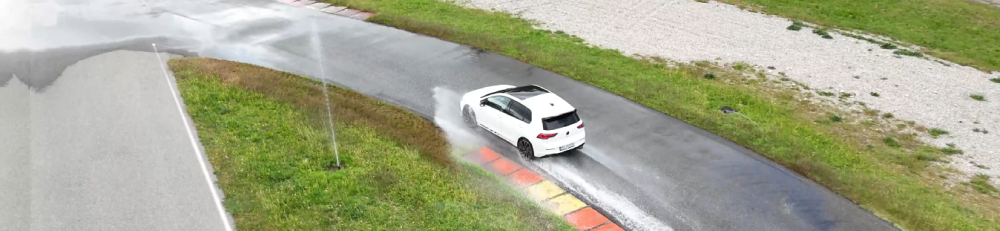
However, the Pirelli P Zero R was faster still - another two seconds over the Bridgestone. It appeared to have unlimited front grip, allowing later turn-in, continued adjustment mid-corner, and earlier and harder power application than anything else in the group. The rear was completely planted throughout; there was no hint of the rear wanting to fight you. Both the Bridgestone and Pirelli received my highest steering enjoyment scores of the group - with hindsight the Bridgestone may have had a marginal edge in reactivity and granularity, but the Pirelli's outright grip level was simply on another level. For a tire positioned as more dry-focused, its wet performance was extraordinary.
Continental managed to just beat Pirelli in wet braking, with the Bridgestone close behind. The Pilot Sport Cup 2 did impressively well considering its low starting tread depth but it couldn't match the more road-focused tires.
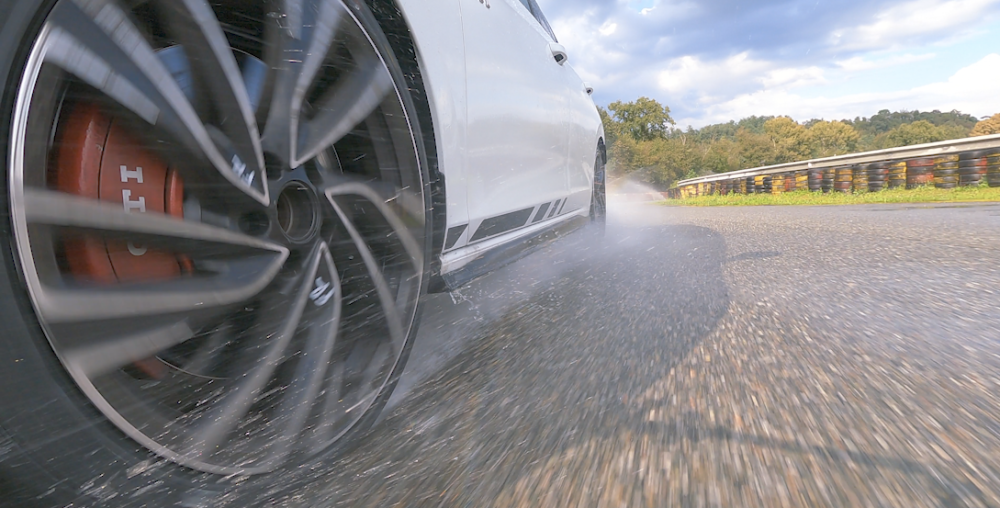
Straight aquaplaning was closer than expected, given the differing natures of the products. Hankook was the best, with Continental once again at the sharp end, with the Pirelli and Michelin very close overall. It's likely curved aquaplaning would have separated these tires further.
Comfort
As always I did run subjective noise and comfort on a reasonably long road route. Unfortunately it started raining so I couldn't do subjective noise across all of the sets. However, to the three of us in the car while doing the comfort testing, it was pretty clear that the Goodyear, Continental and even the Bridgestone were very good in comfort. The Falcon, Hankook, and Pirelli were just a little bit firmer, with the Cup 2 noticeably firmer.
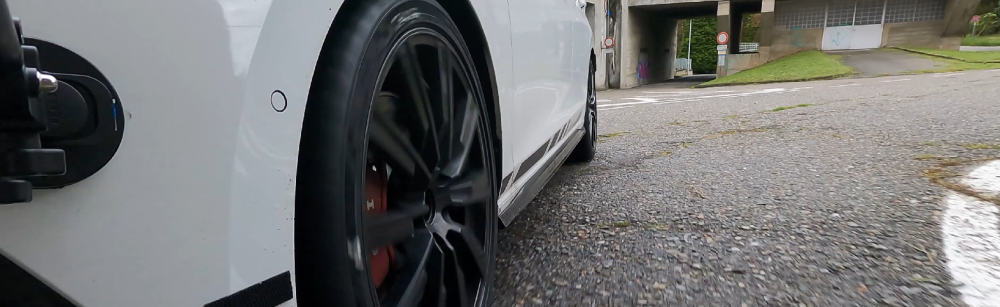
Again, perhaps you don't really care as you are probably willing to sacrifice some comfort for the best handling possible. I know I am.
During the road drive I did also assess the steering response on the road, which was also very close. Goodyear was my favourite by a tiny margin on the road but Bridgestone, Michelin, and Pirelli were all excellent. I haven't scored this category but I thought it would be worth mentioning.
The external noise test had the Michelin best again, which again might be counterintuitive but that's because noise is also a factor of tread depth. The Falken was the next best. All of them were split by just 3.3%
Value
To me, the rolling resistance of this category of tires is less important than regular summer tires, But as these are intended for everyday use, other than maybe the cup 2, the rolling resistance is still a factor so I've tested it.
The Continental and the King Boss were joint-tied for the best rolling resistance, with surprisingly the Cup 2 in third place. It's not what you would imagine when looking at that kind of category of tire, it is a track-focused product afterall so why would they care about rolling resistance, well rolling resistance is quite aligned with tread depth and void, and the Cup 2 has the lowest starting tread depth and the least pattern here so it kind of makes sense.
The rest of the tires were in a little group of their own, which is not going to make much difference in real-world other than maybe the Goodyear Eagle F1 Super Sport, which is showing its age at 10.4 kg/t.
Results

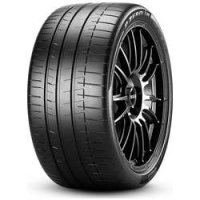
- EU Label: D/A/72
- Rim Protection: Medium
- Weight: 9.6 kgs
- Tread: 6.5 mm
If you told me at the start of the test that one tire would beat the Cup 2 in the dry and the same tire would beat the Continental in the wet, I wouldn't have believed you, but here we are.
It certainly wasn't the most comfortable and it doesn't have the lowest rolling resistance but I really don't care. This tire is awesome and I would like to fit it to everything I own; which brings me to the biggest issue with it, the size range. I think there's currently only 3 non-OE sizes, so if you are one of the blessed ones, do it, and if you're not, I've been told there are more coming very soon.
| Test | # | Result | % |
|---|---|---|---|
| Dry Braking | 1st | 31.7 M | 100% |
| Dry Handling | 1st | 76.48 s | 100% |
| Subj. Dry Handling | 1st | 8.75 Points | 100% |
| Test | # | Result | % |
|---|---|---|---|
| Wet Braking | 2nd | 24.89 M | 98.59% |
| Wet Handling | 1st | 99.38 s | 100% |
| Subj. Wet Handling | 1st | 8 Points | 100% |
| Straight Aqua | 6th | 76.1 Km/H | 97.31% |
| Test | # | Result | % |
|---|---|---|---|
| Subj. Comfort | 5th | 6.75 Points | 93.1% |
| Noise | 4th | 73.2 dB | 97.4% |
| Test | # | Result | % |
|---|---|---|---|
| Rolling Resistance | 6th | 9.8 kg / t | 89.8% |
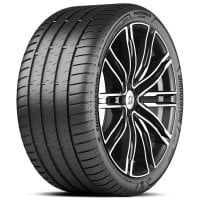
- EU Label: D/A/72
- Rim Protection: Massive
- Weight: 10.2 kgs
- Tread: 7 mm
It seems like they have done that. I didn't get to do as many laps on the Sport Evo as I wanted to but my gut is telling me the track wear is significantly better than the Potenza Sport, Which was admittedly a very low bar.
As always I want to see more than just my test data to form a firm conclusion but in this test it was a very fun tire and had good grip, So it's showing a lot of promise as being a great enthusiast product.
| Test | # | Result | % |
|---|---|---|---|
| Dry Braking | 3rd | 33.2 M | 95.48% |
| Dry Handling | 3rd | 77.38 s | 98.84% |
| Subj. Dry Handling | 3rd | 8.5 Points | 97.14% |
| Test | # | Result | % |
|---|---|---|---|
| Wet Braking | 3rd | 24.96 M | 98.32% |
| Wet Handling | 2nd | 102.58 s | 96.88% |
| Subj. Wet Handling | 1st | 8 Points | 100% |
| Straight Aqua | 5th | 76.9 Km/H | 98.34% |
| Test | # | Result | % |
|---|---|---|---|
| Subj. Comfort | 2nd | 7 Points | 96.55% |
| Noise | 8th | 73.7 dB | 96.74% |
| Test | # | Result | % |
|---|---|---|---|
| Rolling Resistance | 4th | 9.5 kg / t | 92.63% |
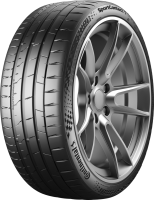
- EU Label: D/A/72
- Rim Protection: Large
- Weight: 10.2 kgs
- Tread: 6.9 mm
In this group its steering response and handling were just a little bit below where I would want to be for a tire that I would use on track a lot, but you can't argue with the fact that this is an excellent tire And one I continue to highly recommend.
| Test | # | Result | % |
|---|---|---|---|
| Dry Braking | 4th | 33.39 M | 94.94% |
| Dry Handling | 4th | 78.42 s | 97.53% |
| Subj. Dry Handling | 5th | 8 Points | 91.43% |
| Test | # | Result | % |
|---|---|---|---|
| Wet Braking | 1st | 24.54 M | 100% |
| Wet Handling | 4th | 104.4 s | 95.19% |
| Subj. Wet Handling | 4th | 7.75 Points | 96.88% |
| Straight Aqua | 2nd | 78 Km/H | 99.74% |
| Test | # | Result | % |
|---|---|---|---|
| Subj. Comfort | 2nd | 7 Points | 96.55% |
| Noise | 6th | 73.6 dB | 96.88% |
| Test | # | Result | % |
|---|---|---|---|
| Rolling Resistance | 1st | 8.8 kg / t | 100% |
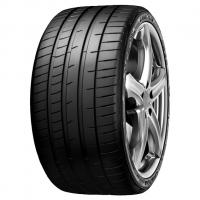
- EU Label: C/A/70
- Rim Protection: Massive
- Weight: 10.2 kgs
- Tread: 7.3 mm
I think now it's just starting to show its age. It couldn't quite match the best in the dry and its rolling resistance is very high but it is still a very good tire. I assume it's going to be priced very well for its longevity, My gut tells me this will be the best-wearing tire here, although I don't have any data to prove that, so ignore me.
| Test | # | Result | % |
|---|---|---|---|
| Dry Braking | 7th | 34.18 M | 92.74% |
| Dry Handling | 5th | 78.66 s | 97.23% |
| Subj. Dry Handling | 4th | 8.25 Points | 94.29% |
| Test | # | Result | % |
|---|---|---|---|
| Wet Braking | 6th | 26.95 M | 91.06% |
| Wet Handling | 3rd | 102.7 s | 96.77% |
| Subj. Wet Handling | 1st | 8 Points | 100% |
| Straight Aqua | 3rd | 77.6 Km/H | 99.23% |
| Test | # | Result | % |
|---|---|---|---|
| Subj. Comfort | 1st | 7.25 Points | 100% |
| Noise | 3rd | 72.4 dB | 98.48% |
| Test | # | Result | % |
|---|---|---|---|
| Rolling Resistance | 8th | 10.4 kg / t | 84.62% |
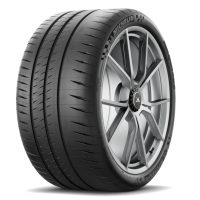
- EU Label: D/C/70
- Rim Protection: Small
- Weight: 10.2 kgs
- Tread: 5.7 mm
I think people give the cup 2 too much credit as a fully focused track tire, probably because Michelin officially say it's an 80:20 track-to-road tire.
A lot of the time it doesn't even feel that focused, especially compared to the North American 200 treadwear category. I really enjoyed this tire; however, I wouldn't rush to recommend it for a UK-based person for year-round use, I have a video demonstrating its cold, wet weather performance and it really does harden up. That's something to keep in mind. Though maybe similar tires around it will suffer similar consequences, your reviews will tell me that once you've used them.
| Test | # | Result | % |
|---|---|---|---|
| Dry Braking | 2nd | 32.97 M | 96.15% |
| Dry Handling | 2nd | 76.8 s | 99.58% |
| Subj. Dry Handling | 1st | 8.75 Points | 100% |
| Test | # | Result | % |
|---|---|---|---|
| Wet Braking | 7th | 28.04 M | 87.52% |
| Wet Handling | 6th | 107.09 s | 92.8% |
| Subj. Wet Handling | 6th | 7.5 Points | 93.75% |
| Straight Aqua | 6th | 76.1 Km/H | 97.31% |
| Test | # | Result | % |
|---|---|---|---|
| Subj. Comfort | 8th | 6.25 Points | 86.21% |
| Noise | 1st | 71.3 dB | 100% |
| Test | # | Result | % |
|---|---|---|---|
| Rolling Resistance | 3rd | 9.2 kg / t | 95.65% |
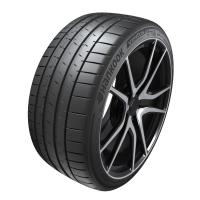
- EU Label: D/A/72
- Rim Protection: Small
- Weight: 10.2 kgs
- Tread: 6.9 mm
| Test | # | Result | % |
|---|---|---|---|
| Dry Braking | 5th | 33.93 M | 93.43% |
| Dry Handling | 6th | 79.15 s | 96.63% |
| Subj. Dry Handling | 7th | 7.75 Points | 88.57% |
| Test | # | Result | % |
|---|---|---|---|
| Wet Braking | 4th | 25.71 M | 95.45% |
| Wet Handling | 5th | 105.19 s | 94.48% |
| Subj. Wet Handling | 4th | 7.75 Points | 96.88% |
| Straight Aqua | 1st | 78.2 Km/H | 100% |
| Test | # | Result | % |
|---|---|---|---|
| Subj. Comfort | 5th | 6.75 Points | 93.1% |
| Noise | 5th | 73.3 dB | 97.27% |
| Test | # | Result | % |
|---|---|---|---|
| Rolling Resistance | 7th | 9.9 kg / t | 88.89% |
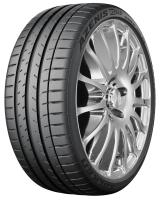
- EU Label: D/A/70
- Rim Protection: Medium
- Weight: 10.8 kgs
- Tread: 7.1 mm
| Test | # | Result | % |
|---|---|---|---|
| Dry Braking | 6th | 34.05 M | 93.1% |
| Dry Handling | 7th | 79.17 s | 96.6% |
| Subj. Dry Handling | 5th | 8 Points | 91.43% |
| Test | # | Result | % |
|---|---|---|---|
| Wet Braking | 5th | 26.29 M | 93.34% |
| Wet Handling | 7th | 107.59 s | 92.37% |
| Subj. Wet Handling | 7th | 7.25 Points | 90.63% |
| Straight Aqua | 4th | 77 Km/H | 98.47% |
| Test | # | Result | % |
|---|---|---|---|
| Subj. Comfort | 5th | 6.75 Points | 93.1% |
| Noise | 2nd | 71.6 dB | 99.58% |
| Test | # | Result | % |
|---|---|---|---|
| Rolling Resistance | 5th | 9.6 kg / t | 91.67% |
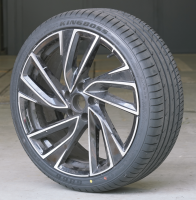
- EU Label: D/C/72
- Rim Protection: Small
- Weight: 10.5 kgs
- Tread: 6.35 mm
| Test | # | Result | % |
|---|---|---|---|
| Dry Braking | 8th | 38.92 M | 81.45% |
| Dry Handling | 8th | 82.21 s | 93.03% |
| Subj. Dry Handling | 8th | 7 Points | 80% |
| Test | # | Result | % |
|---|---|---|---|
| Wet Braking | 8th | 31.48 M | 77.95% |
| Wet Handling | 8th | 117.14 s | 84.84% |
| Subj. Wet Handling | 8th | 6 Points | 75% |
| Straight Aqua | 8th | 75 Km/H | 95.91% |
| Test | # | Result | % |
|---|---|---|---|
| Subj. Comfort | 2nd | 7 Points | 96.55% |
| Noise | 6th | 73.6 dB | 96.88% |
| Test | # | Result | % |
|---|---|---|---|
| Rolling Resistance | 1st | 8.8 kg / t | 100% |
Can you tell me how you tested the Pirelli P Zero R when they are not in production yet? Or at least not in the UK yet.
Naming tires Kingboss needs a significant dose of overconfidence and serious lack of invention ???
so, best one for 18" goes on Bridgestone?
This is a FWD car.
Would love to see the exact tire test on a mid engined car to see what the differences are.
And if using a 4.0 718 GTS Boxster, doing the wet laps with the top down to dodge the sprinklers. Would be a fun end to the video...
This Pirelli is crazy. Lets be honest, dry handling is the only major thing for these tires. And the Pirelli beat the semislick CUP2? What the hell. And its not a hard compund, so its not a pain for everyday use, to heat them up before the playtime. I hate Pirelli from my heart... having 3 different compounds in the last 4 years, and every single one of those gone rubish after 3-4years passed...they are getting harder, rigid, and very very very bad...dangeouros wet performance. Do you have any kind of information if these latest class leading tires are somehownl different? (I had issues with the classic P Zero, and sottozero 2) I'm a follower since about 10years, and was waiting to have something better then PS4S. Last year I went with the SC7, since that is a tiny bit better. Vut omg!!! 2 seconds improvement? Perfect feeling? Semislick killer??? It was never heard. 2 seconds is a unuverse difference. I have to try this . My mk3 Focus Rs has the exact sime size :D .
Btw what happened? Last years the SC7 was the awesome perfect nonplusultra. (Much better then Supersport) but now seems mediocre. Did the compoune change?
I completely disagree, living in the UK. Last 6 months in the UK have been 50% more rain than the long term average. Now finally the sun came out and took my MX5 for a spin
Stuck behind
Learner
Dustbin van
Two blokes on 1950s motobikes
cyclists
In that order.
Not sure my tires even warmed up !
Having said that, the Pirelli R does seem fast.
Yeah, we can agree, that in the UK its hard to have a proper weather for a spirited drive. I dont live in the UK, I can have my sprints in the dry :D
Thanks for the review !
Now it's getting a bit older, good to see where the Continental is
Too bad :( It seams this new Pirelli is only available from 19" at the moment :-/ (My car drives on 18")
I would have like to see the Kumho Ecsta PS72 instead of this KingBoss
Thanks a lot. The "Pirelli P Zero R" is a positive surprise!
Please consider for next test: Use Michelin Pilot Sport Cup 2 Connect instead of Michelin Pilot Sport Cup 2 (without Connect) as tire rubber compound (among other things) has changed in 2020 with version "Connect" (off. treadwear 240 instead of 180 .. / change is more on paper). "Connect" rubber with slightly better results in wet and cold conditions.
Thanks for the great data. I’ll probably go with the Potenza Sport Evos for my Golf MK 8 GTE. I was debating between the Michelin Pilot Sport 5 and the Pirelli PZ5, but considering the milder climate here in the Netherlands, I think this might be the best choice.
Yep. Same for me. I'm currently on GY Asym 6 on my Fiesta ST. Brilliant tire but fitted as you don't get the really good tires in 17 inch so the 6 does a fine job. But Bridgestone have seen the light ! Happy days.
Exellent point, I have exactly the same problem with my MX5 which has 17 inch wheels, so also went with the Asym 6 and will be going Bridgestone next also. 17 inch wheels are also limited in choice.
I think some companies are missing out a trick not doing 16/17 inch anymore. Certainly limits our choice, which is unfortunate.
I also have an ND MX-5 and I’m currently running 5-year-old Hankook Ventus S1 Evo 2s. Since I’ve never had to shop for tires before, I’ve been trying to do as much research as possible.
Right now I’m leaning towards the Goodyear Eagle F1 Asymmetric 6 or something from Continental. Unfortunately, the roads where I live are pretty rough, and the Miata is my daily driver.
One thing I really miss is steering feedback, which is why I’ve pretty much ruled out the Michelin PS5 and PS4S - from what I’ve gathered, they’re very grippy but a bit numb and less communicative.
I’m mainly looking for something that’s fun and progressive, with good feedback and more controllable oversteer compared to my current tires (which are fun but can be a bit snappy and hard to catch, especially now that they’re worn).
Curious to hear what you guys are running in 205/45 R17 on stock 17" wheels.
Unfortunately I can’t change tire sizes here without paying around €200 for legalisation, so I’m sticking with OEM size.
Well I am running the Asymetric 6 but not done enough miles in all conditons to give you advice on your particular requirement of a good feedback tire that stops it going from great to pear shaped very quickly.
Previously I had Michelin Pilot SuperSports on which were very grippy on track, but then I ended up in a nettle patch on a cold wet UK day with them.
I think the Continentals might be a good bet, but they probably cost more. The Goodyears have always been a good bang for buck tire and a jack of all trades tire, which is not a negative comment, they are well rounded, good on those spider graphs tire companies love.
Good luck, and great choice of car of course :)
Agree with all that. Also have supersports on my Lotus, would like to try the Pzero R but size not available. Will settle for Corsa's next.
Thanks guys, I think I’m going to go with the Goodyear Eagle F1 Asymmetric 6.
After checking a bunch of local shops, it seems to be the best all-round bang for buck. It’s about €100-150 cheaper than the Michelin Pilot Sport 5 and Bridgestone Potenza Sport, and only around €60 more than the Falken FK520.
Best prices I've found for 4x Tires (including fitting, balancing, and alignment):
PS5 - €668
Asym 6 - €568
Potenza Sport - €668
Falken FK520 - €508
Given that, the Goodyear just feels like the sweet spot for a daily-driven ND.
Also, if anyone here is from Portugal and looking for a good shop, I had the best experience/quotes from Riamar Pneus - highly recommended.
I’ll probably pair them with a custom alignment setup as well to improve steering feedback, something along the lines of the Flying Miata specs.
I don't think you will be disappointed with the Goodyear. It's a fantastic tire, good price point to ( in the UK). I found it sharper than the Pilot Sport 4 which I guess is it's nearest competitor). We still stick with the PS4 for the wifes BMW as its slightly more comfortable on a very stiff BM and one thing MIchelin excell in ( I think ) is still very good wet braking when worn down. Perfect for the wife. GY but now moving to Bridgestone for me. (205/40/17)