
Michelin and BMW spent over 2.5 years making the perfect tire for the new G80 BMW M3 and G82 BMW M4. Here's all the work and changes that went into the project!
Testing Methodology

- Test Driver
- Jonathan Benson
- Tire Size
- 275/35 R19
- Test Location
- Professional Proving Ground
- Test Year
- 2021
- Tires Tested
- 2
Immediately when driving the car I felt sure the Pilot Sport 4S was no ordinary 4S, as it felt quicker to steer, stiffer, and seemed to give you more feedback, all things I've wanted from the 4S.
To find out whether this was just the car, or whether the tire was in fact different, I dropped a message to Michelin, who invited me out to their test facility in France to find out first hand.
Before driving the two sets of tires, I was lucky enough to interview the lead developer of the new * marked PS4S Pierre Chapu, and what I thought was going to be 5 mins chat turned into well over an hour of awesome tire geeking! Because this is far too long to put into a single youtube video, I'm going to try my best to answer some of the common questions you've had around OE tires, but if you really want to hear all the details, I'll get something up on tire-reviews.com.
What are some characteristics that BMW specifically requests when homologating tires?
Pierre said that BMW M are a very technical OEM to work with, and while they work on every aspect of the tires performance, their key goals revolve around maximum dry grip, and precise steering with quick reaction at small steering angles… all things I really love. While this does come at the expense of some wet performance, it's very important to BMW that the balance and driveability of the car isn't lost in the wet, but it's fair to say that overall the focus is on dry performance, perhaps led by a famous certain german track.
As for the other aspects of the tire, PS4S is already excellent in noise and rolling resistance for it's class, something I've proven in tests, so the two tires are similar there, and while BMW M don't push for comfort, internally Michelin have a rule that the tire can't stray too far from the original product line, which means comfort is considered.
What are the exact differences between the * marked PS4S and the regular aftermarket tire?
This is the bit that took nearly an hour to explain, so I'll be paraphrasing a lot here, but a lot has changed!
The compound is the biggest difference, as with the OE tire you can design the compound around the specification from BMW, and the changes are far greater than even I'd imagined with my small amount of insider knowledge.
The aftermarket tire has a 2 compound design, with what Michelin calls black carbon + on the outer section of the tire for cornering grip, and a high silica compound on the rest of the tread which is great for many things like wet grip, low rolling resistance and good mileage.
The BMW specification front tire not 2, but FOUR compounds! Firstly, the black carbon compound they use is black carbon+++, with two extra plusses. This I've been told is more like the cup 2 compound than the 4S.
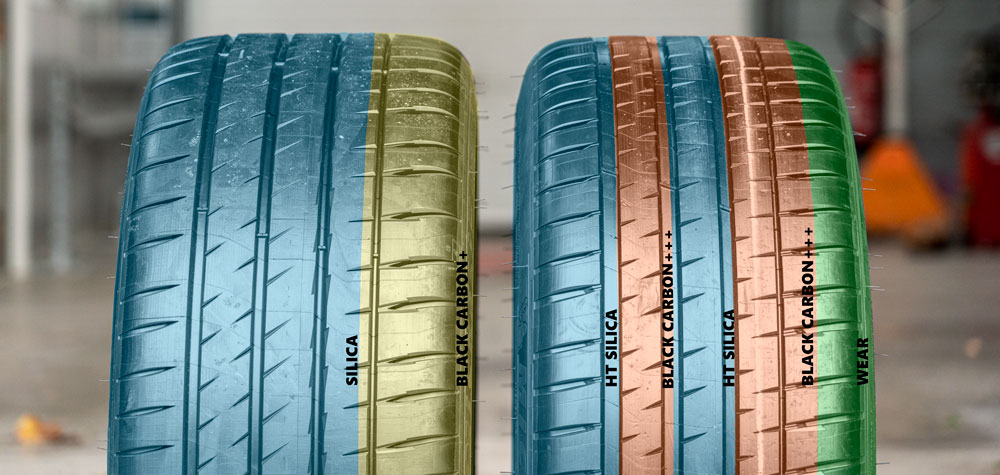
As this compound is more grippy, but can also have higher wear, so to balance that the OE tire gets a high wear compound on the outer shoulder to improve wear characteristics on track. As we move into the tire, like the OE tire we get back to a silica based compound, but one tuned to work better at higher temperatures. As this still wouldn't meet the BMW M requirement of dry grip and steering precision, Michelin have laid another rib of black carbon +++ to give the tire even more grip and direction change, then back to the high temperature silica.
As for the construction, well that's all different too. The OE cap ply has the same materials as the aftermarket tire, but it's laid at a different tension which changes the contact patch on the road. The belting is actually tighter in the middle for improved steering precision, which to me is crazy levels of engineering!
The steel belting under the cap ply is also changed, it's wavy instead of flat which dips into the tread more, further improving rigidity, and the angle of the belts have also been tuned to help the tires work perfectly with this G80 M3.
Naturally, the sidewall rigidity is also tuned. As the M3 puts a lot of demands on the front axle they increase the sidewall stiffness, and they even change the groove locations, width and starting tread depth to further tune the tire in line with the BMW demands. While that might sound bad for wear, apparently it's not, as the narrower grooves mean there's the same amount of rubber to go through as the aftermarket tire.
How long did this project take?
Michelin and BMW started the PS4S development program in 2017, and the first production tire was made in mid 2020, that's more than 2.5 years of development.
There were 8 test loops with bmw in total, with more than 30 different versions of the PS4S for each axle, and the tires were tested at Miramas (France) Nurburgring (Germany) Idiada (Spain) Ladoux (France) Ascheim (Germany), which is an impressive array of tracks.
One final note, the development engineer said that this generation of BMW xDrive system is very sensitive to overall tire sizes, something to keep in mind when trying to decide about the OE vs aftermarket tire.
Be sure to watch the video to see all the subjective differences in handling between the OE and Aftermarket versions of the excellent Michelin Pilot Sport 4S!
Dry
Wet
Results
| Test | # | Result | % |
|---|---|---|---|
| Dry Handling | 1st | 70.63 s | 100% |
| Test | # | Result | % |
|---|---|---|---|
| Wet Handling | 2nd | 99.3 s | 98.32% |
| Test | # | Result | % |
|---|---|---|---|
| Dry Handling | 2nd | 72.47 s | 97.46% |
| Test | # | Result | % |
|---|---|---|---|
| Wet Handling | 1st | 97.63 s | 100% |
Hello,
Could you help choosing between 4s* and pirelli pz5 for f80 m3? Does 4s* still offers superior dry handling and feel or that tire is just old now and pz5 offers similar dry performance while having much better wet grip? I am doing track days one in a couple of months.
Thank you!
I'm about to pull the trigger on an M3 G80 xDrive that's less than a year old with less than 1000 miles, from a BMW main dealer, which is in near perfect condition (as you might expect). However, I've noticed the fronts are PS4S*, while the rears are PSS*.
The dealer is refusing to change the rears to PS4S* as the current PSS* are seemingly still BMW/Michelin approved for the model. Is this difference likely to problematic, and should I walk away, which is my current inclination?
Interesting question. I don't know the specifics of the G80 but I would be surprised if the PSS was homologated against that particular vehicle given Michelin and BMW spent a lot of money putting the PS4S on it. Perhaps it's another homologation like an M5, but if the rear size is unique to the G80 they might be correct.
Still, i'd want matching tires, the PS4S should be a lot better in the wet than the PSS and you don't want less wet grip on the rear axle.
Clearly, in this application, those with certain priorities should get OE. Much does, however, depend on priority alignment of manufacturer & tire buyer.
Say a manufacturer fitted tires deigned to maximise fuel economy but one's own priorities favoured wet grip. Or: comfort versus responsiveness; or: longevity versus wet grip & so on.
Hi,
I've got a BMW 530i - front PS4S(245/40 ZR19) and rear PS4 S*(275/35 ZR19). Now I know they are different tires. :( Should I change the OE to Michelin PS4S? Or try to get used to it.
The rear tire will be more dry optimised so I'd suggest keeping that in mind in wet and especially cold and wet conditions!
Ok, Thanks!!
"The BMW specification front tire not 2, but FOUR compounds!"
Interestingly the 225/40 R18 PSS HN spec (Hyundai i30N) looks the same. I gathered why road dust was sticking to the rubber. It's not just outer edge harder compound on the rest of the tread, but another rib is obviously different.
Oo, got any pictures?
Hi,
Excellent article as always.
A question on a different OE. My weekend toy, a Porsche Boxster 987S, is running on N rated Michelin tires at present (Pilot Sport Cup 2 front, Pilot Super Sport rear, - a bit too track focused for me but they were on the car when I bought it) which are near the end of their relatively short life.
If I stick to N rated tires for their replacements am I missing out on new tire developments? For example the N rated Goodyear tire is an Eagle F1 Asymmetric but the non N version of that tire is now in its sixth iteration, similarly the N rated Michelin road tire is a PS2 whereas the 'normal' tire is a PS5 or PS4S. Are the OE tires frozen in time or do they evolve as well?
They are frozen, it's part of the OE agreement, so unless there's a new N version out (n2, n3 etc) then you're dealing with an old tire
Hello,
I ask for your recommendation. I have a BMW M340i xDrive 2021. Using the car is mostly on the street, sometimes (twice a year) track day without drifting.
My decision is:
1. Michelin PS4S *
225 / 40x19 front
255 / 35x19 rear
2. Goodyear Eagle F1 asymmetric 6
255 / 35x19 front and rear
3.Michelin PS4S *
255 / 35x19 front and rear
Thank you so much and keep up the amazing work
I would probably stick with OE in this case, so option 1
Please, and only for the street without Track days?
Or do you recommend any other tires and other dimensions?
Thanks.
The same
Fantastic article and video!!
I've been in analysis paralysis choosing tires for my 2016 m235i coupe for a month now and need some help. (God I hate that they reused m235i for the new "Gran Coupe") I'm thinking of moving to 235/40 on some sweet BimmerWorld 18x8.5" TA5R wheels and see that there's both a standard and a Ford OE DT1 version of the PS4S. I think the DT1 was OE on the Ford Focus ST.
The only differences in specs on the DT1 version I've found are 0.5/32" shallower and 0.3" narrower tread as well as a HUGE 1.9 lbs weight savings. By my calculations, the narrower tread width would account for only about 1/3 lb weight savings so it leaves my wondering where the rest of the weight savings came from. That relatively large weight savings is fairly attractive, more for handling feel and comfort that raw lap times, but I'm worried that Ford/Michelin may have optimized the DT1 for something that I care less about.
You replied to someone somewhere else saying that you don't know what the difference in the DT1 version is (can't find that right now). I've tried calling both Tire Rack and Michelin and couldn't get any more information. How can I get in touch with someone helpful at Michelin? Could you ask Pierre Chapu or send me his contact info? Thanks!
Michelin UK have a customer service technical contact email somewhere on their website (or maybe just a normal contact address / form), there's a technical guy called Brian who deals with these emails and will certainly have all the answers as he''s a tire genius, I'd try that route initially. Let me know how you get on!
are all the ps4s bmw tires the same regardless of size? you mention the front tire has 4 compounds is that different to the rear tire?
Do you think there would be much difference in the wet braking distances between the OE and normal PS4S?
It seems the BMW version of the ps4s might be a good option for non bmw cars for people who want better steering response but dont want to run cup2 tires
This specification of tire is only made in the G80 sizes, and as they are fairly specific and staggered wheels it's unlikely they'll be able to fit other vehicles.
The Michelin website lists 255/35r19 and 275/35r19 and several other sizes as star (bmw) tires, does Michelin develop different tires for each size bmw
They are probably PSS for the F80
I have a 2014 BMW M6 Gran Coupe with Michelin Pilot Super Sports and have been through 2 sets already in the last 7 years. Would you recommend Pirelli for a change ? How do they compare ? I do not do track days, just normal everyday driving
Hey! I'm not sure anyone has ever tested the Pirelli OE vs BMW OE, in theory there shouldn't be much in it.
In this case as your car is 2014 and the PSS has been replaced, I'd suggest seeing if anyone has moved over to an aftermarket PS4S and felt it was an upgrade, as it could be the case now!
Best reviews and tire information on the Internet!
Do you know what characteristics Audi put into OE tires? I have an Audi A3 and the rears are Goodyear Eagle F1 Supersport but now the fronts are due and I can only get the F1 Supersport in the AO version due to current availability.
I cannot find anywhere that explains what the difference is and I avoided AO on the back as Audi are known for being a bit safe and steady, rather than prioritising handling like BMW do. Is there as much of a difference in AO tires as you found in this test?
Thanks and keep up the good work.
I don't, sorry, I guess it depends on vehicle too, I'm sure Audi RS are all for handling and grip. I do know Audi require pretty good mileage from their OE tires so they should wear well.
Thanks for replying. I've gone with the AO tire anyway. It would be nice if all tire manufacturers published the level of detail you gave in this comparison test so we can make an informed choice.
I think it´s impossible to get details without a test. The car-dealer is instructed to say that the OE-tire is optimal for this car and with an other tire the car will have a worse behavior in handling and noise.
Does it apply only to BMW M tires size or to all PS4S available with * specification? Thanks
This test applies to the G80 M3/M4 fitment, but other * marked tires will have gone through a similar process
Thank you !
Considering that the Michelin Pilot Sport Cup 2 is already a great track day tire, I wonder how its OEM versions are! As far as I know, they are being sold OEM for BMW, Mercedes and Porsche in, at least, 245/35 R19 and 265/35 R19 sizes, and for Porsche, Ferrari and Jaguar on 245/35 R20 and 265/35 R20 with considerably different EU labels. So, different compounds (or compound cocktails) and belting for different auto makers... Interesting!
I just wonder, how far apart is this Michelin Pilot Sport 4S* from the Pilot Sport Cup 2 or Cup 2 Connect?!
Good news, I have a video coming on 4S* vs Cup 2 Connect * :)
The gap is certainly smaller than 4S vs Cup 2
Great news, then! Can't wait!