
Runflat tires have a bad reputation; they’re known for having poor ride comfort, tramlining, noise, low levels of wet grip, and if you puncture them very few places will actually repair a runflat due to the risk of sidewall damage. One new runflat tire which nearly solves the runflat comfort and grip issues is the Bridgestone DriveGuard. (full report) This new type of runflat can be fit to any vehicle, and offers a very similar general experience to a regular tire, but will still deflate in the event of a tread puncture.

The alternate to runflat is the new seal technology. Pioneered by Continental tires, who are the sole supplier to VW for OE ContiSeal tires, seal tires have a different approach to ditching the spare.
Instead of a hard sidewall that allow you to run safely on the tire when it’s deflated, the seal technology aims to stop the tire being deflated in the first place. While the implementation is a little more high-tech than the “can of gunk” you put in bicycle tires to avoid punctures, the theory is the same. The seal tires have a 2 part chemical "near solid" compound bonded to the inside of the tire tread, which when exposed to air in the event of the puncture, instantaneously fills the void and hardens up.
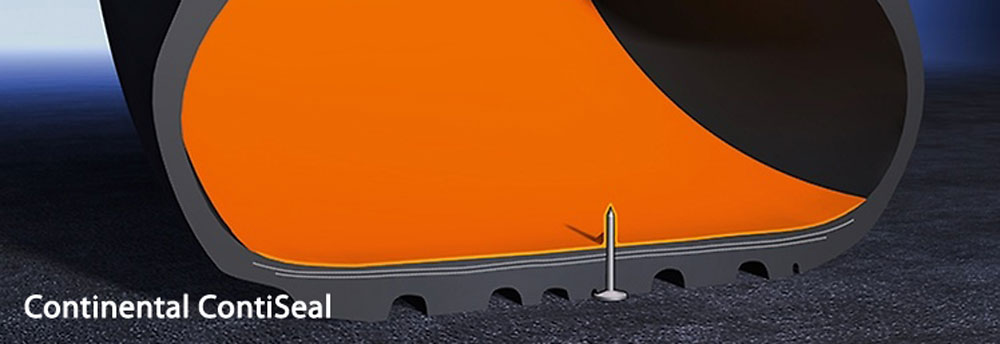
This means that while a runflat allows you to stay mobile with a flat tire, the seal tires can avoid the issue all together. They can literally be punctured 100's of times without losing any meaningful pressure, and it works right down to the legal limit of 1.6mm.
The added bonus of not needing to run when deflated means these perform as normal tires do, so you won’t get any grip, comfort or handling issues as you do with runflat tires. The only real drawbacks to a seal tire is in the unlikely event of an issue with the sidewall or a large slash to the tread - a runflat tire will still keep you mobile, where a seal tire would deflate like a regular tire and leave you stranded.
Is it a Solution?
Is there a golden bullet to not carrying a spare? We’d still prefer a normal tire with a spare, but if we had to run without one, the seal tire would be the more practical tire in the event of a large percentage of punctures, but the runflat / DriveGuard is still the only solution to ensure mobility no matter what happens.
Continental are currently adding seal technology to many aftermarket patterns and sizes, and we can expect other manufacturers to quickly follow suit. Perhaps even BMW will one day be convinced of the benefits of a seal tire over a traditional runflat...
A runflat/seal tire would seem to cover all eventualities?
It would but I imagine the cost would put a lot of people off
I'm after some new tires for my bmw it's got 275 35 r20 on the rears which I need to replace. I want something quiet. Currently have Bridgestone run flats on it.
The Bridgestone DriveGuard is probably the quietest runflat, but Seal technology tires should be even more comfortable.
Hello everyone, please could someone help me..
i need a bit of advice, we are looking to buy a new car (hybrid or full electric he he.. i'm still not decided yet between Golf GTE & e-Golf) since both models are more heavy then the normal Golf i need advice regarding tires, should i get a full set of Run-flat or a full set of sealed all season considering the fact that both cars i mentioned do not have spare tire (just the emergency flat kit) from the factory and as i mentioned since the cars are heavy and with people and luggage these type of tires in theory probably will last a bit longer than normal tires..
many thanks, in advance ! :)
As far as I know, no modern Golf suspension is designed to be used with a runflat. That's not to say you can't use a runflat, but a seal tire, which behaves much more like a normal tire, would likely be the better choice in this case.
The Bridgestone DriveGuard is also worth looking at, but there is no all season version of this tire.
Very useful response i'll consider that.. Tank you.
I know, I know, old thread and all that. I'd rather have a spare, too. But TJ's comment tells it straight.
I add my tuppeny bits-worth to liking the notion of self sealing tires.
Must say I prefer the idea of seal tires.
However, I have a great idea, why not have a spare wheel? 'Revolution-ary!' (I'll get my coat...)
Unfortunately I think OEMs are pushed to save weight and cost where they can; dropping 10kg and saving 40€ is a win win for them. Especially in an area where it's accepted by the marketplace.