

It's been a while since we've mentioned basic tire safety, but with the latest research from Michelin and Kwikfit showing four in 10 motorists are running on dangerously under inflated tires, it's as good as time as any to remind everyone to check their tire pressures.
Under inflated tires are an issue for many reasons. An under inflated tire can give poor handling, unpredictable car behaviour, lower overall grip, wear the tires out prematurely, cause the tires to fail, and reduces fuel economy. It only takes 2 minutes to check tire pressures with a dedicated digital tire pressure gauge, so there's no excuse not to do it every couple of weeks.
While checking pressures, you can also visually inspect your tires to ensure there's no unexpected damage and that the tires still have good tread remaining. Keeping your tires in a good condition is the first step to safe motoring.
Here's the full press release from Michelin.
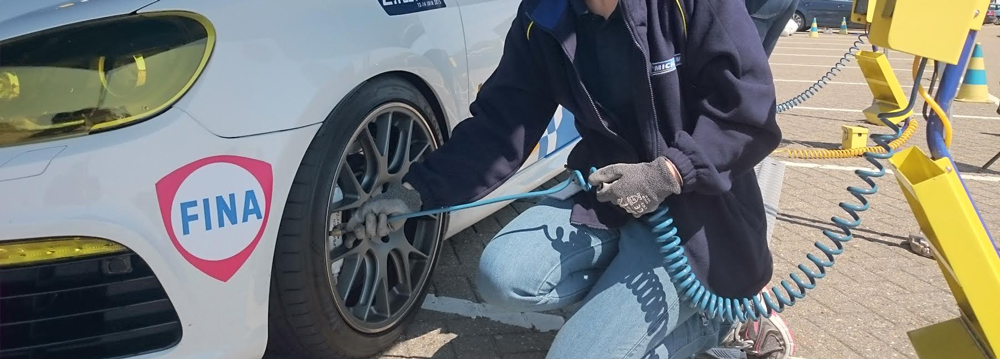
Four in 10 motorists using “dangerous” or “very dangerous” tires
Almost 40 per cent of cars in the UK are running on at least one tire that is “dangerously” or “very dangerously” underinflated.
The figures come after Michelin and Kwik Fit inspected more than 500 vehicles in Tesco car parks around the UK.
Michelin classifies tires that are between 7psi and 14psi below the manufacturer’s recommendation as “dangerously underinflated”, while 14 psi or more underinflation is deemed to be “very dangerous.”
Michelin and Kwik Fit technicians found 27.56 per cent of cars had at least one dangerous tire, with 12.01 per cent having at least one very dangerous tire. Jamie McWhir, technical manager for Michelin in the UK, said: “Driving around on underinflated tires costs money and it can cost lives. “We wanted to team up with Kwik Fit to encourage motorists to check their tire pressures regularly. It makes sense from a cost and environmental point of view, but more importantly it’s critical for the safety of the vehicle, its passengers, other road users and pedestrians.”
Running a car with tires underinflated by 7psi decreases fuel efficiency by about one mile per gallon. Michelin estimates that underinflated tires could be costing motorists in a city the size of Manchester more than £2 million a year in unnecessary fuel consumption – as
well as pumping thousands of tonnes of additional CO2 into the atmosphere.
Roger Griggs, communications director at Kwik Fit, said: “Checking tire pressure is as important as checking tread depth, as tires at the wrong pressure will compromise handling, grip and braking. As well as the significant safety issues, incorrectly inflated tires will hit drivers in the pocket through excessive fuel consumption and increased tire wear. “It’s worth reflecting on the fact that a car’s tires are the only thing to connect it with the road and we urge motorists to check their air pressure, tire condition and tread depth every fortnight.”

Manufacturer's recommended pressures usually don't correctly reflect actual car weight and effort to get equal distribution of hot pressures. Targeted correction of pressures on each axle can improve many aspects of handling...steering weight, heating-up of tires, comfort&grip on uneven surfaces, save suspension components, improve rake (high-speed aerodynamics).
For example slightly higher rear pressure usually brings more agility(less understeer), making the rear more loose. Value of 0.1bar over front pressure is usually sufficient.(for very short journeys +.05 will do) But at first, we should set front pressures. Car weight: 1300kg= ~2.2bar ...1500kg= ~2.3bar ...1700kg= ~2.4bar..respectively their interpolation.(accurate to two decimal places)
With following tuning|improvement of wheel alignment, we can solve: steering consistency and response, building-up of braking action and acceleration, further prolong life of tires and brakes.
With gas filled tires, heating-up of tires will be reduced and more even.
Thanks for your comments. Surely setting the front pressures will not just be an application of a cars weight, but also the FR weight distribution, camber and toe set, and relative tire sizes front and rear.
I agree that test would be interesting.
In Spain, most tire garages recommend to inflate the tires 0,2 to 0,8 bar over the manufacturer recommendation to reduce wear. Specially on directional patterns like Michelin Crossclimate to avoid wear in the outer tread section.
The same happens in other countries like the USA.
It would be interesting to see the results of testing the differece between underinflated tires, overinflated tires and tires having the right pressure.
We have this planned for 2018 :)
To revisit a discussion we had some years ago about doing a piece on tire pressure tuning of handling balance, how about adding that as an element to your planned piece? Most manufacturers' recommended pressures seem to be comfort & understeer biased & much handling improvement can be achieved by not just an absolute pressure increase but a relative increase at the front. Of course tire type & vehicle are key variables concerning the detail of this.
Just to catch up on this discussion, it looks like this video could be two parts.
The first, tire pressure tuning on track, is planned later this year with something like a Caterham, and will cover cold / warm pressure tuning, and how adjusting pressures can change the balance of your cars handling. If there's anything else you'd like to see, feel free to suggest.
A second video on tire pressure tuning for the road would be interesting, but I need to be careful. Recommending people change their road pressures outside of maybe +-2psi over manufacturers recommended pressures could lead to legal issues, especially as it's so vehicle specific, so it's something I'll sadly have to consider further. Again, any suggestions would be more than welcome.
Sounds like the Caterham one would have it covered. My only comment would be to note that one can sometimes improve the relative desirability of a tire which operates at high slip angles & thus is less responsive than a rival which operates at lower slip angles but which is otherwise more meritorious (better wet-compounded say) by playing with tire pressures' front/rear balance.
As for legal risk, perhaps the key would be to recommend nothing but to simply note that not all tires behave the same on manufacturers' pressures & that changes can be wrought in handling behaviour by playing with pressures.
I'll await events then. Ta!
You could use an infra-red camera to measure temps across the tread after some high-speed driving or straight line braking to gauge the perfect pressure. You could also put the front wheels on a weigh bridge and repeat for the rear wheels. I suppose, in theory, it is the weight that determines the optimum? Of course, under steering the 'weight' on each tire changes.