

Due to a number of cold and snowy winters, the UK population now understands winter tires both exist, and aren’t just for snow and ice - they also offer a real benefit when the conditions are cold and wet. This is why tire manufacturers recommend that for the highest level of safety during year round motoring, you should switch between dedicated summer and winter tires.

What you might not be so sure of is how the performance degrades as the tire wears. The UK has no particular laws surrounding winter tire use, but in parts of Europe where winter tires use is a legal requirement such as Germany, a winter tire is no longer deemed a “legal” winter tire below 4mm of tread depth, with some countries have the legal limit at 6mm!
The Test
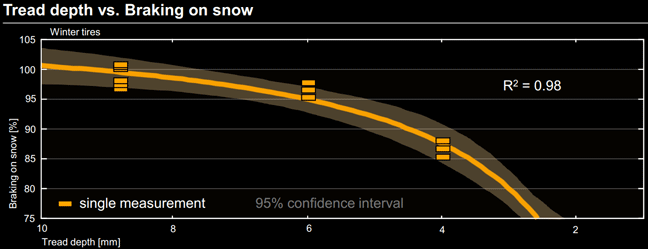
To find out how snow performance degrades as the tire wears, Continental invited us to test its new Continental WinterContact TS860 at full tread depth (around 9mm), 4mm, and the legal UK limit of 1.6mm.
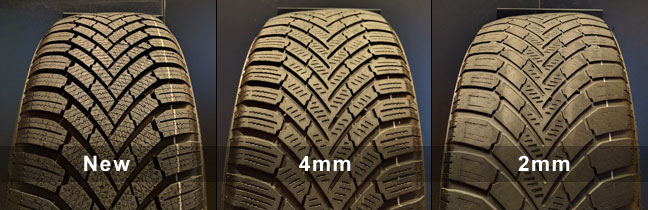
Testing inside the Arctic Circle, and driving new Audi A3s with 205/55 R16 tires fitted, a group of testers ran forty or so snow traction and braking runs on identical cars, in identical conditions fitted with the tires at the various tread depths.
The results plotted an interesting graph. The drop off wasn’t linear as you’d perhaps expect, from 8mm to 4mm tread depth, the reduction in braking performance per mm wear is around 2%, from 4mm to 2mm it doubles, to over 4% per mm. This means that when stopping from just 30 mph on snow, a tire at 4mm would take an extra 14 meters over a new tire to stop you, and at tire at 1.6mm a massive 26 meters!
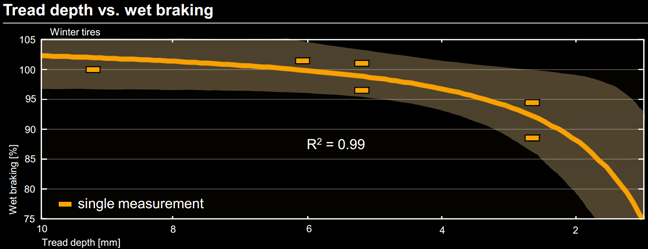
Wet braking, which we didn't experience first hand due to conditions, is even more apparent, but not exclusive to winter tires. Like the snow, from 8mm to 4mm you lose approximately 2% per mm of tread, but at some point after 4mm the degradation doubles to over 8% per mm, largely due to the micro aquaplaning influence!
Why is this?
Winter tires rely heavily on the tread pattern during snow and ice performance. A winter tire needs good tread depth and a blocky pattern to pack snow into the tread, and numerous sipes with sufficient length to bend and provide plenty of edges to cut through the snow and slush to the ice below.
As a tire wears, the volume of tread void to pack snow into lessens, and the number of edges decreases, resulting in a winter tire at 1.6mm with a largely similar performance to a summer tire.
If you want any meaningful snow and ice performance from your winter tire, make sure you don't run them to 1.6mm. If you finish a winter season with less than 4mm of tread depth, consider running them in the summer to the 1.6mm limit, so as not to waste any tread life.
In 2016 we'll be testing the dry performance of a winter tire as it wears.

None of the tires, summer or winter should be responsibly recommended to drive to legal minimum 1,6 mm, as it is in the final part of the otherwise great article, especially not in the UK, considered as typical rain country.
It is de facto leading to illegal tread levels in the UK practise, as most of the drivers are NOT able in practise to determine exactly this 1,6 mm. level in most of the tire main remaining central tread space.
On water roads it is extremely dangerous, especialy with higher speeds and/or more wet/rainy roads.
Average UK tires tread level stats published recently on Tirepress.com are kind of schocking!
And not, I am not from tire production or selling industry, just amateur studying different interent sources and reviews.
So, good luck and safe journey!
Around 15 years ago, when in brief technical correspondence with Car & Driver's then technical editor, I made the suggestion that, to assist in smoothing a tire's wet grip decline in various disciplines of assessment as it wears, it should be moulded such that major channels & siping increase in area as that wear occurs. Moulding technology can handle that. Tread block stability would be achieved by buttresses arching across major channels. The Conti manifestly does not achieve this.
Combine this with layered tread compounds with greater exposure of the softer compound as the tire wears (as practised by Bridgestone at one point) & much of the wet road grip gradient would be flattened.
cheers! Peter
Look into michelins evergrip (i think) tech currently being used that does just that! Certainly bigger grooves and more sipes as the tread wears, along with rubber that ages well...
Goodyear did it first :)
http://www.tirereviews.co.u...
Ah! Didnt know that...
from another discussion:
http://www.rubbernews.com/a...
I assume that the new CrossClimate employs EverGrip.
AllI can say is that my correspondence was in 1999 & the article mentions Michelin USA's first thoughts as being around the same time. Clearly my email was leaked to them by Dennis S. & I am owed huge I.P. sums :-)
Whatever; I'm glad that it's happening.
I asked the question to Michelin this morning. The reply:
We use the same shoulder sipe technologies as the premier a/s has in the crossclimate
So the shoulder sipe on a crossclimate is shaped wider at the bottom to keep the wet grip levels as the tires wear
It's the first tire in our European range to benefit from this
Do you remember Michelin XM+S Alpin tire with Y shaped sipes that double their number when tire is worn? http://m.ina.fr/video/PUB37...