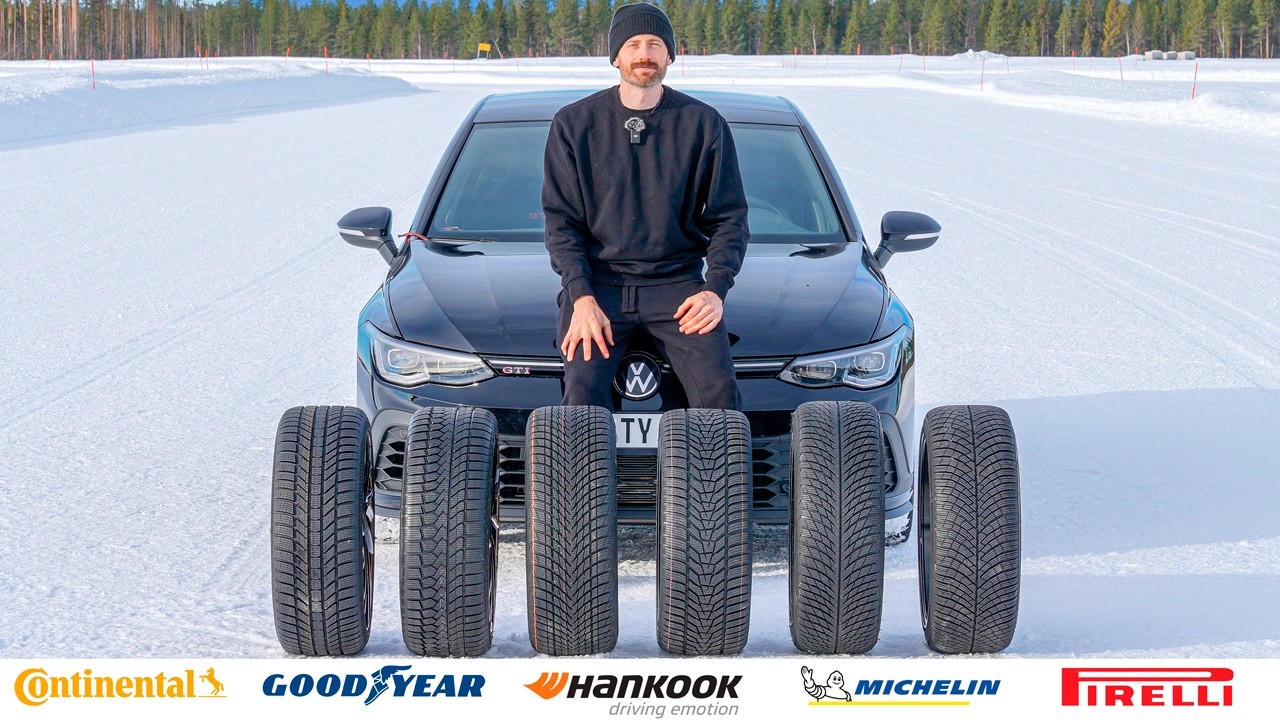
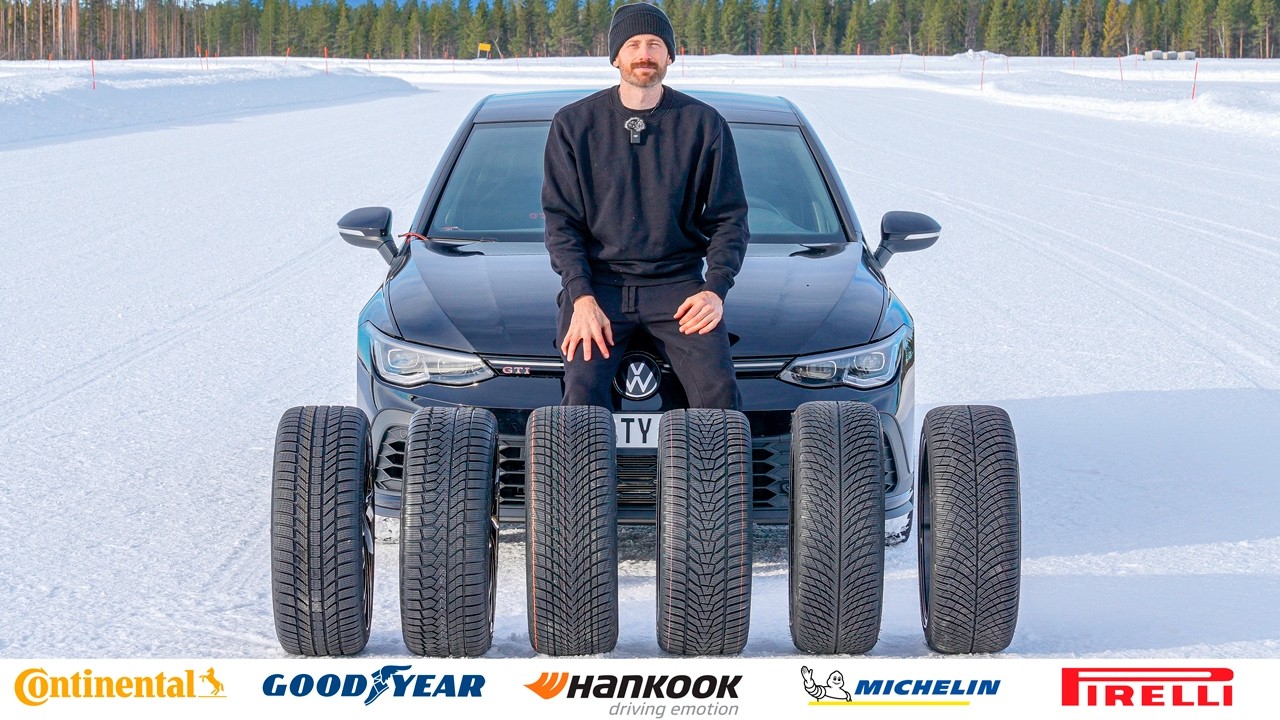
In this test, we selected 6 of the best ultra-high-performance winter tires, and compared them against all-season and summer tires to reveal their true capabilities. We evaluated their performance in dry, wet, snow, and ice conditions, along with comfort, noise, and rolling resistance. The results were remarkably close, and the data from the all season and summer tires is really interesting.
Testing Methodology
Test Driver
Jonathan Benson
Tire Size
235/35 R19
Test Location
Professional Proving Ground
Test Year
2024
Tires Tested
6
Show full testing methodologyHide methodology
Every tire is tested using calibrated instrumented measurement and structured subjective assessment. Reference tires are retested throughout each session to correct for changing conditions, ensuring fair, repeatable comparisons. Multiple reference sets are used where needed so that control tire wear does not affect accuracy.
We use professional-grade testing equipment including GPS data loggers, accelerometers, and calibrated microphones. All tires are broken in and conditioned before testing begins. For full details on our equipment, preparation process, and calibration procedures, see our complete testing methodology.
Categories Tested
Dry Braking
For dry braking, I drive the test vehicle at an entry speed of 110 km/h and apply full braking effort to a standstill with ABS active on clean, dry asphalt. I typically use an 100–5 km/h measurement window. My standard programme is five runs per tire set where possible, although the sequence can extend to as many as fifteen runs if conditions and tire category justify it. I analyse the full set of runs and discard statistical outliers before averaging. Reference tires are run repeatedly throughout the session to correct for changing conditions.
Dry Handling
For dry handling, I drive at the limit of adhesion around a dedicated handling circuit with ESC disabled where possible so I can assess the tire's natural balance, transient response, and limit behaviour without electronic intervention masking the result. I usually complete between two and five timed laps per tire set, depending on the circuit, tire type, and consistency of conditions. I exclude laps affected by clear driver error or obvious environmental inconsistency. Control runs are carried out frequently throughout the session, and I often use multiple sets of control tires so that wear on the references does not become a meaningful variable. For more track-focused products, I also do endurance testing, which is a set number of laps at race pace to determine tire wear patterns and heat resistance over longer driving.
Subj. Dry Handling
Objective data is only part of the picture, so I also carry out a structured subjective handling assessment at the limit of adhesion on a dedicated dry handling circuit. I score steering precision, steering response, turn-in behaviour, mid-corner balance, corner-exit traction, breakaway characteristics, and overall confidence using a standardised 1–10 scale used consistently across my testing. The final assessment combines numeric scoring with written technical commentary. I complete familiarisation laps on the control tire before evaluating each candidate.
Wet Braking
For wet braking, I drive the test vehicle at an entry speed of 88 km/h and apply full braking effort to a standstill with ABS active on an asphalt surface with a controlled water film. I typically use an 80–5 km/h measurement window to isolate tire performance from variability in the initial brake application. My standard programme is eight runs per tire set where possible, although the sequence can extend to as many as fifteen runs if conditions and tire category justify it. I analyse the full set of runs and discard statistical outliers before averaging. To correct for changing conditions, I run reference tires repeatedly throughout the session — in wet testing, typically every three candidate test sets.
Wet Braking - Cool
This test follows the same procedure as the standard wet braking test — entry speed of 88 km/h, full ABS braking, VBOX measurement over the 80–5 km/h window — but is conducted at cooler ambient temperatures, typically below 7°C. The lower temperature allows assessment of how each tire's compound performs when cold, which is particularly relevant for all-season and winter tire evaluation. Reference tires are run at the same frequency as the standard wet braking programme.
Wet Handling
For wet handling, I drive at the limit of adhesion around a dedicated handling circuit. I generally use specialist wet circuits with kerb-watering systems designed to maintain a consistent surface condition. ESC is disabled where possible so I can assess the tire's natural balance, transient response, and limit behaviour without electronic intervention masking the result. I usually complete between two and five timed laps per tire set, depending on the circuit, tire type, and consistency of conditions. I exclude laps affected by clear driver error or obvious environmental inconsistency. Control runs are carried out frequently throughout the session, and I often use multiple sets of control tires so that wear on the references does not become a meaningful variable.
Subj. Wet Handling
Objective data is only part of the picture, so I also carry out a structured subjective handling assessment at the limit of adhesion on a dedicated wet handling circuit. I score steering precision, steering response, turn-in behaviour, mid-corner balance, aquaplaning resistance, breakaway characteristics, and overall confidence using a standardised 1–10 scale used consistently across my testing. The final assessment combines numeric scoring with written technical commentary. I complete familiarisation laps on the control tire before evaluating each candidate.
Straight Aqua
To measure straight-line aquaplaning resistance, I drive one side of the vehicle through a water trough of controlled depth, typically around 7 mm, while the opposite side remains on dry pavement. I enter at a fixed speed and then accelerate progressively. I define aquaplaning onset as the point at which the wheel travelling through the water exceeds a specified slip threshold relative to the dry-side reference wheel. I usually perform four runs per tire set and average the valid results.
Curved Aquaplaning
For curved aquaplaning, I use a circular track, typically around 100 metres in diameter, with a flooded arc of controlled water depth, usually about 7 mm. The vehicle is instrumented with GPS telemetry and a tri-axial accelerometer. I drive through the flooded section at progressively increasing speed, typically in 5 km/h increments, and record the minimum sustained lateral acceleration at each step. The test continues until lateral acceleration collapses, indicating complete aquaplaning. The result is expressed as remaining lateral acceleration in m/s² as speed rises.
Snow Braking
For snow braking, I drive the test vehicle at an entry speed of 50 km/h and apply full braking effort to a standstill with ABS active on a groomed, compacted snow surface, measuring 45-5 km/h. I generally use a wide VDA (vehicle dynamic area) and progressively move across the surface between runs so that no tire ever brakes on the same piece of snow twice. My standard programme is twelve runs per tire set, although the sequence can extend further if the data justify it. I analyse the full set of runs and discard statistical outliers before averaging. The surface is regularly groomed throughout the session. To correct for changing snow surface conditions, I run reference tires repeatedly — typically every two candidate test sets.
Snow Traction
For snow traction, I accelerate the vehicle from rest on a groomed snow surface with traction control active and measure speed and time using GPS telemetry. I typically use a 5–35 km/h measurement window to reduce the influence of launch transients and powertrain irregularities. I use a wide VDA (vehicle dynamic area) and progressively move across the surface between runs so that no tire ever accelerates on the same piece of snow twice. The surface is regularly groomed throughout the session. I complete multiple runs per tire set and average the valid results. Reference tires are run typically every two candidate test sets to correct for changing snow surface conditions.
Snow Handling
For snow handling, I drive at the limit of adhesion around a dedicated snow handling circuit with ESC disabled where possible. The circuit is groomed and prepared after every run while tires are being changed, so each set runs on a consistently prepared surface. I usually complete between two and five timed laps per tire set, excluding laps affected by clear driver error or obvious environmental inconsistency. Because snow surfaces degrade more rapidly than asphalt, control runs are carried out more frequently — typically every two candidate test sets.
Subj. Snow Handling
Objective data is only part of the picture, so I also carry out a structured subjective handling assessment at the limit of adhesion on a dedicated snow handling circuit. The circuit is groomed and prepared after every run while tires are being changed, so each set runs on a consistently prepared surface. I score steering precision, turn-in behaviour, mid-corner balance, corner-exit traction, breakaway characteristics, and overall confidence on snow using a standardised 1–10 scale used consistently across my testing. The final assessment combines numeric scoring with written technical commentary. I complete familiarisation laps on the control tire before evaluating each candidate.
Ice Braking
For ice braking, I drive the test vehicle at an entry speed of 35 km/h and apply full braking effort to a standstill with ABS active on a prepared ice surface. Surface temperature is continuously monitored as ice friction properties vary substantially with temperature. My standard programme is twelve runs per tire set but with ice testing, you often do many more. I analyse the full set of runs and discard statistical outliers before averaging. Reference tires are run typically every two candidate test sets to correct for changing surface conditions.
Ice Traction
For ice traction, I accelerate the vehicle from rest on a prepared ice surface with traction control active and measure speed and time using GPS telemetry. I typically use a 5–35 km/h measurement window to reduce the influence of launch transients. I use a wide VDA (vehicle dynamic area) and progressively move across the surface between runs so that no tire ever accelerates on the same piece of ice twice. Surface temperature is continuously monitored. I complete multiple runs per tire set and average the valid results, with reference tires run typically every two candidate test sets.
Subj. Comfort
To assess comfort, I drive on a wide range of road surfaces (often dedicated comfort tracks at test facilities) at speeds from 50 to 120 km/h, including smooth motorway, coarse surfaces, expansion joints, broken pavement, and sharp-edged obstacles. I evaluate primary ride quality, secondary ride quality, impact harshness, seat-transmitted vibration, and the tire's ability to absorb sharp inputs. Ratings are assigned on a 1–10 scale relative to the reference tire.
Noise
I measure external pass-by noise in accordance with UNECE Regulation 117 and ISO 13325 using the coast-by method on a compliant test surface. Calibrated microphones are positioned beside the test lane, and the vehicle coasts through the measurement zone under controlled conditions. I record the maximum A-weighted sound pressure level in dB(A), complete multiple runs over the relevant speed range, and normalise the result to the reference speed required by the procedure.
Rolling Resistance
Rolling resistance is measured under controlled laboratory conditions in accordance with ISO 28580 and UNECE Regulation 117 Annex 6. The tire is mounted on a test wheel and loaded against a large-diameter steel drum. After thermal stabilisation at the prescribed test speed, rolling resistance force is measured at the spindle and corrected according to the relevant procedure. The result is expressed as rolling resistance coefficient, typically in kg/tonne.
How each category is weighted in the overall score:
Dry20%
Dry Braking50%
Dry Handling40%
Subj. Dry Handling10%
Wet30%
Wet Braking20%
Wet Braking - Cool20%
Wet Handling30%
Subj. Wet Handling10%
Straight Aqua15%
Curved Aquaplaning5%
Snow30%
Snow Braking35%
Snow Traction20%
Snow Handling30%
Subj. Snow Handling15%
Ice5%
Ice Braking60%
Ice Traction40%
Comfort5%
Subj. Comfort50%
Noise50%
Value10%
Rolling Resistance100%
Snow
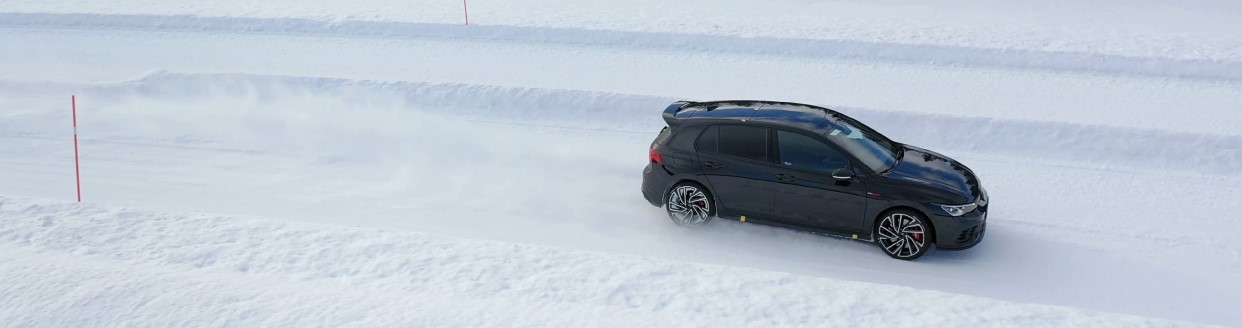
Snow performance is crucial for winter tires, and this test saw a surprise victor. The Pirelli P Zero Winter 2 outperformed the traditionally dominant Michelin Pilot Alpin 5 across all snow tests, including braking, traction, and handling. Both tires offered exceptional snow performance, with the Pirelli showing a slight edge in grip and overall handling characteristics.
The Hankook Winter I*Cept Evo3 performed well in snow handling and snow braking, but was a little down in snow traction.
Naturally the summer tire struggled, and the unusually strong performance of an all season tire in the snow test is thanks to the Michelin CrossClimate 2 being the best in class.
Snow Braking
Spread: 26.71 M (152.9%)|Avg: 21.06 M
Snow braking in meters (40 - 5 km/h) [Average Temperature -6c] (Lower is better)
Snow Braking: Safety Impact: Best vs Worst Tire
Snow Traction
Spread: 24.81 s (480.8%)|Avg: 8.13 s
Snow acceleration time (5 - 35 km/h) [Average Temperature -6c] (Lower is better)
Pirelli P Zero Winter 2
5.16 s
Michelin Pilot Alpin 5
5.18 s
Reference All Season Ref
5.31 s
Goodyear UltraGrip Performance 3
5.37 s
Goodride ZuperSnow Z507
5.42 s
Continental WinterContact TS 870 P
5.53 s
Reference All Season Avg Ref
5.58 s
Hankook Winter i cept evo3
5.63 s
Reference Summer Ref
29.97 s
Snow Handling
Spread: 65.02 s (83.1%)|Avg: 87.16 s
Snow handling time in seconds [Average Temperature -6c] (Lower is better)
Pirelli P Zero Winter 2
78.28 s
Hankook Winter i cept evo3
79.07 s
Michelin Pilot Alpin 5
79.28 s
Reference All Season Ref
79.65 s
Continental WinterContact TS 870 P
80.05 s
Goodyear UltraGrip Performance 3
80.25 s
Goodride ZuperSnow Z507
81.53 s
Reference All Season Avg Ref
83.00 s
Reference Summer Ref
143.30 s
Ice
On ice, the Michelin, Pirelli, and Hankook demonstrated strong performance in both braking and traction tests. The Goodyear and Continental showed some weakness in these challenging conditions, highlighting the diverse demands placed on winter tires.
The all season tire you see topping the results was the budget all season tire, which almost certainly had a soft winter compound not suitable for all seasons.
Ice Braking
Spread: 23.16 M (256.5%)|Avg: 12.47 M
Ice braking in meters (25 - 5 km/h) (Lower is better)
Ice Braking: Safety Impact: Best vs Worst Tire
Ice Traction
Spread: 13.05 s (290%)|Avg: 6.21 s
Ice acceleration time (5 - 25 km/h) (Lower is better)
Reference All Season Ref
4.50 s
Michelin Pilot Alpin 5
4.50 s
Pirelli P Zero Winter 2
4.50 s
Hankook Winter i cept evo3
4.63 s
Goodride ZuperSnow Z507
4.82 s
Reference All Season Avg Ref
4.95 s
Goodyear UltraGrip Performance 3
5.14 s
Continental WinterContact TS 870 P
5.32 s
Reference Summer Ref
17.55 s
Wet
Wet braking tests, conducted at both warm and cool temperatures, saw the Goodyear UltraGrip Performance 3 shine, offering the shortest stopping distances. The Michelin and Pirelli also performed strongly, while the Hankook and Continental lagged slightly behind. The budget tire significantly underperformed in this crucial safety test.
Wet Braking
Spread: 10.89 M (45.6%)|Avg: 29.57 M
Wet braking in meters (80 - 5 km/h) [Average Temperature 26.5c] (Lower is better)
Wet Braking: Safety Impact: Best vs Worst Tire
Wet Braking - Cool
Spread: 7.30 M (29.1%)|Avg: 28.09 M
Wet braking at cooler temperature in meters (80 - 5 km/h) [Average Temperature 8c] (Lower is better)
Wet Braking - Cool: Safety Impact: Best vs Worst Tire
In wet handling, the Pirelli P Zero Winter 2 narrowly edged out the competition, with the Michelin and Goodyear following closely. All three offered excellent grip and predictability. The Hankook and Continental, while still good, couldn't quite match the top performers' level of sporty dynamics in wet conditions.
Wet Handling
Spread: 14.50 s (14.1%)|Avg: 109.56 s
Wet handling time in seconds [Average Temperature 21.5c] (Lower is better)
Reference Summer Ref
103.02 s
Pirelli P Zero Winter 2
107.35 s
Goodyear UltraGrip Performance 3
107.94 s
Reference All Season Ref
107.96 s
Michelin Pilot Alpin 5
108.88 s
Continental WinterContact TS 870 P
109.92 s
Hankook Winter i cept evo3
110.83 s
Reference All Season Avg Ref
112.59 s
Goodride ZuperSnow Z507
117.52 s
Aquaplaning resistance tests revealed the Hankook's strength in straight-line aquaplaning, while the Pirelli showed the best overall performance when combining straight and curved aquaplaning results. This highlights the importance of tread design in managing deep water evacuation.
Straight Aqua
Spread: 10.80 Km/H (13.7%)|Avg: 73.47 Km/H
Float Speed in Km/H (Higher is better)
Reference All Season Ref
79.10 Km/H
Reference Summer Ref
76.50 Km/H
Reference All Season Avg Ref
75.95 Km/H
Hankook Winter i cept evo3
73.00 Km/H
Continental WinterContact TS 870 P
72.80 Km/H
Goodyear UltraGrip Performance 3
72.00 Km/H
Pirelli P Zero Winter 2
72.00 Km/H
Michelin Pilot Alpin 5
71.60 Km/H
Goodride ZuperSnow Z507
68.30 Km/H
Curved Aquaplaning
Spread: 0.79 m/sec2 (31.1%)|Avg: 2.14 m/sec2
Remaining lateral acceleration (Higher is better)
Reference Summer Ref
2.54 m/sec2
Reference All Season Avg Ref
2.33 m/sec2
Pirelli P Zero Winter 2
2.24 m/sec2
Hankook Winter i cept evo3
2.16 m/sec2
Michelin Pilot Alpin 5
2.12 m/sec2
Continental WinterContact TS 870 P
2.10 m/sec2
Goodyear UltraGrip Performance 3
2.06 m/sec2
Reference All Season Ref
1.92 m/sec2
Goodride ZuperSnow Z507
1.75 m/sec2
Dry
In dry braking, all winter tires performed well, with results within 3% of each other. The Hankook Winter i cept evo3 led the pack, showcasing the impressive capabilities of modern winter tires in dry conditions. However, it's worth noting that even the best winter tires struggled to match the average performance of the all-season tires in this test, and were way behind the summer tire.
Dry Braking
Spread: 7.06 M (20.5%)|Avg: 39.40 M
Dry braking in meters (100 - 5 km/h) [Average Temperature 23.5c] (Lower is better)
Dry Braking: Safety Impact: Best vs Worst Tire
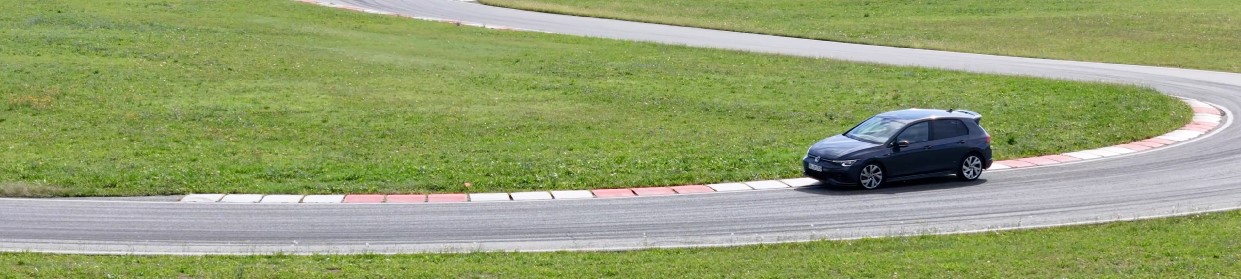
Dry handling revealed some interesting insights. While the budget tire surprisingly performed better than expected, the premium tires showed their worth. The Pirelli P Zero Winter 2, Michelin Pilot Alpin 5, and Goodyear UltraGrip Performance 3 were virtually indistinguishable in terms of lap times and offered excellent driving dynamics. However, all winter tires were outperformed by the summer tire reference, which was about 6 seconds faster per lap and sigifincatly more sporty subjectively.
Dry Handling
Spread: 6.16 s (7.3%)|Avg: 87.27 s
Dry handling time in seconds (Lower is better)
Reference Summer Ref
84.30 s
Reference All Season Ref
84.96 s
Reference All Season Avg Ref
86.76 s
Pirelli P Zero Winter 2
87.02 s
Michelin Pilot Alpin 5
87.31 s
Goodyear UltraGrip Performance 3
87.79 s
Continental WinterContact TS 870 P
88.19 s
Hankook Winter i cept evo3
88.64 s
Goodride ZuperSnow Z507
90.46 s
Comfort
Comfort and noise tests revealed minor differences among the premium tires, with the Continental offering a slight edge in comfort. The Pirelli produced the lowest external noise, closely followed by the Michelin and Continental. It's worth noting that as ultra high performance winter tires in 19-inch sizes, comfort differences were minimal among the premium options.
Subj. Comfort
Spread: 3.00 Points (30%)|Avg: 8.92 Points
Subjective Comfort Score (Higher is better)
Continental WinterContact TS 870 P
10.00 Points
Michelin Pilot Alpin 5
9.50 Points
Hankook Winter i cept evo3
9.00 Points
Goodyear UltraGrip Performance 3
9.00 Points
Pirelli P Zero Winter 2
9.00 Points
Goodride ZuperSnow Z507
7.00 Points
Noise
Spread: 3.60 dB (5%)|Avg: 72.70 dB
External noise in dB (Lower is better)
Pirelli P Zero Winter 2
71.40 dB
Michelin Pilot Alpin 5
71.60 dB
Reference All Season Ref
72.00 dB
Continental WinterContact TS 870 P
72.30 dB
Goodyear UltraGrip Performance 3
72.50 dB
Reference All Season Avg Ref
72.70 dB
Reference Summer Ref
73.30 dB
Hankook Winter i cept evo3
73.50 dB
Goodride ZuperSnow Z507
75.00 dB
Value
Rolling resistance results were remarkably close, with all six tires spread across just a 3.8% range. While the budget tire showed the lowest rolling resistance, its poor performance in other crucial areas makes it difficult to recommend based on this factor alone.
Rolling Resistance
Spread: 2.14 kg / t (27.6%)|Avg: 8.76 kg / t
Rolling resistance in kg t (Lower is better)
Reference All Season Ref
7.76 kg / t
Reference All Season Avg Ref
8.55 kg / t
Goodride ZuperSnow Z507
8.65 kg / t
Goodyear UltraGrip Performance 3
8.67 kg / t
Continental WinterContact TS 870 P
8.69 kg / t
Michelin Pilot Alpin 5
8.71 kg / t
Pirelli P Zero Winter 2
8.95 kg / t
Hankook Winter i cept evo3
8.98 kg / t
Reference Summer Ref
9.90 kg / t
19,000 km
£1.45/L
8.0 L/100km
--
Annual Difference
--
Lifetime Savings
--
Extra Fuel/Energy
--
Extra CO2
Estimates based on typical driving conditions. Rolling resistance accounts for approximately 20% of IC vehicle fuel consumption and 25% of EV energy consumption. Actual savings vary based on driving style, vehicle weight, road conditions, and tire age. For comparative purposes only. Lifetime savings based on a 40,000km / 25,000 mile tread life.
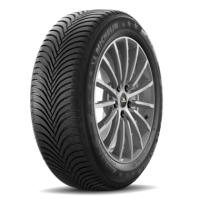
The Michelin Pilot Alpin 5 demonstrated excellent all-round performance, with particularly strong dry handling and comfort.
Despite its strong overall performance, it was slightly outperformed by the Pirelli in snow tests.
Despite being one of the oldest tire in the test, the Michelin Pilot Alpin 5 demonstrated why it has long been considered the benchmark in this category. It offered excellent all-round performance, with particularly strong showings in dry handling and comfort. The tire provided a well-balanced and predictable driving experience across all conditions. While it was slightly outperformed by the Pirelli in snow tests, the differences were minimal. The Michelin Pilot Alpin 5 remains a top choice for drivers wanting a proven, well-rounded winter tire.
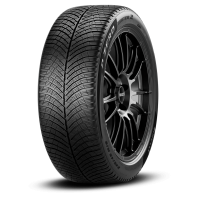
The Pirelli P Zero Winter 2 excelled in snow performance, winning all snow tests and offering excellent wet and dry handling.
It had a slightly higher rolling resistance compared to the Michelin, finishing behind by 1.8%, which is a minor drawback.
The Pirelli P Zero Winter 2 emerged as a top performer, tying for first place with the Michelin Pilot Alpin 5. It excelled in snow performance, winning all snow tests, and showed strong results in wet and dry handling. The tire offered excellent grip and predictability across various conditions. Its only minor drawback was a slightly higher rolling resistance compared to some competitors. Overall, the Pirelli P Zero Winter 2 proves to be an excellent choice for drivers seeking top-tier performance in winter conditions.
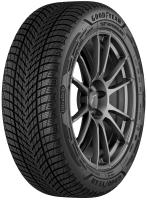
The Goodyear UltraGrip Performance 3 was the wet grip specialist, offering the best braking performance in wet conditions.
It struggled somewhat on ice compared to some competitors.
Securing a solid third place, the Goodyear UltraGrip Performance 3 distinguished itself as the wet grip specialist. It offered the best braking performance in wet conditions at both tested temperatures and excelled in wet handling. The tire also demonstrated good dry performance and had low rolling resistance. Its main weakness was slightly reduced performance on ice compared to the top two contenders. The Goodyear UltraGrip Performance 3 is an excellent choice for regions with predominantly wet winter conditions.
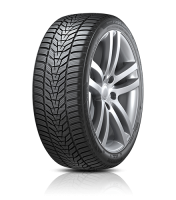
The Hankook Winter i cept evo3 performed best in dry braking and showed strong performance in deep water aquaplaning.
It struggled in snow traction, finishing last among the premium tires.
The Hankook Winter i cept evo3 showed some strong points, particularly in dry braking where it led the pack, and in aquaplaning resistance. It also performed well on ice. However, it struggled in snow traction, finishing last among the premium tires in this crucial winter performance aspect. Subjectively, it received positive feedback for its predictable and linear steering feel. While not matching the top performers' overall balance, the Hankook Winter i cept evo3 still offers good performance in many areas.
The Continental WinterContact TS 870 P offered consistent performance across most tests and had the best comfort rating.
It showed weakness on ice and often finished in fourth place across various tests.
The Continental WinterContact TS 870 P stood out for its consistency across most tests, often finishing in fourth place. It offered the best comfort among all tested tires and performed well in deep water aquaplaning tests. The tire also boasted low rolling resistance. However, it showed some weakness on ice and couldn't quite match the top performers in most categories. The Continental WinterContact TS 870 P is a solid, comfortable choice that performs consistently across a range of conditions.
The Goodride ZuperSnow Z507 had the best rolling resistance among all tested tires.
It significantly underperformed in most tests, especially in wet braking and aquaplaning, and offered a less pleasant driving experience overall.
As the budget option in the test, the Goodride ZuperSnow Z507 predictably lagged behind the premium offerings in most tests. It significantly underperformed in crucial areas such as wet braking and aquaplaning resistance. However, it wasn't without merits - it offered the best rolling resistance among all tested tires and performed better than expected in dry conditions. Despite these positives, its overall performance and less refined subjective feel make it difficult to recommend over the premium options for those prioritising safety and performance in winter conditions.
Fascinating and interesting how much better the summer tire is in those niche areas...would love to know which summer tire was used out of interest, suspect a Conti?
I have asked Continental and they said there will be no non-OE marked 8S made, so it seems like it would be a retailer listing error. Maybe have them double check.
I'm looking at the official Continental page (for Germany) as well as different retailers. Looks to me it's the opposite of being OE-only. Not sure what's happening. I'm kind of willing to go for it, to try them instead of Michelin PA5. I'm running a larger size than usual for 330e - 255/35R19 in the front, and 275/35R19 in the back.
Continental WinterContact 8 S product range here .
I don't disagree with your findings, I'm just telling you what I know.
What I'm assuming is that it is basically an OE based tire without the marking. It sounds like in the sizes you're running, that probably wouldn't be a bad thing as I'm assuming you have a big / powerful car. An OE winter tire like this will be more focused on good handling in the dry and wet so would give up some snow performance to an pure aftermarket tire, but will be much more stable on big powerful applications. Depending on your target use that could be a big win. But then so could the ASC2.
Personally I like new and shiney so I'd get the 8S
Jonathan, I am quite sure I am missing something here. The Cross Climate 2 is basically on the same level as the best winter tires in snow/ice and better/way better in wet/dry.
Great review, just ordered Pirelli P Zero Winter 2 for my E 53 AMG, to be installed next week. On my previous car, for 5 years had Pilot Alpin 5, fantastic tire.
Probably a decent choice. I had the Bridgestone Blizzak LM005 on my E53 AMG Coupé and they were fantastic. Wet grip and snow performace was the best i have ever experienced on any of my cars. Once it was dry though they worn down super fast although driving 240 kph with winter tires did not help either.
Just what I needed - a review on low-profile all-seasons! After watching the review I'm torn between the Continentals and the Bridgestones for my Mk2 Audi TTS (Quattro) to replace the Goodyear Assym's which very slowly slid me into the curb last snowfall here in the S.E of England... however, I'm still curious about the Hankook Kinergy 4S2 as I just 'like' Hankook, although they don;t appear to be available in a Y rating (can't find a legal answer on dropping the speed rating) - What would you recommend?
Why should anyone still buy a pure winter typre (like the winning Alpin5) when the all-season tire CrossClimate2 is even better in snow & ice as the best winer typre ?
Michelin Alpin (insert number) is a touring level tire. Michelin Pilot Alpin (insert number) is a performance tire. This test is for performance tires.
You need to refer to the All-Season test that was done at the same time - the reference all-season tire is the top rated tire for each of the test categories. In other words, it varies. In most cases, it is the Pirelli Cinturato All Season SF-3.
What would you guys recommend for a Mini Cooper in Central Europe? I just got the car and I've absolutely no idea whether I should get all-season tires, or should I use winter+summer. Any ideas? And if so, what would be the best choice in terms of price and performance?
Hi, in text you mention what is the all season tire you compare to, but I couldn't find info about what was the reference summer tire. If all season tires are showing so good performance I also consider switching to them, but would like to better understand how they perform comparing to summer ones.
So why I should buy winter tires now? If Allseasons are better in dry and wet and on par in snow and ice, I don't see the reason why to buy special winter tires. The best solution seems to be to fit Allseason from oct to april and from may to september fit summers.
Sadly there was limited space and as I've tested it a bunch before I thought it would be ok to leave it out. There will be new data on the site in the coming week from other tests.
Just watched the video on YT and also wondered why for example the Bridgestone Blizzak LM005 was left out. But it was in last year's review and I just compared some of the tests, seems to be not too far off from the winning duo. Anyways, great test again this year thanks for the work!
Plus probably Bridgestone are rolling out Blizzak 6 currently - not sure this size was available at time of test ... and LM005 might not be on the market for very long with Blizzak 6 arriving right now on the market. Autobild tested Blizzak 6 very recently on 205/55R16 (not sporty mount I know :( )





Fascinating and interesting how much better the summer tire is in those niche areas...would love to know which summer tire was used out of interest, suspect a Conti?
I haven’t seen any coverage of Continental WinterContact 8 S yet.
Would it be a better choice than Michelin PA5 in wider sizes - 255 and 275/35R19?
The S range are intended for OE, we need to wait for the 8P sadly
Hmmm, interesting. Because i see it available for purchase already, without any special OE markings.
Meanwhile, I’m struggling to find aftermarket non OE marked PA5 in those two sizes.
I have asked Continental and they said there will be no non-OE marked 8S made, so it seems like it would be a retailer listing error. Maybe have them double check.
I'm looking at the official Continental page (for Germany) as well as different retailers. Looks to me it's the opposite of being OE-only. Not sure what's happening. I'm kind of willing to go for it, to try them instead of Michelin PA5. I'm running a larger size than usual for 330e - 255/35R19 in the front, and 275/35R19 in the back.
Continental WinterContact 8 S product range here .
Direct link to a label without OE mention:
https://www.contimediacenter.com/eulabel/en/03202300000/
Another label with mention of OE (a different tire) as an example: https://www.contimediacenter.com/eulabel/de_DE/03143590000/
https://uploads.disquscdn.c...
I don't disagree with your findings, I'm just telling you what I know.
What I'm assuming is that it is basically an OE based tire without the marking. It sounds like in the sizes you're running, that probably wouldn't be a bad thing as I'm assuming you have a big / powerful car. An OE winter tire like this will be more focused on good handling in the dry and wet so would give up some snow performance to an pure aftermarket tire, but will be much more stable on big powerful applications. Depending on your target use that could be a big win. But then so could the ASC2.
Personally I like new and shiney so I'd get the 8S
Thank you for your insight and feedback! As well as wealth of knowledge you’re sharing with us!
I’ll pull the trigger on the 8S, I too like new and shiny! I’ll definitely leave a review how 8S handles 420HP and 750Nm on the rear axle. :)
Excellent, look forward to the review!
Jonathan, I am quite sure I am missing something here. The Cross Climate 2 is basically on the same level as the best winter tires in snow/ice and better/way better in wet/dry.
The CrossClimate was only the reference for the snow as it wasn't the best in the dry and wet, they are other tires
A winter tire test without Nokian is like a German car test without Mercedes.
What's the point testing a winter tire in 23,5 Celsius?
For comparison with best case conditions of summer tires.
But I agree, dry testing at 0C would be more beneficial for the test
inability to control the weather
Great review, just ordered Pirelli P Zero Winter 2 for my E 53 AMG, to be installed next week.
On my previous car, for 5 years had Pilot Alpin 5, fantastic tire.
Probably a decent choice. I had the Bridgestone Blizzak LM005 on my E53 AMG Coupé and they were fantastic. Wet grip and snow performace was the best i have ever experienced on any of my cars. Once it was dry though they worn down super fast although driving 240 kph with winter tires did not help either.
nice, let me know how you like them!
What is the reference all season?
Just what I needed - a review on low-profile all-seasons! After watching the review I'm torn between the Continentals and the Bridgestones for my Mk2 Audi TTS (Quattro) to replace the Goodyear Assym's which very slowly slid me into the curb last snowfall here in the S.E of England... however, I'm still curious about the Hankook Kinergy 4S2 as I just 'like' Hankook, although they don;t appear to be available in a Y rating (can't find a legal answer on dropping the speed rating) - What would you recommend?
I've not tried the hankook in this size, but you can drop speed ratings, just not load ratings.
Why should anyone still buy a pure winter typre (like the winning Alpin5) when the all-season tire CrossClimate2 is even better in snow & ice as the best winer typre ?
It's an interesting question.
That really looks like a testing/measurement error. How can it be that all season tire is better on ice than the best dedicated winter tire?
Compound is key on ice, and a lot of all season tires use a winter compound just with less siping
What about Alpin 7?
Wasn't available in time for this test
Michelin Alpin (insert number) is a touring level tire.
Michelin Pilot Alpin (insert number) is a performance tire.
This test is for performance tires.
What is difference between 870 and 870P?
P is performance versions
Which was the reference AllSeason tire used in the test?
It's the best from each category which can be found in the all season test on this site.
You need to refer to the All-Season test that was done at the same time - the reference all-season tire is the top rated tire for each of the test categories. In other words, it varies. In most cases, it is the Pirelli Cinturato All Season SF-3.
What would you guys recommend for a Mini Cooper in Central Europe?
I just got the car and I've absolutely no idea whether I should get all-season tires, or should I use winter+summer. Any ideas? And if so, what would be the best choice in terms of price and performance?
The data from the winter and all season tests should give you the information to answer this yourself based on your own needs.
Having had time to figure out why are you testing winter tires on dry @ 25C degrees. How about 5 or 0C, which is more realistic usage case...
The answer isn't overly complicated, I've not yet mastered the ability to control the weather sadly.
Hi, in text you mention what is the all season tire you compare to, but I couldn't find info about what was the reference summer tire.
If all season tires are showing so good performance I also consider switching to them, but would like to better understand how they perform comparing to summer ones.
He mentions next article/video will be giving comparison between AS/Winter and Summer - looking forward to see this :)
You can cross reference the best all season tire from each test on this site
So why I should buy winter tires now? If Allseasons are better in dry and wet and on par in snow and ice, I don't see the reason why to buy special winter tires. The best solution seems to be to fit Allseason from oct to april and from may to september fit summers.
No Vredestein Wintrac Pro/Pro+ included?
Sadly there was limited space and as I've tested it a bunch before I thought it would be ok to leave it out. There will be new data on the site in the coming week from other tests.
Just watched the video on YT and also wondered why for example the Bridgestone Blizzak LM005 was left out. But it was in last year's review and I just compared some of the tests, seems to be not too far off from the winning duo. Anyways, great test again this year thanks for the work!
Plus probably Bridgestone are rolling out Blizzak 6 currently - not sure this size was available at time of test ... and LM005 might not be on the market for very long with Blizzak 6 arriving right now on the market.
Autobild tested Blizzak 6 very recently on 205/55R16 (not sporty mount I know :( )
I tried to get the B6 but I couldn't get it in time