



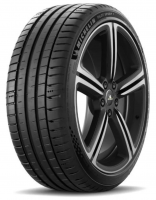
 The Michelin Pilot Sport 5 is a customer favorite - it's test-winning, long-lasting, and one of the best all-round UHP tires you can buy. So adding a low rolling resistance "Energy" version was always going to be tricky. Historically, energy-focused performance tires have meant giving up a noticeable chunk of wet grip. The question is whether Michelin has managed to close that gap.
The data here comes from two test programmes, both commissioned by Michelin. Performance testing was carried out by TÜV SÜD at TRIWO Pferdsfeld in August 2025 (Report Nr. 713379856-S32-01), covering wet braking, dry braking, wet handling, and rolling resistance. Tread wear testing was conducted by DEKRA in Narbonne, France, during September and October 2025 (Report CPA MARK25H). Both used a Tesla Model Y (RWD, 75 kWh, 2,080 kg) and a tire size of 255/40 R20 101Y XL.
Wet Braking
Wet Braking
Wet braking in feet (50 - 12 mph)
Lower is better ↓| Tire | Result | Gap to best | Residual speed |
|---|---|---|---|
| 84 ft | Best | 0 mph | |
| 91 ft | +7 ft | 23 mph |
The difference between best and worst was 8.6% (7 ft ≈ 0.5 Car Lengths). From 80 mph, the Michelin Pilot Sport 5 Energy would still be travelling at 23 mph when the Michelin Pilot Sport 5 had stopped.
Residual speed is calculated from the measured braking distances, assuming constant deceleration; it is not a separate measurement.
The PS5 stopped in 84ft compared to 91ft for the PS5 Energy — a 7ft advantage. That's a measurable difference, but it's a far smaller penalty than we've seen from previous low-rolling-resistance performance tires.
Dry Braking
Dry Braking
Dry braking in feet (62 - 0 mph)
Lower is better ↓| Tire | Result | Gap to best | Residual speed |
|---|---|---|---|
| 114 ft | Best | 0 mph | |
| 115 ft | +1 ft | 7 mph |
All the tires in the Dry Braking test finished less than 3% apart. From 80 mph, the Michelin Pilot Sport 5 would still be travelling at 7 mph when the Michelin Pilot Sport 5 Energy had stopped.
Residual speed is calculated from the measured braking distances, assuming constant deceleration; it is not a separate measurement.
From 100-0 mph on dry asphalt, the PS5 Energy actually stopped fractionally shorter at 114ft versus 115ft. This is likely due to lower starting tread depth on the Energy - less tread squirm generally helps dry braking - though the reports don't confirm starting depths.

Wet Handling
Subj. Wet Handling
Subjective Wet Handling Score
Higher is better ↑| Tire | Result | Gap to best |
|---|---|---|
| 8.92 Points | Best | |
| 8 Points | -0.92 Points |
The difference between best and worst was 10.3% (0.92 Points).
On TÜV SÜD's 6,004ft wet handling circuit, the PS5 was quicker, scoring 105.4% on lap time versus 100% for the PS5 Energy. Subjective ratings followed: 8.92 versus 8.00. The PS5 is clearly the better wet handler, but an 8.00 subjective score is still a strong result in absolute terms.

Rolling Resistance
Rolling Resistance
Rolling resistance in kg t
Lower is better ↓| Tire | Result | Gap to best | Extra fuel / year |
|---|---|---|---|
| 6.5 kg/t | Best | $0 | |
| 7.9 kg/t | +1.40 kg/t | $63 |
The difference between best and worst was 21.5% (1.4 kg / t). Over 12,000 miles a year at $3.60/gal, the Michelin Pilot Sport 5 uses about 18 gal ($63) more fuel than the Michelin Pilot Sport 5 Energy.
Adjust the assumptions
Calculated estimates, not additional measurements. Use the controls to explore the assumptions.
This is the headline figure. The PS5 Energy achieved an RR label value of 6.5 versus 7.9 for the standard PS5, that's a huge difference. For EV owners, this translates directly into range, and across the life of the tire that cumulative energy saving is significant.
Tread Wear
Abrasion
Total weight loss after wear test in grams
Lower is better ↓| Tire | Result | Gap to best |
|---|---|---|
| 901 g | Best | |
| 1138 g | +237.00 g |
The difference between best and worst was 26.3% (237 g).
In DEKRA's 4,792 miles convoy test, the PS5 Energy lost 901g of rubber across all four positions, while the standard PS5 lost 1,138g — 26% more material. Despite this, the extrapolated tread life was essentially identical, with the PS5 projected to last just 63 miles longer. The PS5 likely started with more tread depth, giving it a slightly longer runway to the wear limit despite wearing faster.
Verdict
The Pilot Sport 5 Energy gives up some wet grip - the PS5 stops shorter in the wet and is more agile during wet handling. But the margins are much smaller than we've come to expect from this type of tire. Dry braking is a dead heat, tread life is essentially the same, and the rolling resistance improvement is genuinely impressive.
For a tire as well-regarded as the Pilot Sport 5, producing a lower energy variant without undermining its core qualities is a difficult thing to do, and I think Michelin have done a good job here. If you're an EV owner looking to maximise range without dropping to a compromised tire, the PS5 Energy looks like a strong option.
19" Ionic 5N is the direction most tests are heading
The car has negative camber of -02º10' in the rear, to compensate it has a toe-in of +00º23' per wheel.
The Pilot Sport 5 tires with a treadwear rating of 340 lasted 34,000 km until 1.8 mm in the center and were only rotated and crossed from front to back once.
The rear tires became scalloped (sawtooth effect).
I was considering changing to Pilot Sport 5 Energy (Treadwear 420), or Primacy 5 (Standard) (Treadwear 420), or Pirelli Cinturato C3 (no treadwear information available because they are only manufactured for the European market, but I know they have a 7.8mm tread depth confirmed by Pirelli).
What do you suggest, given that I prioritize safety in dry and wet conditions and some resistance to the car's geometry/weight characteristics?
I've not seen any reports on the longevity of the Pilot Sport 5 Energy. I assume it starts with lower starting tread depth than the Pilot Sport 5. Something to keep in mind. You are correct that the Primacy 5 should be the longest-lasting of the group you mentioned. However you are going to change the dynamics of the vehicle, check out the comparison here: https://www.youtube.com/watch?v=TKyJtVGOZwk
Camber is not adjustable.
Toe-in is.
Would the Pilot Sport 5 energy fall somewhere between the Primacy 5 and the standard Pilot Sport 5 in terms of rain safety?
If so, perhaps I should risk trying the energy version given the possibility of greater longevity (at least in theory, given the treadwear value of 340 PS5 vs 420 PS5energy).
Otherwise, perhaps I should try some Pirelli C3s to see if I can get more mileage out of the tires?
The original tire on the car was Pirelli P7 ( 1st gen )
Algo had some Pirelli PZ4 that did not had uneven wear... but went to 1.6mm with only 9000kms
Your opinion is highly valued; can you offer any insight on this topic?
Thank you for your attention.
The Pirelli C3 is an option. If you're set on longevity, the Goodyear EfficientGrip Performance 2 is worth looking at too, as it does very well in wear tests and if I recall, its rolling resistance isn't particularly high.
I love the PS5 , but wish i could squeeze more kms with something similar in performance.
Would you say the C3 could do more kms than the PS5 ?
The Primacy 5 seems too much touring, so i was more into a more confidence inspiring tire.
Really thought the PS5 Energy would be better than the Primacy 5 in the wet, being specific in Highway driving at speed limit ( 120km/h ) and being able to avoid aquaplaning like the standard PS5
Camber is not adjustable.
Toe-in is.
Would the Pilot Sport 5 energy fall somewhere between the Primacy 5 and the standard Pilot Sport 5 in terms of rain safety?
If so, perhaps I should risk trying the energy version given the possibility of greater longevity (at least in theory, given the treadwear value of 340 vs 420).
Otherwise, perhaps I should try some Pirelli C3s to see if I can get more mileage out of the tires?
The original tire on the car was the Pirelli P7 (Seal Inside)
Also had Pirelli PZero PZ4 that did not suffer from uneven wear... but went to 1.6mm with only 9000kms
Your opinion is highly valued; can you offer any insight on this topic?
Thank you for your attention.
69.000km and 4mm tread depth still on the Hankook. Should I just repeat when they are worn?
Do you know when/if they're likely to bring out more sizes of this tire? Would be great on my mach e (225 55 19) which at the moment looks like I'll be going to the Michelin Primacy 5 Energy.
I'm intresested in the Pilot Sport 5 Energy for my EV... Does anyone have Informations about comfort and noise level for this tire?
If the general tradeoff is that an "eco" tire will have a lower rolling resistance at the cost of wet grip, while their expected mileage is the same, wouldn't their wet grip performances and rolling resistances just converge over time, and thus the results shown are basically the widest they will ever be.
Additionally if we account for the fact that in this case the PS5 Energy has lower abrasion while achieving the same mileage, the user is essentially buying a tire with a harder compound, which performs worse grip wise.
I would assume that the need for such tires comes from car manufacturers primarily to reduce their carbon tax when selling new vehicles and that there are regulative pressures from EU primarily when it comes to abrasion as tires are a decent factor in micro plastics pollution, it just seems that the rolling resistance gains over the life of the tire are exaggerated over time.
You are correct that, as the tread depth gets worn, they are likely going to get closer overall. Unfortunately, how much closer we don't know without seeing the data, which I'm not sure anyone will ever publish.