



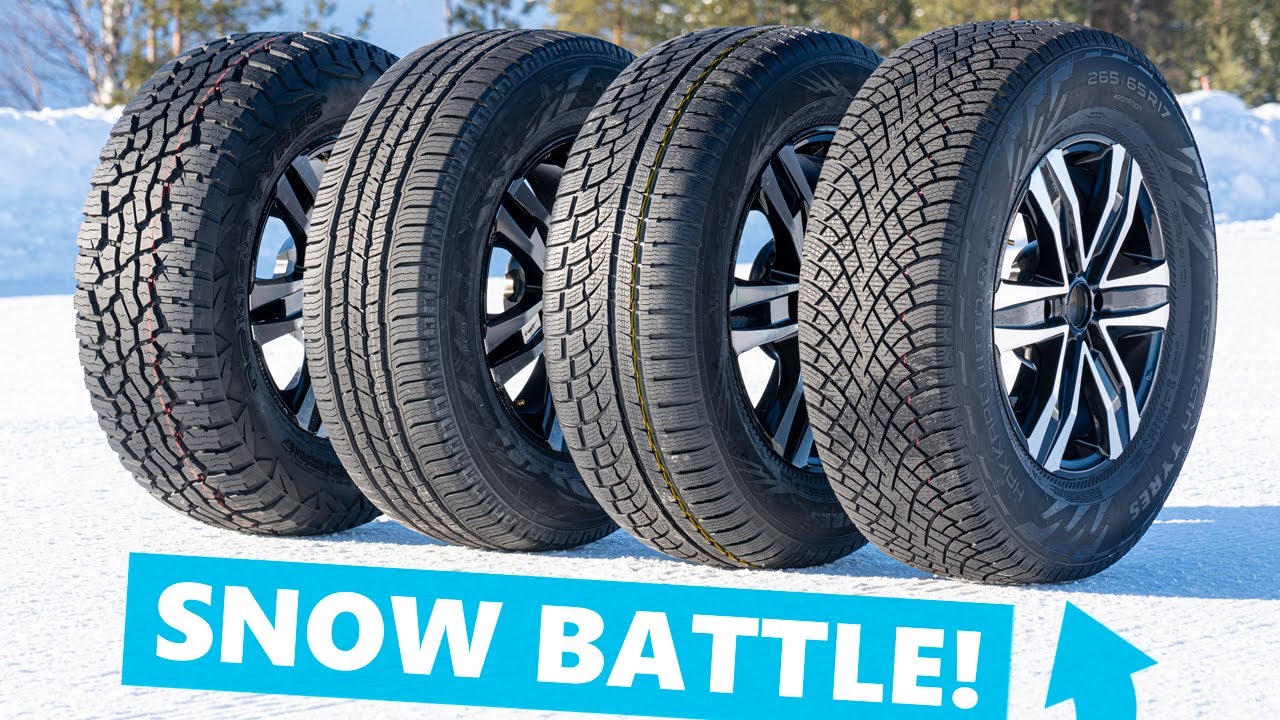
The new Nokian Outpost nAT claims to be an all terrain tire you can use in snow, but how good is it? Nokian invented winter tires, so they're pretty confident, so confident in fact they suggested we test it against the king of winter tires, the Nokian Hakkapeliitta R5, along with their much loved all weather tire, the Nokian WRG4 SUV, and their high mileage all season tire, the Nokian One SUV.
Before we start, it's worth noting that three of the tires are 3PMSF marked, which is the 3 peak mountain snowflake symbol, sometimes called "severe snow rating". The Winter, All Weather and All Terrain tires carry the 3PMSF marking, but the all season does not. The test size was 265/65 R17, and we used a Toyota Hilux for the test in RWD only mode.
Test setup & methodology
The test setting, the conditions recorded and how the results contribute to the score.
Show full testing methodology
Recorded test conditions
- Snow Braking
- 24.9 → 3.1 mph · 19–16 °F
- Snow Traction
- 3.1 → 21.7 mph · 19–16 °F
- Snow Handling
- 19–16 °F
Score Weighting
Weights express the scoring priorities, not how much each discipline actually changed the finishing order. The size of the performance gaps matters too. Category weights contribute to the overall score. Within each category, discipline weights divide that category’s share. Published finishing positions also need to be read alongside the editorial verdict.
| Test | Within category | Share of overall score |
|---|---|---|
| Snow · 100% | ||
| Snow Braking | 40% | 40% |
| Snow Traction | 40% | 40% |
| Snow Handling | 20% | 20% |
Our standard methods
The conditions above are recorded for this test. The descriptions below explain our standard procedures; measurement windows and run counts can vary by test.
Snow Braking
For snow braking, I drive the test vehicle at an entry speed of 50 km/h and apply full braking effort to a standstill with ABS active on a groomed, compacted snow surface, measuring 45-5 km/h. I generally use a wide VDA (vehicle dynamic area) and progressively move across the surface between runs so that no tire ever brakes on the same piece of snow twice. My standard programme is twelve runs per tire set, although the sequence can extend further if the data justify it. I analyze the full set of runs and discard statistical outliers before averaging. The surface is regularly groomed throughout the session. To correct for changing snow surface conditions, I run reference tires repeatedly — typically every two candidate test sets.
Snow Traction
For snow traction, I accelerate the vehicle from rest on a groomed snow surface with traction control active and measure speed and time using GPS telemetry. I typically use a 5–35 km/h measurement window to reduce the influence of launch transients and powertrain irregularities. I use a wide VDA (vehicle dynamic area) and progressively move across the surface between runs so that no tire ever accelerates on the same piece of snow twice. The surface is regularly groomed throughout the session. I complete multiple runs per tire set and average the valid results. Reference tires are run typically every two candidate test sets to correct for changing snow surface conditions.
Snow Handling
For snow handling, I drive at the limit of adhesion around a dedicated snow handling circuit with ESC disabled where possible. The circuit is groomed and prepared after every run while tires are being changed, so each set runs on a consistently prepared surface. I usually complete between two and five timed laps per tire set, excluding laps affected by clear driver error or obvious environmental inconsistency. Because snow surfaces degrade more rapidly than asphalt, control runs are carried out more frequently — typically every two candidate test sets.
Snow Data
Snow traction is a difficult test for a tire, especially on an unloaded pickup, so it gave us the largest differences between the tires. The Winter was naturally the best, with the all weather around 18% slower in the acceleration test, the all terrain was 12% behind the all weather, and the all season another 11% behind the all terrain.
Snow Traction
Snow acceleration time (3 - 22 mph) [Average Temperature 18°F]
Lower is better ↓| Position / Tire | Result | Gap to best |
|---|---|---|
| 4.92 s | Best | |
| 5.8 s | +0.88 s | |
| 6.96 s | +2.04 s | |
| 8.44 s | +3.52 s |
The difference between best and worst was 71.5% (3.52 s).
Interestingly while the order remained the same for snow braking, the extra weight over the primary axle helped the all terrain finish closer to the all weather, and significantly ahead of the all season.
Snow Braking
Snow braking in feet (25 - 3 mph) [Average Temperature 18°F]
Lower is better ↓| Position / Tire | Result | Gap to best | Residual speed |
|---|---|---|---|
| 50 ft | Best | 0 mph | |
| 66 ft | +16 ft | 39 mph | |
| 68 ft | +18 ft | 41 mph | |
| 78 ft | +28 ft | 48 mph |
The difference between best and worst was 56.1% (28 ft ≈ 1.9 Car Lengths). From 80 mph, the Nokian One would still be travelling at 48 mph when the Nokian Hakkapeliitta R5 had stopped.
Residual speed is calculated from the measured braking distances, assuming constant deceleration; it is not a separate measurement.
While the Nokian Hakkapeliitta R5 was unsurprisingly the fastest around the lap, the real brilliance of a full winter tire came in the subjective handling - the confidence you felt on the Hakka R5 was unrivaled. The all terrain was close to the all weather in time, but the all weather tire felt more balanced around the lap.
Snow Handling
Snow handling time in seconds [Average Temperature 18°F]
Lower is better ↓| Position / Tire | Result | Gap to best |
|---|---|---|
| 89.6 s | Best | |
| 98.3 s | +8.70 s | |
| 98.65 s | +9.05 s | |
| 105 s | +15.40 s |
The difference between best and worst was 17.2% (15.4 s).
Results

Nokian Hakkapeliitta R5
265/65 R17
All discipline results (3)
Discipline positions compare the ranked tires in this test, not the whole market. These are individual measurements, not weighted overall scores.
| Test | Position in discipline | Result | Gap to best |
|---|---|---|---|
| Snow BrakingLower is better | 1st / 4 | 50 ft | Best in this discipline |
| Snow TractionLower is better | 1st / 4 | 4.92 s | Best in this discipline |
| Snow HandlingLower is better | 1st / 4 | 89.6 s | Best in this discipline |
- 3PMSF
- Yes
Nokian WR G4 SUV
265/65 R17
All discipline results (3)
Discipline positions compare the ranked tires in this test, not the whole market. These are individual measurements, not weighted overall scores.
| Test | Position in discipline | Result | Gap to best |
|---|---|---|---|
| Snow BrakingLower is better | 2nd / 4 | 66 ft | +16 ft |
| Snow TractionLower is better | 2nd / 4 | 5.8 s | +0.88 s |
| Snow HandlingLower is better | 2nd / 4 | 98.3 s | +8.70 s |
- 3PMSF
- Yes
Nokian Outpost nAT
265/65 R17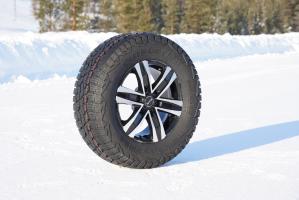
Sure, the all terrain tire felt a little more like a blunt instrument, there was less feedback around the limit of grip and even coming out of the garage you could tell that it's a more solid tire, but considering you could do a weekend of winter offroading in the sunshine then drive back home through a where it's snowing and still be better off than everyone on their all season tires - it's a very impressive blend.
All discipline results (3)
Discipline positions compare the ranked tires in this test, not the whole market. These are individual measurements, not weighted overall scores.
| Test | Position in discipline | Result | Gap to best |
|---|---|---|---|
| Snow BrakingLower is better | 3rd / 4 | 68 ft | +18 ft |
| Snow TractionLower is better | 3rd / 4 | 6.96 s | +2.04 s |
| Snow HandlingLower is better | 3rd / 4 | 98.65 s | +9.05 s |
- 3PMSF
- Yes
Nokian One
265/65 R17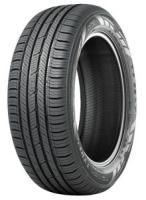
All discipline results (3)
Discipline positions compare the ranked tires in this test, not the whole market. These are individual measurements, not weighted overall scores.
| Test | Position in discipline | Result | Gap to best |
|---|---|---|---|
| Snow BrakingLower is better | 4th / 4 | 78 ft | +28 ft |
| Snow TractionLower is better | 4th / 4 | 8.44 s | +3.52 s |
| Snow HandlingLower is better | 4th / 4 | 105 s | +15.40 s |

Wonderful review and comparative analysis! But why not include the Outpost APT as the fifth contender? Or please do a separate review on the Outpost APT. I think many people would LOVE to know how the APT stacks up against (between?) the nAT and the WRG4. I currently run a set of APTs and I believe they are very good in the rain and slush and light snow but I haven't yet had a true winter experience with them and, more importantly, haven't seen any specs on stopping distance etc. like you provide with the other tires. Anyway, love your reviews and hope to hear what you have to say about this interesting tire the Nokian Outpost APT. https://www.nokiantires.com...
If I recall at the time of filming it wasn't possible to get the APT in the test size.
OK thank you very much for the reply. I really wish they could have included a fifth wheel...
Do you have any reviews planned for the Nokian Outpost APT?
I'm certain that all of us who run them would love to see you put them through the wringer, especially on Nokian's winter track.