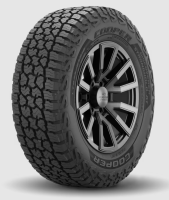

Test Charts / Tire Reviews
2023/24 Best All Terrain Tires In Snow
Compare each discipline in the tested size. See the measured result, position and gap to the best tire, then read the verdict for the trade-offs behind the finishing order.
- Tested size
- 275/65 R18
- Tires tested
- 7
- Disciplines
- 3

Read the measurements, not just the rank
Lower is better for braking distances and lap times; higher is better for subjective scores and aquaplaning speed. Bars start at zero. Read the gap alongside the position: adjacent tires can be separated by very different margins.
Positions and gaps always refer to the full test field within each group. Selecting tires does not recalculate rankings or change the best-in-test benchmark.
Focus on your tires
Select tires to highlight them throughout the charts.
Positions and gaps always refer to the full test field within each group. Selecting tires does not recalculate rankings or change the best-in-test benchmark.
Snow
3Snow Braking
Snow braking in feet (20 - 5 mph)
Lower is better ↓| Position / Tire | Result | Gap to best | Residual speed |
|---|---|---|---|
RefMichelin X Ice Snow SUV |
108 ft | -20 ft | 0 mph |
| 128 ft | Best | 0 mph | |
RefMichelin Defender LTX MS |
142 ft | +14 ft | 25 mph |
| 149 ft | +21 ft | 30 mph | |
| 157 ft | +29 ft | 34 mph | |
| 164 ft | +36 ft | 37 mph | |
| 166 ft | +38 ft | 38 mph | |
| 168 ft | +40 ft | 39 mph | |
| 169 ft | +41 ft | 39 mph |
The difference between best and worst was 56.5% (61 ft ≈ 4.1 Car Lengths). From 80 mph, the Yokohama Geolandar AT G015 would still be travelling at 39 mph when the BFGoodrich Trail Terrain TA had stopped.
Residual speed is calculated from the measured braking distances, assuming constant deceleration; it is not a separate measurement.
Snow Traction
Snow acceleration time (5 - 20 mph)
Lower is better ↓| Position / Tire | Result | Gap to best |
|---|---|---|
RefMichelin X Ice Snow SUV |
4.28 s | -0.29 s |
| 4.57 s | Best | |
RefMichelin Defender LTX MS |
5.05 s | +0.48 s |
| 5.07 s | +0.50 s | |
| 5.61 s | +1.04 s | |
| 5.66 s | +1.09 s | |
| 6.07 s | +1.50 s | |
| 6.26 s | +1.69 s | |
| 6.93 s | +2.36 s |
The difference between best and worst was 61.9% (2.65 s).
Snow Handling
Snow handling time in seconds
Lower is better ↓| Position / Tire | Result | Gap to best |
|---|---|---|
RefMichelin X Ice Snow SUV |
85.89 s | -11.51 s |
| 97.4 s | Best | |
| 97.73 s | +0.33 s | |
RefMichelin Defender LTX MS |
101.03 s | +3.63 s |
| 101.77 s | +4.37 s | |
| 102.45 s | +5.05 s | |
| 102.56 s | +5.16 s | |
| 111.18 s | +13.78 s | |
| 111.23 s | +13.83 s |
The difference between best and worst was 29.5% (25.34 s).
Test setup & methodology
The test setting, the conditions recorded and how the results contribute to the score.
Show full testing methodology
Recorded test conditions
- Snow Braking
- 19.9 → 5.0 mph
- Snow Traction
- 5.0 → 19.9 mph
Score Weighting
Weights express the scoring priorities, not how much each discipline actually changed the finishing order. The size of the performance gaps matters too. Category weights contribute to the overall score. Within each category, discipline weights divide that category’s share. Published finishing positions also need to be read alongside the editorial verdict.
| Test | Within category | Share of overall score |
|---|---|---|
| Snow · 100% | ||
| Snow Braking | 40% | 40% |
| Snow Traction | 30% | 30% |
| Snow Handling | 30% | 30% |
Our standard methods
The conditions above are recorded for this test. The descriptions below explain our standard procedures; measurement windows and run counts can vary by test.
Snow Braking
For snow braking, I drive the test vehicle at an entry speed of 50 km/h and apply full braking effort to a standstill with ABS active on a groomed, compacted snow surface, measuring 45-5 km/h. I generally use a wide VDA (vehicle dynamic area) and progressively move across the surface between runs so that no tire ever brakes on the same piece of snow twice. My standard programme is twelve runs per tire set, although the sequence can extend further if the data justify it. I analyze the full set of runs and discard statistical outliers before averaging. The surface is regularly groomed throughout the session. To correct for changing snow surface conditions, I run reference tires repeatedly — typically every two candidate test sets.
Snow Traction
For snow traction, I accelerate the vehicle from rest on a groomed snow surface with traction control active and measure speed and time using GPS telemetry. I typically use a 5–35 km/h measurement window to reduce the influence of launch transients and powertrain irregularities. I use a wide VDA (vehicle dynamic area) and progressively move across the surface between runs so that no tire ever accelerates on the same piece of snow twice. The surface is regularly groomed throughout the session. I complete multiple runs per tire set and average the valid results. Reference tires are run typically every two candidate test sets to correct for changing snow surface conditions.
Snow Handling
For snow handling, I drive at the limit of adhesion around a dedicated snow handling circuit with ESC disabled where possible. The circuit is groomed and prepared after every run while tires are being changed, so each set runs on a consistently prepared surface. I usually complete between two and five timed laps per tire set, excluding laps affected by clear driver error or obvious environmental inconsistency. Because snow surfaces degrade more rapidly than asphalt, control runs are carried out more frequently — typically every two candidate test sets.
More tire tests
Cross-check this test
Where these tires were tested again, and how the verdict held up.
2022/23 Best 9 All Terrain Tires
275/65 R189 tires tested
7 of these 7 tires tested again
2025 ADAC All Terrain Tire Test
225/65 R178 tires tested
4 of these 7 tires tested again
2026 Tire Rack All Terrain Tire Snow Test
265/70 R1730 tires tested
2 of these 7 tires tested again