






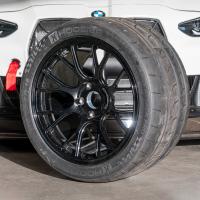
In the world of high-performance tires, Hoosier has long been a name synonymous with speed and grip. Recently, we had the opportunity to put three of their top offerings to the test at the BMW driving school, using an M4 GT4 race car as our platform. The tires in question? The Hoosier R7, a medium compound Hoosier slick, and the new Hoosier Track Attack Pro. Each brought its own unique characteristics to the track, and the results were nothing short of impressive.

Let's start with the Hoosier R7, a tire that straddles the line between road legality and race-level performance. Despite its grooving, the R7 proved to be an absolute powerhouse on the track. The grip was high, allowing for confident braking and cornering. What stood out was not just its outright performance, but its playful nature. Even when pushed to the limit and sliding, the R7 remained controllable and predictable. Our initial lap times with the R7 were blistering, starting at 1:04.5 and settling into a consistent mid-1:05 range.
Moving to the full racing slick, we entered the realm of pure, unadulterated performance. As expected, the medium compound Hoosier slick allowed for even later braking and more aggressive trail braking into corners. There was a noticeable increase in stability compared to the R7, particularly in high-speed sections. Lap times with the slick were consistently around the 1:04 mark, showcasing its superior speed. It's worth noting that due to extra warm-up laps taken as a precaution, we may not have captured the slick's absolute peak performance, leaving room for even more impressive times.
The dark horse in this comparison was the new Hoosier Track Attack Pro, a tire designed for the 200 treadwear category. Despite being the most "street-oriented" of the three, the Track Attack Pro delivered a shockingly good performance. On initial feel, it was remarkably similar to the R7, with only a slight reduction in ultimate grip. Where it truly shone was in its progressive nature at the limit, offering even more controllability than its racier counterparts. Lap times with the Track Attack Pro were eye-opening, starting only half a second behind the R7 and stabilizing in the mid-1:06 range.
The Hoosier slick, as expected, offers the highest outright performance, but the margin of improvement over the R7 was smaller than anticipated on this particular track and temperatures. This speaks volumes about the R7's capabilities as a compromise between all-out performance and road legality.
However, the real story here might be the Track Attack Pro. Its performance relative to its 200 treadwear rating is nothing short of remarkable. This positions the Track Attack Pro as a potential game-changer in its category, offering near-race tire performance in a more versatile package.
Dry Handling Fastest Laps
Dry Handling
Dry handling time in seconds
Lower is better ↓| Tire | Result | Gap to best |
|---|---|---|
| 63 s | Best | |
| 64.7 s | +1.70 s | |
| 64.9 s | +1.90 s |
All the tires in the Dry Handling test finished less than 3% apart.
Dry Handling Long Run Times
Dry Handling Long Run
Average long run time in seconds
Lower is better ↓| Tire | Result | Gap to best |
|---|---|---|
| 64 s | Best | |
| 65.5 s | +1.50 s | |
| 66.3 s | +2.30 s |
The difference between best and worst was 3.6% (2.3 s).
Subj. Dry Handling
Subjective Dry Handling Score
Higher is better ↑| Tire | Result | Gap to best |
|---|---|---|
| 10 Points | Best | |
| 9.5 Points | -0.50 Points | |
| 9.25 Points | -0.75 Points |
The difference between best and worst was 7.5% (0.75 Points).
Looking ahead, two major questions emerge from this test. First, how does the Track Attack Pro stack up against other top performers in the 200 treadwear category, such as the Yokohama A052 and Bridgestone Potenza RE71RS? And second, could the Track Attack Pro potentially rival OE tires like the Michelin Cup 2 R or Pirelli P Zero Trofeo RS on high-performance cars such as the Porsche 911 GT3 RS?
These are questions we're eager to answer in future tests. The implications could be significant for track day enthusiasts and amateur racers looking for that perfect balance of performance, durability, and versatility.
In the end, this comparison has not only showcased the impressive capabilities of Hoosier's lineup but has also hinted at an exciting future in the world of high-performance tires. Whether you're looking for all-out race performance or a more streetable option that doesn't sacrifice much on the track, Hoosier seems to have an option that fits the bill. Stay tuned to tirereviews.com as we delve deeper into these questions and continue to push the limits of tire technology.
Discussion