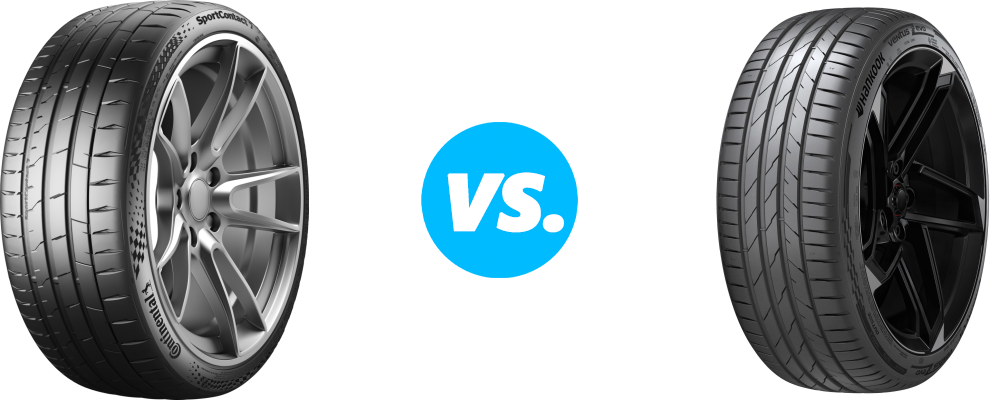
Continental SportContact 7 vs Hankook Ventus Evo
The interesting twist is that the overall results split by test: in AutoView's 275/35R19 sports tire test the SportContact 7 lands 2nd (and is described as the strongest replacement tire on test), while in Auto Express's 225/40R18 test it drops to 8th after an uncharacteristically weak wet showing-while the Ventus Evo climbs to 3rd on the back of consistently strong wet metrics. In practice, this makes the comparison less about “which is best” and more about matching the tire to your climate, driving style, and what you value day to day.
Test Results
Independent comparison tire tests are the best source of data to get tire information from, and the good news is there have been two tests which compare both tires directly!
| Tire | Test Wins | Performance |
|---|---|---|
| Continental SportContact 7 | one | |
| Hankook Ventus Evo | one |
The Continental SportContact 7 and Hankook Ventus Evo have an equal number of test wins. However, tires are very complicated objects which means where one tire is better than the other can be more important in real world use.
Let's look at how the two tires compare across multiple tire test categories.
Key Strengths
- Stronger dry braking across both shared tests (33.5 m vs 34.78 m; 34.9 m vs 36.4 m)
- Quicker and more precise dry handling in both tests (86.46 s vs 87.62 s; 82.5 s vs 83.1 s) with top subjective ratings in AutoView
- Competitive wet braking capability in at least one test (best wet braking in AutoView at 21.91 m)
- Slight edge in efficiency/noise in the measured data: better rolling resistance in Auto Express (7.63 vs 7.9 kg/t) and marginally lower dB in AutoView (62.7 vs 63.2 dB)
- Stronger wet-weather package in Auto Express: wet braking (32.4 m), wet handling (90.2 s), and aquaplaning (86.5 km/h straight; 0.85 m/sec² curved)
- More refined subjective experience in Auto Express (higher subjective noise score: 9.6 vs 8.7) and noted good bump absorption
- Good efficiency trend in AutoView (second-best rolling resistance on that test)
- Predictable steering character noted by AutoView (linearity highlighted positively), making it easy to place on the road
Dry Braking
Looking at data from two tire tests, the Continental SportContact 7 was better during two dry braking tests. On average the Continental SportContact 7 stopped the vehicle in 3.91% less distance than the Hankook Ventus Evo.
Best In Dry Braking: Continental SportContact 7
See how the Dry Braking winner was calculated >>
Dry Handling [s]
Looking at data from two tire tests, the Continental SportContact 7 was better during two dry handling [s] tests. On average the Continental SportContact 7 was 1.03% faster around a lap than the Hankook Ventus Evo.
Best In Dry Handling [s]: Continental SportContact 7
See how the Dry Handling winner was calculated >>
Subj. Dry Handling
Looking at data from one tire tests, the Continental SportContact 7 was better during one subj. dry handling tests. On average the Continental SportContact 7 scored 10% more points than the Hankook Ventus Evo.
Best In Subj. Dry Handling: Continental SportContact 7
See how the Subj. Dry Handling winner was calculated >>
Wet Braking
Looking at data from two tire tests, the Hankook Ventus Evo was better during one wet braking tests. On average the Hankook Ventus Evo stopped the vehicle in 2.78% less distance than the Continental SportContact 7.
Best In Wet Braking: Hankook Ventus Evo
See how the Wet Braking winner was calculated >>
Wet Handling [s]
Looking at data from one tire tests, the Hankook Ventus Evo was better during one wet handling [s] tests. On average the Hankook Ventus Evo was 1.74% faster around a wet lap than the Continental SportContact 7.
Best In Wet Handling [s]: Hankook Ventus Evo
See how the Wet Handling winner was calculated >>
Wet Circle
Looking at data from one tire tests, the Continental SportContact 7 was better during one wet circle tests. On average the Continental SportContact 7 was 0.35% faster around a wet circle than the Hankook Ventus Evo.
Best In Wet Circle: Continental SportContact 7
See how the Wet Circle winner was calculated >>
Straight Aqua
Looking at data from one tire tests, the Hankook Ventus Evo was better during one straight aqua tests. On average the Hankook Ventus Evo floated at a 1.97% higher speed than the Continental SportContact 7.
Best In Straight Aqua: Hankook Ventus Evo
See how the Straight Aqua winner was calculated >>
Curved Aquaplaning
Looking at data from one tire tests, the Hankook Ventus Evo was better during one curved aquaplaning tests. On average the Hankook Ventus Evo slipped out at a 17.65% higher speed than the Continental SportContact 7.
Best In Curved Aquaplaning: Hankook Ventus Evo
See how the Curved Aquaplaning winner was calculated >>
Subj. Comfort
Looking at data from one tire tests, the Continental SportContact 7 and Hankook Ventus Evo performed equally well in subj. comfort tests.
Best In Subj. Comfort: Both tires performed equally well
See how the Subj. Comfort winner was calculated >>
Subj. Noise
Looking at data from one tire tests, the Hankook Ventus Evo was better during one subj. noise tests. On average the Hankook Ventus Evo scored 9.38% more points than the Continental SportContact 7.
Best In Subj. Noise: Hankook Ventus Evo
See how the Subj. Noise winner was calculated >>
Noise
Looking at data from one tire tests, the Continental SportContact 7 was better during one noise tests. On average the Continental SportContact 7 measured 0.79% quieter than the Hankook Ventus Evo.
Best In Noise: Continental SportContact 7
See how the Noise winner was calculated >>
Rolling Resistance
Looking at data from one tire tests, the Continental SportContact 7 was better during one rolling resistance tests. On average the Continental SportContact 7 had a 3.42% lower rolling resistance than the Hankook Ventus Evo.
Best In Rolling Resistance: Continental SportContact 7
See how the Rolling Resistance winner was calculated >>
Real World Driver Reviews
Continental SportContact 7 Driver Reviews
Across 95 reviews, the Continental SportContact 7 is widely praised as a top-tier UUHP summer tire, with standout wet and dry grip, very strong braking and high confidence at/near the limit. Many drivers also report predictable handling and strong all-round road/track capability, often comparing it favorably to Michelin PS4S/PSS and other rivals. The most recurring drawback is fast wear/short mileage (especially on heavier or high-torque cars and with spirited/track use), with a secondary theme of higher noise and/or a harsher ride for some setups.
Based on 103 reviews with an average rating of 83%
Hankook Ventus Evo Driver Reviews
Across 11 reviews, the Hankook Ventus Evo is described as a strong all-rounder with standout wet-road confidence, including impressive aquaplaning resistance and secure braking, while also delivering high dry grip and stable, predictable handling. Many drivers also note it is quieter and more comfortable than several premium alternatives, with some reporting low rolling resistance and potential fuel-economy benefits. A smaller subset mentions a softer feel with slightly reduced steering/road feedback versus sportier benchmarks, but overall satisfaction is very high.
Based on 11 reviews with an average rating of 83%
The size is a bit of an unusual one, and therefore the price of this set, compared to a set of... Continue reading this review using the link below
Conclusion
If you drive in frequent rain, encounter standing water, or want a more relaxed, refined tire for daily use, the Hankook Ventus Evo makes a strong case-especially in the Auto Express test where it beats the Continental clearly in wet braking (32.4 m vs 35.0 m), wet handling (90.2 s vs 91.8 s), and aquaplaning resistance (curved: 0.85 vs 0.70 m/sec²; straight: 86.5 vs 84.8 km/h). Even in AutoView, where the Continental dominates overall, the Hankook is positioned as a solid mid-tier UHP with strong rolling resistance and decent comfort.
Value-wise, the data implies a “pay for what you use” decision: the SportContact 7 looks like the better choice for enthusiastic dry driving and track-style precision (with a potential efficiency/rolling-resistance penalty noted by AutoView), while the Ventus Evo suits wet-climate commuters and fast-road drivers who want stability in the rain and low noise-though AutoView cautions its pricing can be high for its mid-tier outright pace. The practical takeaway: pick Continental for maximum dry performance feel; pick Hankook for wet confidence and everyday refinement.
Key Differences
- Dry performance bias: SportContact 7 consistently wins dry braking and dry handling in both tests, indicating higher ultimate grip and sharper responses.
- Wet performance split by test: SportContact 7 leads wet braking in AutoView (21.91 m vs 22.93 m), but Ventus Evo dominates wet braking/handling in Auto Express (32.4 m vs 35.0 m; 90.2 s vs 91.8 s).
- Aquaplaning resistance advantage for Hankook in Auto Express (straight 86.5 vs 84.8 km/h; curved 0.85 vs 0.70 m/sec²), aligning with a wet-safety focus.
- Overall ranking volatility: SportContact 7 goes 2/5 in AutoView but 8/9 in Auto Express due to wet-event weaknesses; Ventus Evo improves from 4/5 to 3/9 on wet consistency.
- Refinement signals: Hankook scores better on subjective noise in Auto Express (9.6 vs 8.7) and is described as comfortable; Continental is noted to transmit some road noise on certain surfaces.
- Efficiency/rolling resistance messaging differs by source: AutoView flags SportContact 7 rolling resistance as high, while Auto Express measures it better than Hankook (7.63 vs 7.9 kg/t), suggesting size/test sensitivity in efficiency outcomes.
Overall Winner: Continental SportContact 7
Based on the tire test data and user reviews we have in our database, the Continental SportContact 7 has demonstrated better overall performance in this comparison. However, as you can see from the spider diagram above, each tire has its own strengths which should be considered in your final tire buying choice.Similar Comparisons
Looking for more tire comparisons? Here are other direct comparisons involving these tires:

Footnote
This page has been developed using tire industry testing best practices. This means we are only comparing tests which have had both tires in the same test.
Why is this important? Tire testing is heavily affected by things like surface grip levels and surface temperature, which means you can only compare values from the same day. During a tire test external condition changes are calculated into the overall results, but it is not possible to calculate this between tire tests performed on different days or at different locations.
As a result you will see other tests on Tire Reviews which feature both the %s and %s, but as they weren't conducted on the same day, the results are not comparable.
Lots of other websites do this sort of tire comparison, Tire Reviews doesn't.
Discussion
- No comments yet — be the first.